Home Subscribe
Jobs Cars Homes Shopping Travel Weddings Golf Best of Las Vegas Photo
.
Member Center

Recent Editions
SuMTWThFS
>> Search the site
.
.
.
.
NEWS
.
.
.
.
.
.
.
Sep. 29, 2006
Copyright © Las Vegas Review-Journal


HOT PURSUIT

Expert detects rare life-forms

By LAWRENCE MOWER
REVIEW-JOURNAL


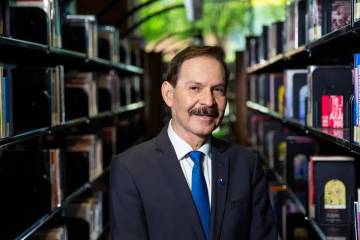
UNLV microbiologist and assistant professor Brian Hedlund handles a vial in an anaerobic chamber in his lab, used to house organisms that can survive only in certain environments. Hedlund won an award from the National Science Foundation to continue research on Nevada's hot springs.
Photo by Clint Karlsen.


Click image for enlargement.
Graphic by Mike Johnson.

Many of Nevada's hot springs know Brian Hedlund by now.

The 34-year-old microbiologist and assistant professor at the University of Nevada, Las Vegas has been extracting small amounts of water and mud from the boiling springs for three years.

Advertisement

The only problem is, Hedlund still doesn't know the hot springs, or, rather, what's in them.

After researching the state's hottest springs, he has found several groups of microorganisms -- single-celled creatures that can be seen only with a microscope -- that defy classification in the scientific universe.

He suspects some of the organisms might be found nowhere else in the world.

Hedlund's efforts have catapulted UNLV to the forefront of hot springs research and landed Hedlund a five-year grant worth more than $840,000 from the National Science Foundation.

The results of his research could be significant: Unlocking the genomes and DNA from the creatures could yield a cure for cancer, Parkinson's disease and other maladies.

"It's a new frontier that biology is pushing toward," Hedlund said.

But aside from medical benefits, the advent of nanotechnology and the manipulation of microscopic organisms could yield commercial benefits, especially with these extraordinary creatures, which can withstand the planet's extreme temperatures.

Think of a laundry detergent with organisms designed to break down enzymes and stains as the organisms withstand the hot water in the washing machine.

Hedlund has been studying hot springs around the world since 1998. In 2001, he started studying in Germany under the renowned biologist Karl Stetter.

"It's always looked really interesting to me," he said.

But when the professor had to retire early, Hedlund found himself looking for a job.

That's where UNLV came in. The biology department had been wanting to improve its microbiology section, and Hedlund was considered a key hire, said Bill Brown, the College of Science's director of development.

"We're lucky to have him," Brown said. "The NSF thinks we're lucky to have him."

After joining UNLV in 2003, Hedlund was able to resume his research, only this time he was concentrating on hot springs in Nevada and the West, including the famous springs in Yellowstone National Park.

Nevada has more than 300 hot springs areas, with as many as a dozen individual springs in each area, said Larry Garside, a research geologist with the Nevada Bureau of Mines and Geology.

"We're probably the leading state as far as actual counting of hot springs goes," Garside said.

The state's relatively thin crust allows magma and heat from the Earth's interior to reach underwater springs and pools, boiling the water and pushing it to the surface.

Nevada's hot springs don't tend to be as sulfuric as Yellowstone's springs, but they're still highly metallic and not safe to drink, Hedlund said.

While most people think of hot springs as comfortable oases, Hedlund seeks out some of the hottest pools, which would be deadly for a person to dip into.

The work is dangerous, Hedlund said. A colleague at the University of Georgia suffered third-degree burns on his foot last year when the fragile ground around a hot spring gave way. He was wearing tennis shoes and socks, but he still suffered blisters and permanent scars.

But Hedlund seeks the hottest springs because of the rare organisms that are able to withstand the temperatures.

Most of his work has been done on springs hotter than 73 degrees Celsius, about 163 degrees Fahrenheit, because the temperature is the borderline between the two major forms of life.

Earth's creatures obtain energy through two sources: light or chemical reactions. Humans, although they use chemical reactions to digest food, receive their energy indirectly through light in the form of eating plants, which transform the light and chlorophyll into energy.

No creature is known to be able to use light as energy in liquid temperatures above 73 degrees Celsius, and whatever can survive has to find energy elsewhere, in the form of chemical reactions.

"Think of them eating hydrogen instead of sugar," Hedlund said.

Most scientists think the Earth's earliest forms of life sprang from the energy generated from such chemical reactions and not from the sun, Hedlund said.

The microscopic organisms in Nevada's super-hot hot springs also obtain energy through such reactions.

When Hedlund began studying the genetic makeup of the life in the pools, unknown genetic signatures started popping up.

That wasn't necessarily unusual, Hedlund said. Thirty different major groups of bacteria cannot find a home in today's species classification, including one found in Yellowstone's hot springs.

"These are so different we can't place them in a phylum," Hedlund said. "This is a major, major new group."

A phylum is a broad grouping of creatures, like creatures with backbones.

But what made the creatures in Nevada's hot springs unique was their prevalence and the fact that they appear to be exclusive to Nevada.

"I thought, 'Oh my God, this is great!'" Hedlund said.

In other springs, the unknown organisms usually make up a small part of the life in the ecosystem. In Nevada's springs, they're thought to make up more than half of the life.

Hedlund hasn't been able to see pictures of the organisms; he knows them only through the genetic signatures they produce.

"I can predict that they exist, but I can't see them," he said.

Hedlund, with students from UNLV, froze samples of mud and water from the springs and brought them back to the university's labs, where they're trying to unlock their genetic secrets.

The NSF grant Hedlund received is "very prestigious," said Matt Kane, program director for the NSF's Microbial Observatories and Microbial Interaction and Processes Program.

"It's a highly competitive program, with less than a 10 percent funding rate," Kane said.

With the money, Hedlund will take another team of colleagues, with students from UNLV and Pyramid Lake High School, to study hot springs in summer 2007.

He said he will start to pin down more information about the organisms, including what they are, what they do and how they survive. Determining what types of gases they consume will go a long way to figuring out what they do.

"We can perform specific tests, so we can say, definitely, yes, we know this eats hydrogen," Hedlund said "The statement 'you are what you eat' is pretty significant."

Hedlund is interested in the expansion of understanding the world around him.

"It's stretching that box that we think of as life," he said.

SPONSORED LINKS

Advertisement


Contact the R-J | Subscribe | Report a delivery problem | Put the paper on hold | Advertise with us
Report a news tip/press release | Send a letter to the editor | Print the announcement forms | Jobs at the R-J

Copyright © Las Vegas Review-Journal, 1997 -
Stephens Media   Privacy Statement