Nevadan at Work: Adviser works to keep investors’ portfolios in the money
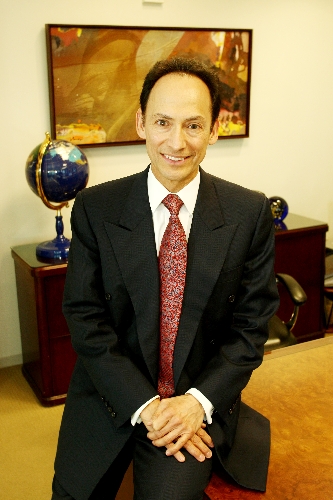





Investment Counsel Co. founder and Chief Executive Officer Randy Garcia treats investing like an Olympic event.
"When I walk into the office in the morning, it's like walking into the coliseum," Garcia said.
He is intent on making wise investment choices and avoiding mistakes.
Garcia, who grew up in a middle-class family, now is charged with overseeing investments for some of Southern Nevada's wealthiest residents. He knows that 225 clients rely on him to make the right call for their collective $800 million in stocks, bonds or other investments.
Barron's, the weekly financial tabloid, recently named Investment Counsel Co. as the best investment advisory firm in Nevada.
Question: Where did you grow up?
Answer: I grew up one block east of Las Vegas Boulevard and Oakey. There was a big desert area nearby. We used to dig holes and take old tires and make forts out in the desert. My dad would come out and dig.
Question: How did you become an investment adviser?
Answer: I was taking a hike at Basin State Park, and my knee went out. I couldn't go any farther. A couple passed by me. We got to talking for hours.
The man said, "I just got through traveling around the world."
I said, "What do you do that affords you an opportunity to travel around the world?"
He said, "I'm a stockbroker."
That's why I ended up in this industry.
They helped me (walk out of the park) and the swelling of my knee went down.
Question: You joined Blyth, Eastman Dillon & Co. in 1978 in Las Vegas, right?
Answer: Yes. I stayed in the retail stock industry for 20 years. I had accumulated the best clientele in the city if not the state.
In the retail brokerage industry, there are conflicts of interest and there are times when clients are at a disadvantage.
I wanted to give our clients every advantage a financial services firm can offer them. I said, "Maybe I need to start a firm."
What I was looking for was an environment where the clients' interests were aligned with the firm's interests. (His company is an investment advisory firm, not a stock brokerage).
Question: How did you cope with the U.S. financial industry's near-collapse a few years ago?
Answer: When we saw Lehman (Bros.) fail, I had tears in my eyes. I knew what it could mean for our clients, the industry, our family.
I said, "Our clients need to be informed." I picked up the phone and called three of the most respected money management firms in the industry (to make presentations at) a town hall meeting in three business days.
We weren't there to sugarcoat anything. We were there to give them the complete facts, the right information, the right knowledge.
Question: How have you adjusted your clients' investment portfolios this year?
Answer: We restructured our bond portfolios so that if interest rates rise the bond portfolio would not be as adversely impacted.
Some are in adjustable rates; some are in positions where the portfolio's performance is more dependent on the manager's skill set, less dependent on the interest rate direction.
We want to be protected if the dollar weakens, given all this debt the government has yet to figure out how to pay down. So some of the money will be invested in other governments' (bonds), governments that today are more fiscally prudent. These are governments running surpluses, not large deficits.
Question: Are you worried about deflation or inflation?
Answer: Given today's political parties' views, we believe that the fear of inflation is overstated. There is enough difference or separation between the Democratic and Republican Party to avoid one of those scenarios from running away in either direction.
When you have 9 percent unemployment, if we look at what that means in terms of stifling growth or stifling inflation, it's very, very significant.
The biggest risk is that unforeseen event. We know the economy, the government is in a very vulnerable place if that happens again.
It's like having a checking account or a rainy-day fund at the U.S. Treasury, and we've used a lot or most of our rainy-day fund.
Question: How long will it take Las Vegas housing prices to recover?
Answer: I expect it to take not a decade, but some decades, to get back to that high-water mark, because it was a bubble. We believe that the next 30-some-odd years are going to be more challenging than the last 30 years.
Contact reporter John G. Edwards at
jedwards@reviewjournal.com or 702-383-0420.
VITAL STATISTICS
Name: Randy Garcia
Age: 57
Occupation: Founder and chief executive officer, Investment Counsel Co.
Quotable: “I expect it to take, not a decade, but some decades, to get back to that higher water mark (in housing prices), because it was a bubble. We believe that the next 30 some odd years are going to be more challenging than the last 30 years.”
Family: Wife, Staci; children, Alli, Anthony and Andrew.
Education: Graduate of Bishop Gorman High School; graduated with honors in accounting from the University of Nevada, Las Vegas; certified investment management analyst.
Work history: Stock broker at Blyth, Dillon, Eastman & Co. (which later merged with PaineWebber); founder and chief executive officer of the Investment Counsel Co.
Hobbies: Archery, collecting American Indian and Western artifacts
Favorite books: Sherlock Holmes books by Arthur Conan Doyle and “Geronimo: The True Story of America’s Most Ferocious Warrior” as edited by S.M. Barrett.
In Las Vegas since: 1957.
The Investment Counsel Co. is at 10000 W. Charleston Blvd.and can be reached at 871-8510.