Broadcasters tell Series story from flops to folds
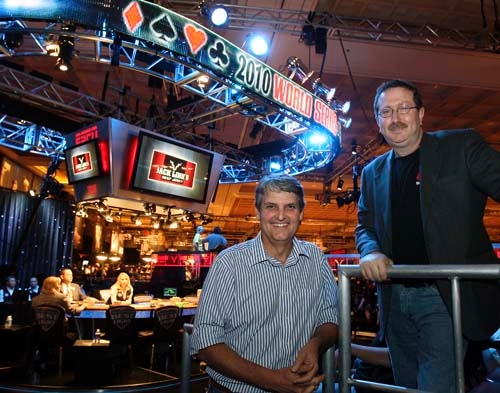





The two ESPN broadcasters, whose careers are closely linked with the cable television network's coverage of the World Series of Poker, are taken aback by the ever increasing popularity of the tournament.
Seven years after the network paired veteran sports broadcaster Lon McEachern with syndicated sports columnist Norman Chad to cover the Word Series of Poker, ESPN has increased the tournament's amount of airtime fourfold.
This year, ESPN is devoting more than 30 hours of network prime time to the 2010 tournament, including 28 hours of episodes surrounding the $10,000 buy-in No-limit Hold 'em World Championship Main Event and an hour-long preview special that will air Tuesday.
Chad, an author whose weekly syndicated sports column Couch Slouch appears in almost two dozen newspapers, always advocated televising poker. He just wasn't sure how successful it would be.
"I didn't think anyone would watch it," Chad said. "It's just a bunch of people sitting around a table throwing chips in the middle. Poker on TV essentially didn't exist a decade ago. Now, you can't turn on a television without seeing it."
McEachern, who has been with ESPN since 1994 and has broadcast such events as the X Games, World Cup skiing, billiards and kickboxing, said his pairing with Chad came at unanticipated moment for the World Series of Poker.
Harrah's Entertainment purchased the tournament from the Binion family, saving the 2003 event. That year, ESPN began using tiny cameras embedded in poker tables to show a player's two hole cards. Then, an unknown accountant named Chris Moneymaker, who qualified for the tournament on the Internet, won the Main Event, topping a field of 839 players while winning $2.5 million.
"It was like the perfect storm," McEachern said. "Fans loved the hole cameras because you could get inside information, plus, the winner is someone with a name like Moneymaker."
ESPN increased its coverage from one hour to seven hours that year. The audience and number of shows have grown annually.
The sponsorships brought into the World Series of Poker have also increased. Harrah's has multiyear advertising agreements with Jack Link's, Miller Brewing, Red Bull, Planters Peanuts and Hershey's, many of which air commercial on the ESPN telecasts.
This year, ESPN is adding a new graphics package to give its coverage more of a sports feel. Statistics will be available to show a certain player's wagering tactics, such as average raises and betting aggressiveness. McEachern likened the statistics to those used in televised baseball, such as how a certain batter has performed in the past against a particular pitcher.
Despite the wide viewership, both broadcasters don't believe there is a market for live poker on television. ESPN tried a pay-per-view live broadcast of the final table a few years ago, as well as radio coverage, both of which saw little success.
"You would have to change the format and the rules so the whole thing is played out in two or three hours," Chad said. "Most people don't realize the final table takes eight, 10 or 14 hours to complete."
Chad believes the popularity of the World Series of Poker comes from the viewing public's interest with reality television. The tournament shows formerly anonymous poker players trying to become the last player standing and win millions of dollars.
"I've always liked the fact you have handful of people, who you did not know a week ago, and all of sudden, they are part of your lives," Chad said. "I think that's a great element of this tournament."
But there are also past champions and well-known professionals, such as Phil Hellmuth, Doyle Brunson, Johnny Chan and Phil Ivey, who draw in an audience.
"I really believe that part of the draw for the people watching at home is that unlike any other sport, all you need is the money to buy in and you can be sitting next to your favorite players and compete against them," McEachern said.
The broadcasters have been in Las Vegas for much of the past three weeks helping with the behind-the-scenes production in taping the tournament. It helps them learn something about the players and their personalities as the field is reduced to the nine players who will return to the Rio in November for the Main Event's final table.
McEachern and Chad add their commentary to the play back in a studio when the episodes are put together.
"We're kind of another set of eyes and ears as to what's going on out on the floor," McEachern said.
Contact reporter Howard Stutz at hstutz@reviewjournal.com or 702-477-3871.
THEN THERE WERE NINE ...
The field for the World Series of Poker’s Main Event will be reduced to the final table of nine players sometime tonight or early Sunday morning.
Twenty-seven players will return to the Rio at noon today to compete for a one-in-nine chance of winning first prize in the $10,000 buy-in No-limit Hold ’em World Championship.
After a four-month layoff, the nine players will come back to the Rio on Nov. 6 to play for the title. The winner collects $8.9 million while the runner-up earns $5.54 million.
Third place at the final table collects $4.13 million. The fourth place finisher wins almost $3.1 million while fifth place takes home $2.3 million. The sixth place finisher wins $1.77 million while seventh place earns $1.3 million. Eighth place earns $1.04 million while the ninth place finisher collects $811,823.
The 2010 Main Event had the second-largest starting field in tournament history, 7,319 players, and a prize pool of more than $68.8 million.
Follow World Series of Poker updates and results this weekend at lvrj.com/blogs/wsop.