



Mom takes matters into her own hands
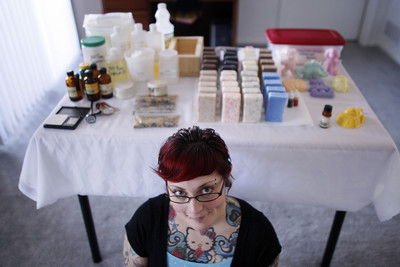
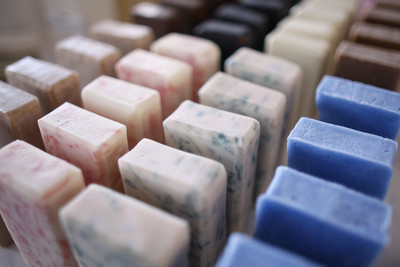


It's a safe bet that despite a couple of kids and a couple of cats, the apartment of Kylee and Rory Lane is one of the freshest-smelling in the Las Vegas Valley. And that would be in large part because of the soap Kylee Lane makes.
Lane started making soap several years ago for the sake of her son, Trent, now 3. The Las Vegas native, then living in Iowa, noticed that Trent had patches of dry skin that clearly itched.
"He'd just scratch them until he bled," she said.
She tried all kinds of soaps, including some that claimed to be all-natural and gentle to the skin. She changed her laundry detergent and fabric softener. She took him to doctors, who couldn't figure out what was wrong and didn't have what Lane considered a practical solution.
"They just wanted us to put more chemicals on him," she said.
So Lane started studying -- for about six months -- soaps and how to make them. She started experimenting -- again for about six months -- persevering even when she had to dump a batch or so. She discovered that even "natural" products, including glycerine soap, can contain ingredients that she considers harmful.
"If you look at the chemical ingredients in stuff that says all-natural ..." she said, trailing off with a shake of her head.
What started as a solution for Trent became an artistic outlet and a business for the 24-year-old stay-at-home mom (via her Web sites, www.luxurylanesoap.com and www.SoapLane.etsy.com). And it's a hobby shared by other Southern Nevadans.
How easy is it to make your own soap?
That depends. The simplest type, melt-and-pour, is so easy that Lane's 6-year-old daughter, Starla, can help out with a demonstration. As Lane points out, the process is educational for Starla. She starts by suggesting they make "a purple heart for Grandma." But the coloring doesn't include purple; Starla remembers that she can mix red and blue to get the color of choice.
They melt the granules in the microwave, with Lane lending a hand so Starla doesn't spill the hot liquid on herself. The coloring -- a special type that won't stain skin or shower -- is added, and Starla starts stirring.
"Keep stirring," Lane tells her. "Tell me when you think it's purple."
"It's purple!" Starla says after a few minutes. "Oh, Grandma's going to like that color!"
Lane adds a little vitamin E for the skin, a little almond oil for fragrance. They pour the mixture into a heart-shaped mold, spray the surface with rubbing alcohol to pop the bubbles, et voila: soap.
But while melt-and-pour is how she started, it didn't take long for Lane to graduate to cold-process soap. She had difficulty finding a melt-and-pour base that didn't contain propylene glycol and sodium laurel sulfate, which seem to cause adverse reactions in many people, she said.
The "cold-process" name comes from the fact that the mixture isn't heated. But that's a little misleading, because it does get hot. To make cold-process soap, lye is used. With small kids at home, Lane is particularly careful with the lye. She orders 4 pounds of granules at a time, clearly marks the container and makes sure it's out of reach. And Starla and Trent know all about the dangers of lye. Asked about the skull-and-crossbones her mom has drawn on the container, Starla says: "That's poison! We have to be careful with poison." And the kitchen's considered a danger zone when mom's working.
"They know they can't go in there," she said.
To start a batch of cold-process soap, Lane weighs her ingredients one at a time on a jewelers' scale that goes to 1 pound. When she adds the dry lye to the cold water, the temperature immediately climbs to 250 to 300 degrees. She puts the lye mixture in an ice bath to cool.
Then Lane weighs her fats -- shea butter "because I'm a huge fan of shea butter," coconut oil for lathering -- and warms them. The cooled lye solution is added to the warmed fats. She mixes with a stick blender and the mixture begins to thicken and turn into what soap-makers call "trace."
Fragrance oils and coloring are added at this point; Lane might use blue coloring and a fresh-linen fragrance oil to make an exceptionally clean-smelling soap. She notes that fragrance oils have a flash point, so the mixture must be below that temperature before the oil is added to reduce danger of flash-fire.
Then she pours the mixture into a mold and insulates it. It heats further, then gels and turns clear.
Sliced into bars, the soap is cured for four to six weeks to shed excess water.
"In Las Vegas, they cure so much faster than they did in humid Iowa," she said.
Lane takes one extra step: trimming the edges of each bar with a potato peeler to make them nice and uniform.
And she has soap.
Lane said she sometimes "re-batches" her soap. If a batch doesn't come out well, or the soap-maker wants a particular effect, she can shred the soap and add it to a new batch. Re-batched soap, she said, is spongier and lighter.
Lane said she prefers cold-process soap because she has more control over the ingredients. She noted that everything in it -- except the lye, of course -- could be eaten. Shea butter is so soothing, she said, that it won't even hurt a fresh tattoo.
But Julia Ai, an assistant professor of dermatology with the University of Nevada School of Medicine who has a private dermatology practice near Reno, said novice soap-makers need to be cautious about using any ingredient, because it could cause a reaction in a susceptible person. And that extends to vitamin E.
"People have this myth" about its beneficial effects, she said, but "the big problem is allergic contact dermatitis."
"Same thing with scented fragrance oils," she said. "Jojoba oil is a common one."
The concerns, she said, extend to any soap you use.
"I usually tell people, 'Less is more,' " she said. "Simple soaps with less fragrance and less ingredients. Concentration is also important. Generally, the more exposure you have to something, the more likely you are to have a reaction."
Contact reporter Heidi Knapp Rinella at hrinella@reviewjournal.com or (702) 383-0474.
CLEAN UP
Soap-making supplies are available at local crafts stores and through numerous online sources.
Marlis Walls, owner of the Craft Cottage in Boulder City, said while soap-making isn't as popular as it was a few years ago, she still carries soap-making base, glycerin, fragrances and coloring. "Crafts just come and go," she said. "They go in spurts."
Walls said it has been a popular craft for gift-giving.
"A lot of them made the cute little soaps and used them for Christmas gifts -- a little bag of little soaps," she said. "Or they put them in a net bag for party favors. They're kind of cute for people to put in their bathrooms."
Las Vegas soap-maker Kylee Lane said personalized, individual-sized soaps also are popular as wedding and baby-shower favors.
REVIEW-JOURNAL


