



Did airport grow too far, too fast?


When the Las Vegas economy was flying high in 2005, folks were so worried McCarran International Airport would run out of room that Clark County Commission Chairman Rory Reid told airport officials working on a $2.4 billion expansion plan to "sleep less and get it done."
Today, with the Clark County Department of Aviation completing some of those expansion projects, local economic indicators are plunging back to Earth and a tourist shortage, not a surplus, is keeping people awake at night.
The jarring shift in the fortunes of Las Vegas has some, particularly airline officials, questioning the wisdom of continued expansions at McCarran.
The passenger count was down almost 10 percent in August -- there hasn't been a larger one-month decrease in Las Vegas airline traffic since December 2001 during the economic fallout of the Sept. 11, 2001, terrorist attacks, when the number fell 14.5 percent.
For the year, passenger traffic is down 4.8 percent from 2007, and there's nothing to suggest a recovery is on the horizon. Next year, projections from airlines suggest there will be about 12 to 15 percent fewer available seats into the Las Vegas market.
"There is clearly not a current need for increased capacity," said Linda Macey, properties manager for Southwest Airlines, which carries more passengers to Las Vegas than any other airline.
Elected officials, airport managers and some independent analysts, however, say McCarran's plans should continue so the airport is ready to accommodate larger crowds when the economy recovers.
"We do not feel that we should be delaying any of this whatsoever," said Rosemary Vassiliadis, deputy director of McCarran International Airport.
There are myriad projects on tap.
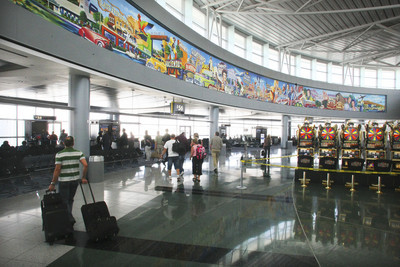
On Sept. 30, the airport opened nine new passenger gates in an expansion of the D concourse at a cost of about $179 million. It also opened 12 new security lanes for the C concourse.
Later this fall McCarran will open a pedestrian bridge that connects the C concourse to the B concourse at a cost of about $84 million.
The projects are a prologue to a terminal building that will open in 2012 at a cost of about $2.4 billion. The terminal will accommodate international traffic that's now going through Terminal 2, a cramped facility considered substandard and dated.
When the third terminal is complete, it will represent the last major capital upgrade to make McCarran capable of supporting about 53 million passenger arrivals and departures annually.
Before the sudden economic plunge, analysts projected McCarran could reach capacity in 2015 or 2016.
One widely distributed projection was made in 2006 and was based on there being nearly 42,000 new hotel rooms expected to open by 2012. Deutsche Bank's Bill Lerner wrote the forecast and suggested the county proceed quickly with plans for a second airport about 25 miles south of Las Vegas at Ivanpah to accommodate all the expected new customers when McCarran runs out of space.
The report said even if the new Ivanpah airport were in place by 2017, new resort development would have outpaced McCarran's capacity, and insufficient airlift would cause hotel occupancy rates to fall below the historical average of near 90 percent.
Completion of an airport at Ivanpah has already been pushed back to 2018 at the earliest, and Clark County Aviation officials say they won't make a decision to proceed with a new airport until 2012.
Still, there has already been about $59 million set aside for an environmental impact statement and other preparatory work.
Hotel development has slowed since the 2006 Deutsche Bank report, but it hasn't stopped. CityCenter, Fontainebleau and Cosmopolitan resorts are still projected to deliver about 17,000 new rooms, and Las Vegas Sands Corp. and Trump Las Vegas completed nearly 4,300 rooms that were included in the 2006 projection.
Now, with airlines struggling and the Las Vegas economy slowing to a crawl, airlines are questioning the pace of airport expansion, especially since they know it will be paid for largely by airline fees.
Macey made waves in July when she signed off on a letter that urged the county commission to cancel or delay every airport upgrade that isn't justified by current needs.
Her suggestion didn't sway the commission.
Commissioners voted to approve a $1.2 billion construction bid for a third terminal building and told airport officials to go back and work with the airlines to pursue smaller cuts in the capital improvement budget.
On Aug. 19, commissioners approved $360 million in cuts to the airport's $3.7 billion capital improvement budget.
They preserved a proposed heliport in Jean that was among the bigger-ticket items airlines wanted to cut. Airline officials say the heliport is something that will mostly benefit helicopter tour operators but will be paid for largely by fees applied to airlines.
"At this time, one asks the question if it is prudent to move forward with that," Macey said.
Commissioners, however, stand by the heliport because it is something they think is important to constituents.
Reid said helicopter tours based in Las Vegas have been increasing in recent years. The tours, Reid said, depart McCarran for the Grand Canyon by way of a route above Tropicana Avenue. On their return, they fly over Charleston Boulevard, he said.
The flights have prompted people who live along the routes to call commissioners and complain.
"It just was untenable for those who were affected by it," Reid said.
"We can't just ignore the negative impact that helicopters have on our residents."
Without a heliport in a remote location like Jean, tour operators seeking to avoid congestion at McCarran could start moving to airports in populated areas such as Henderson, Reid said.
If the operators were dispersed, they would disturb even more people and wouldn't have much incentive to move again to a consolidated location in Jean, he said.
"I can see why the airlines would be against it," Reid said. "They don't live here. It doesn't affect their operation."
Airline officials aren't the only folks who suggest the nation's airports may face tough times ahead.
Kurt Forsgren, a Standard & Poor's debt analyst, said the turbulence facing the economy as a whole and airlines in particular could put a dent in airport finances around the nation.
In July, Forsgren and two other analysts delivered a report, "Ailing Airlines Are Giving U.S. Airports Plenty To Worry About."
The report compared the current situation with the months following Sept. 11 that shut down the airlines and airports nationwide and reverberated through the economy for months, particularly in Las Vegas.
At the time, airports scaled back building plans, restructured debt and raised airline rates and fees. The moves still weren't enough to prevent credit downgrades for some airports.
Today, high fuel costs and a travel decline again have airlines retrenching. In Las Vegas alone, US Airways, the second-largest carrier at McCarran, will have about 50 percent fewer seats available this fall compared with last.
"During the next six to nine months and barring external shocks, Standard and Poor's views airport credit quality as stable but threatened, with little likelihood of improvement," Forsgren's report said.
Although the report was national in scope, the outlook for Las Vegas airline traffic isn't good, either.
That's because the bulk of traffic into McCarran is by people using discretionary income for vacations, the kind of trips that are likeliest to be cut during hard times.
Southwest, which carries about 35 percent of the passengers at McCarran, has weathered the storm better than most airlines. But the airline isn't bulletproof.
Macey said the airline had long-term plans to increase its daily flights at McCarran from about 240 to 350. That increase is no longer part of the airline's long-term vision, she said.
"We are evaluating our flight schedules at Las Vegas and throughout the entire country on a daily basis right now," Macey said. "With the uncertainty of fuel prices and the economy right now, it is certainly fluctuating a lot more frequently than it had in the past."
Even if the economy has recovered by the time Terminal 3 is scheduled to open, Southwest may not have the advantage over other airlines it now enjoys.
Much of Southwest's success in recent years is attributable to a fuel hedging program in which it bought fuel years in advance. That allowed Southwest to keep expenses flat even as fuel prices were driving up costs for other airlines.
Those hedges are running out. By 2012, Southwest will be subject to market prices for fuel.
It could make Las Vegas a less-desirable place to send aircraft because fares into the market are typically lower than routes flown primarily by business travelers.
"I suspect McCarran may be more negatively impacted than other airports," Forsgren said.
But even with a decline in tourism traffic, Forsgren said, McCarran would be wise to proceed with expansion projects already under way.
Forsgren said airport officials have managed debt well and are in position to simultaneously weather a downturn and build for the future.
Airport managers, Forsgren said, use their credit facility wisely, which will pay off during the downturn by allowing them to be financially secure even as demand wanes.
"McCarran, in our view, is a very savvy and sophisticated manager of the facility," Forsgren said. "They have the financial position to be able to accommodate a level of underutilization."
When, or if, demand returns, McCarran will again be able to capitalize because management will have completed the projects needed to accommodate new business.
Another benefit to proceeding is it will help avoid paying higher costs down the road to revive stagnant projects.
"It is purely a financial decision," Forsgren said. "Delaying and postponing those is more expensive in the long run than charging ahead and completing the construction, counter-intuitive as that may seem."
Jeremy Aguero of Applied Analysis, a Las Vegas business consulting firm, agreed with Forsgren's notion that the combination of McCarran's sound management and finances along with the likelihood of an eventual economic recovery suggest expansion plans should proceed intact.
Aguero said that even with the current downturn, McCarran is running so close to capacity that the completion of resort projects that are still alive would justify the expansion.
"I don't think you make long-term decisions based on short term instability," Aguero said. "If we are behind (a tourism recovery), it could be the greater problem. Not being able to get people here would be a substantial issue."
This story first appeared in the Business Press. Contact reporter Benjamin Spillman at bspillman@reviewjournal.com or 702-477-3861.


