Investing in staff can feed prolonged success, executive says
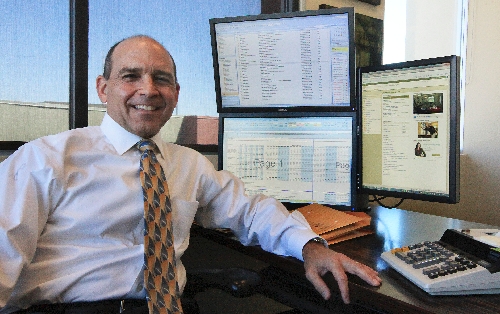





So your client base drops 20 percent and your revenue falls 19 percent.
How do you handle the slower business?
If you're Gary Johnson, you give your workers raises and gift certificates to movie theaters and restaurants.
Johnson is managing partner of Johnson Jacobson Wilcox, a local accounting firm that had a sizable real estate and construction clientele when the economy went bust in 2008.
Despite the downturn, Johnson and his four partners continued to hand out pay increases -- albeit smaller than in better times -- and kept up perks such as profit-sharing, clothing allowances for new employees and free daily lunches during tax season. The benefits are part of a bigger strategy to position the firm for growth when the local economy bounces back.
Question: Why did you get into accounting?
Answer: I wasn't smart enough to be a doctor! Honestly, when I went to school, I really didn't know what I wanted to do. I don't know why -- maybe because they made a lot of money -- I wanted to be a doctor. It lasted all of two weeks. I sat in those small classrooms, where there was a lot of interaction between teachers and students, and I had no clue what was going on. It scared me to death. I changed to all-business classes for no other reason than that it was as far away from medicine as I could get. I started taking business classes, and it clicked.
Question: Make the case for the profession: Why is it not as boring as people think?
Answer: I don't know why we get this reputation that we're as about as exciting as morticians. It's not necessarily just a science. Our firm is working with a couple of clients doing acquisitions. There's some judgment, planning and creativity that is actually pretty exciting to use in helping to structure the transaction. It's not just sitting at an adding machine and adding numbers and preparing financial statements and tax returns. And because we get to know our clients so well, they ask our opinions of things outside of tax returns and financial statements, like what we think about what's going on in the economy, or what would we say about expansion into certain areas. They consult with us on a lot of issues.
Question: Any unusual cases you've worked on?
Answer: We were retained to determine a point in time that a business that had declared bankruptcy had become insolvent. The company sold a book written by its owner that was marketed as a "get rich quick" system. It was really just a scam, as the book was nonsense. It was interesting, though, that this scammer got scammed himself. In reviewing the company's records, we found that he had responded to one of those Nigerian email scams, where a top official of some Nigerian government agency asks for assistance in moving millions of dollars into the U.S., offering a large percentage of the funds as a reward for assistance. This guy got hit for something like $150,000. I'm not sure anyone deserves to get stung, but maybe this guy did.
And divorces are always interesting. Sometimes they're really sad, sometimes they're comical. It depends on how the husband and wife get along.
Question: Do you get people throwing vases at each other in your office?
Answer: No, the lawyers usually deal with that. We deal with the division of assets, who's going to get what, what are the tax ramifications.
Question: You've actually told some clients to close their business. Why? How hard is that to say?
Answer: Sometimes it takes somebody objective, who does not have a lot of emotion tied up in the business, to recognize that you're beating your head against the wall. It gets to the point where we can see what's going on and say, "You have some pretty significant personal assets. Maybe you should protect those assets, and your family. Maybe it's time to let the business go." Those are not easy conversations. Some clients recognize that they need to close, and others really struggle with it for a long time, to their detriment. It's hard to see the look on someone's face when this is something they put their whole life into building up, and it's something they're very proud of, that supported them and their family.
Question: The economy has been tough on your business, too. How have you managed to maintain salaries and benefits for your employees?
Answer: Even though construction and real estate was probably the biggest niche in our practice, we have a solid client base outside of that. While all of our clients are not doing as well as they used to, we have been able to still do well enough to get by. The partners are not making what they used to, but that's just the reality. We've been pretty blessed in that we have a pretty solid client base.
We're looking at different industries, like manufacturing, and we're targeting clients that have markets outside of Southern Nevada, where they have more opportunities to be successful. We just picked up a manufacturing client that sells to the gaming industry, and does business in China, Macau, South Africa and South America. They have markets all over the United States as well.
Question: Why didn't you consider cutting salaries and benefits?
Answer: We still believe in Las Vegas. We think it's going to be a while before things start turning around, but when that happens, we want to be positioned to have a great firm. The only way to do that is to have great people, so we take care of them. It's an investment. It's the right thing to do. It demonstrates that we are committed to the firm and to our combined success here. I look at how smart our employees are, how engaged they are and how excited they are to serve our clients well, and that's what it's about. If we're serving clients well because our people are happy, then in the long run, we'll be successful.
We've kept up with benefits like profit-sharing because we want all of our people to feel like they have a vested interest in how well the firm does. We want to create an entrepreneurial spirit, where everyone feels like an owner. Our manager group came to us recently and asked what they could do to take work off of the partners' plates so we could do more business development. They have an interest in how the firm's doing, and they're acting on that. They're talking like owners.
Question: You show employees the firm's books every month, including how much the partners make as a group. Why don't more businesses do that?
Answer: I think there's a fear of resentment -- a fear that employees would feel like they're working way too hard just to make the partners rich, and they're not being appreciated. But it depends on the culture of the company. We're so open with them from the day they walk in the door, and we see it as providing an incentive. Being a partner in a CPA firm can provide a pretty nice lifestyle. All of our people know they're treated well. They have great benefits. We appreciate them, and we are providing them an opportunity to grow with this firm and become a partner.
They also see that we're making less money in this economy. The partners have taken pay cuts to invest in the future of the firm, and I think our people appreciate that we have not tried to make money off of their backs.
Question: What are your future plans for the firm's growth, and for your career?
Answer: We have mandatory retirement at 65. Our plan is to pass this firm on to a younger generation of partners. And you have to continue to grow to provide opportunities for smart, motivated, enthusiastic people, or they will go somewhere else. By the time the current group starts retiring in about 10 years, we would like to have the firm be at eight to 10 partners and 65 to 75 total people (up from 25).
We're like a lot of businesses right now. We have to reinvent ourselves a little bit, and figure out where new markets are to replace lost revenue or niches. We're looking at doing more litigation support, and we're looking more at medical practices and manufacturing businesses.
Contact reporter Jennifer Robison at
jrobison@reviewjournal.com or 702-380-4512.
NEVADAN AT WORK
Name: Gary Johnson
Age: 55
Occupation: Managing partner, Johnson Jacobson Wilcox
Quotable: "I don't know why we get this reputation that we're as about as exciting as morticians."
VITAL STATISTICS
Name: Gary Johnson.
Position: Managing partner, Johnson Jacobson Wilcox.
Family: Wife, Saundra; daughter, Shaina; son, Brady.
Education: Bachelor of science in business, University of Nevada, Las Vegas.
Work history: Staff accountant, Grant Thornton; partner with father in local accounting firm Johnson & Johnson; accountant and partner, Johnson Jacobson Wilcox.
Hobbies: Riding his Harley-Davidson motorcycle; golf; boating off the San Diego coast.
Favorite book: The Bible.
Favorite movie: "Serpico" (1973).
Hometown: Los Angeles.
In Las Vegas since: 1963.
Johnson Jacobson Wilcox is at 9139 W. Russell Road. It can be reached at 304-0404.