



Jobless rates fall in large cities, including Las Vegas
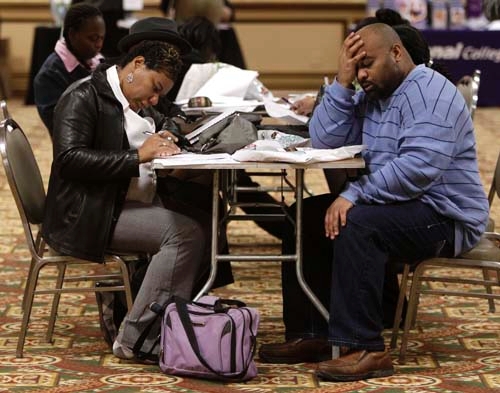


Las Vegas is in lockstep for a change.
After the national recession's June 2009 end, local unemployment continued to rise, even as joblessness held steady or declined in other big cities.
Now, new numbers from the U.S. Department of Labor show unemployment in Las Vegas has fallen along with most other markets.
Unemployment rates fell in about three-quarters of large U.S. cities in September, a sign that the nation's modest job gains that month occurred across most of the country, the department said.
The agency's numbers show that unemployment rates fell in 280 large metro areas from August to September. They rose in 61 and were unchanged in 31. That's the largest number of cities to see a decline since April.
In Las Vegas, the jobless rate fell from 14.3 percent in August to 13.6 percent in September. Part of the decline came from job growth in tourism and other services. But a shrinking labor force also played a role: The local work force dropped by 1,600 people, or 0.7 percent, from August to September.
In all, there were still 129,400 people out of work and looking for a job in Las Vegas in September. The Labor Department noted that Las Vegas still had the highest unemployment rate among cities with populations of 1 million or more.
Nationwide, employers added a net 103,000 jobs in September. And the unemployment rate was 9.1 percent for the third straight month. The job gains were only about enough to keep up with population growth. The economy needs to generate at least twice September's total to reduce the unemployment rate.
Unlike national and state data, metro unemployment figures aren't adjusted for seasonal changes. Many of the areas with the sharpest drops in unemployment were cities with large universities. They likely added jobs at the start of the academic year.
State College, Penn., home to Penn State University, reported the biggest drop in unemployment in September. Its rate fell to 5.1 percent from 6.5 percent in August. Grand Forks, N.D., site of the University of North Dakota, reported the next-largest drop, to 4.1 percent from 5 percent.
Meanwhile, many of the cities with the biggest increases in unemployment were coastal cities, where many summer employees likely lost jobs.
Unemployment in Ocean City, N.J., rose to 9 percent in September, from 7.9 percent the previous month. The second-biggest rise was in Gulfport-Biloxi, Miss., on the Gulf of Mexico, where the rate jumped to 9.8 percent from 8.7 percent.
Other cities with big increases included Myrtle Beach, S.C., a popular beach resort, and Barnstable Town, Mass., part of the Cape Cod area.
Bismarck, N.D., registered the lowest unemployment rate at 2.5 percent. The next-lowest were Fargo, N.D., at 3.3 percent and Lincoln, Neb., at 3.5 percent.
Among cities with 1 million or more residents, Oklahoma City had the lowest rate, 5.5 percent. Oklahoma has benefited from its oil and gas production and high prices for grains and other agricultural communities.
El Centro, Calif., reported the highest rate, at 29.6 percent, followed by Yuma, Ariz., at 27 percent. They are adjacent counties with heavy farm economies and large contingents of migrant labor.
Review-Journal reporter Jennifer Robison contributed to this report.


