Leader helps hospice patients find comfort in last days
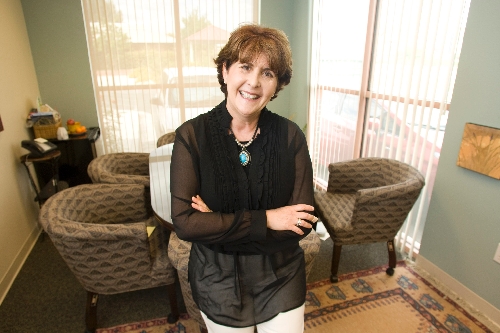


Carole Fisher finds fulfillment as the top executive of an organization that helped many of its 44,000 patients over the past 30 years say their final goodbyes to families and friends.
She runs the Nathan Adelson Hospice, a not-for-profit organization that helps terminally ill patients.
Fisher pursued a career in health care because she wanted to help people, not because she needed the money. Her grandfather, Leonard Tose, made a fortune in the trucking business and once owned the National Football League's Philadelphia Eagles.
The hospice she manages also has a story. It is named for a businessman who sold his supermarket chain in Los Angeles and became administrator of Sunrise Hospital and Medical Center in Las Vegas in 1961 at the request of his son Merv and friend Irwin Molasky.
Nathan Adelson later died of a painful stomach cancer. His son and Molasky established the first city's hospice in 1980. Nathan Adelson is not related to Las Vegas Sands Chairman and CEO Sheldon Adelson.
Question: How do hospices help patients?
Answer: A hospice is available for people whenever they've exhausted their curative options. You want to have your remaining quality of life comfortably financially, spiritually, emotionally and physically.
We live in a society where we do a wonderful job of embracing birth. We don't do a good job celebrating the end of life.
It's very much uncomfortable. We're scared. It's unknown. We don't know what's happening. We don't talk about it.
Question: Do you tell patients they are dying?
Answer: We honor what they want. It's all about their individual choice. Some patients definitely want to have that kind of conversation. Others don't want to know about it.
Question: Do you help patients talk with their families?
Answer: Sometimes, they have said what they needed to say to their loved ones. Sometimes, there are relationships that need to be mended.
Question: Where do you provide hospice care?
Answer: We go to the patients no matter where they are. To their home, to a nursing home, to an assisted care facility, sometimes in hospitals.
It's an interdisciplinary approach. It was not just physician-driven. We bring nurses, social workers, pharmacists, clergymen to help patients.
Question: Are local hospices reaching all the people that would like to have the service?
Answer: We are the oldest and the largest not-for-profit out of about 22 hospices in our community. Even with all the hospices in our community, we are only reaching 35 to 40 percent of the people who have what we would call nontraumatic deaths.
Sometimes, people just don't understand the value of hospice care. Sometimes, there are physicians that look at it as failure when they can't cure people.
Question: Is there enough capacity to serve everyone who asks for hospice care?
Answer: Yes. My capacity is unlimited. We never turn anyone way because of inability to pay.
Question: How has the recession affected Nathan Adelson Hospice?
Answer: We survived one of the worst years in the economics of our business in Las Vegas. We give away a million dollars in free care each year. We instituted and streamlined some positions (excluding workers at the bedside).
Question: How has national health care insurance legislation affected your operations?
Answer: Medicare is reducing the reimbursement to hospices all across the country. We're talking about a signification reduction of about 14 percent over the next 10 years. That hurts.
Question: Are there any benefits from the new law for hospices?
Answer: Yes. A pediatric hospice patient will be able to continue curative care (while getting hospice services). I can continue that chemotherapy at the same time I get the benefit of hospice professionals. It's just a blessing. We have people, sometimes even seniors, that get better.
Question: What is the future of hospice services?
Answer: The regulations are getting stricter and more stringent and that results in more paperwork and additional reporting. Reimbursements are being cut.
I am aware that we continue to be in a recession. Our donors are starting to feel more comfortable giving again to this organization. It's not at the level it's been in the past.
Question: How does your position at the hospice compare with other jobs you have held?
Answer: It's my favorite job. I love it, because we're doing the right thing for the right people.
Contact reporter John G. Edwards at
jedwards@reviewjournal.com or 702-383-0420.
VITAL STATISTICS
Name: Carole Fisher.
Position: President and chief executive officer, Nathan Adelson Hospice.
Age: 52
Quote: "We live in a society where we do a wonderful job of embracing birth. We don't do a good job celebrating the end of life"
Family: Husband, Gary; children, Brooke, Aaron and Colin; grandchildren, Kaya and Miles.
Education: Bachelor's degree in social work at the University of Nevada, Las Vegas.
Work history: President and CEO of Nathan Adelson Hospice since 2006; executive vice president of Nathan Adelson Hospice; executive director of Southwest Medical Associates; business director of Southwest Medical Associates; vice president and chief operating officer of Behavioral Health Care Options; CEO of Harmony Care; executive director of Bridge Counseling Associates.
Hobbies: Knitting, yoga, swimming, reading, spending time with family.
Favorite book: "The Alchemist," by Paulo Coelho; "Four Agreements" by don Miguel Ruiz.
Hometown: Norristown, Pa.
In Las Vegas since: 1980.
Nathan Adelson Hospice is at 4141 Swenson St. and can be reached at 733-0320.