



Nevada’s vanadium may hold key to storing energy
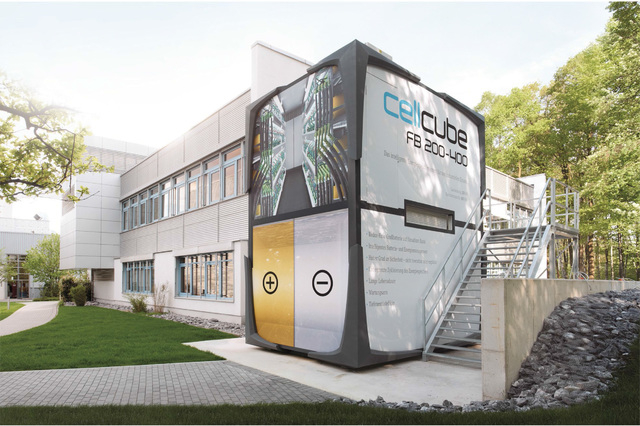



The future of America’s energy storage industry may well be found in “them thar hills” of central Nevada, and Canada-based American Vanadium Corp. is gearing up to harvest what it sees as the 21st century mother lode.
The company is in the permitting phase of starting a mining operation for a deposit of vanadium in Eureka County. Initially, that means up to 125 new jobs but it could mean much more to the state’s economy in the long run.
Vanadium is the 23rd element on the periodic table, and it is classified as a soft silver-gray ductile transition metal. Most vanadium — about 90 percent globally — is used as an additive to strengthen steel. Recently, many people, including President Barack Obama, have gotten excited about vanadium’s status as a strategic metal with “green energy” applications, American Vanadium Corp. CEO Bill Radvak said.
Radvak said Nevada’s vanadium deposit is sun-baked sedimentary shale. It is essentially a ridge of exposed, heavily oxidized, crumbled rock with a strip ratio of 0.22-to-1. That’s a rare combination the company expects to be able to develop into a source of the material scientists are seeking in their quest to develop flow batteries that can be used as energy storage facilities. These batteries will charge with solar power during the day and store the energy for use during peak power usage after the sun sets. It can be recharged numerous times without the battery degrading because of vanadium.
“There are a number of different flow-battery technologies out there,” Radvak said during the annual Solar Power International Conference and Expo held recently at the Las Vegas Convention Center. “Vanadium is the only element we found where you can make both electrodes — the anode and cathode — and that prevents the battery from eroding. There is no other metal that will do that, and it gives you this tremendous capability with energy storage.”
The vanadium flow-batteries can be used for energy storage for up to 20 years, while other battery technologies, such as lithium and lead acid, have a much shorter life span because they degrade on every recharge. Lithium batteries can be recharged for seven years; lead-acid batteries are good only for three years, Radvak said.
The vanadium-flow batteries are already in use in Europe. American Vanadium is working with Gildemeister, a German-based mechanical-engineering company. The two companies have developed a vanadium-flow battery called the CellCube, which can be customized for each customer to provide multiwatt energy storage of four to 12 hours.
Although they’re called batteries, Radvak said they work more like a rechargeable fuel cell in that a liquid electrolyte is being charged, which allows for an energy storage solution that is more and more cost effective with duration.
“Flow batteries are really unique,” Radvak said. “They are similar to a fuel cell where you have power stacks and energy cycles. You have these power stacks and tanks of vanadium electrolyte, which is our core battery solution and what that does is actually allows you to separate the power from the duration. With a lithium or lead-acid battery, if you want to double it, you double the amount of cells and you double your cost.
“With these batteries, we have the ability to separate the power stacks from the tanks. If we want to double the duration, we double the electrolyte tank, and that only increases your cost by 50 percent.”
The Metropolitan Transportation Authority and the New York City office of Strategic Innovation and Technology at 2 Broadway in Manhattan are using the first Cell Cube in the United States. American Vanadium is also working on a request for proposal on a $500 million upgrade at Con Edison’s Brownsville substation. Radvak said energy storage is a big part of what those agencies are looking for in managing 3 megawatts of power with 12 hours of duration.
“The utilities and government are looking to save $10 billion,” Radvak said. “New York has the oldest grid in the world; half of the transmission lines are 50 years or older. They really are committed to rethinking this.”
Closer to home, Radvak said Nevada has lofty goals on solar power. Mandalay Bay has installed a rooftop solar array on its convention center. The array will use 21,324 photovoltaic panels packed together on 20 acres to generate 5 megawatts of electricity — enough to supply the facility with about 20 percent of its load and help the hotel-casino avoid buying power at peak times.
“They have installed one of the largest solar rooftop operations in America,” Radvak said. “They are going to be hit with peak charges, so storage is something they are looking at. They may be coming up with their own RFP in the next three to six months, and we’ll be chasing that hard.”
Nevada vanadium deposit is crucial for energy storage’s future. It is the only deposit in North America that is ready to be mined. Right now, America imports every pound of vanadium, and almost all of it comes from China, Russia and South Africa. Plus, China’s new building codes, which require vanadium to be used as an additive in steel, could increase demand for the element, Radvak said.
The Nevada deposit will be used solely for energy storage; there are no plans to market it as a steel additive. The market price for vanadium that is used as a steel additive is around $6.50 a pound for the vanadium oxide, where vanadium used in energy storage is being sold for $20 to $25 a pound, Radvak added.
American Vanadium is looking to add about 100 to 125 jobs in Nevada. Some will be sales jobs; some will be operational jobs in heap leach extraction, which was first discovered for use in gold extraction. In vanadium extraction, the deposits to be placed on a pad, then sulfuric acid is sprinkled over the deposit, which then filters through the deposit and leaches out the vanadium.
“It’s actually a very environmentally friendly process,” Radvak says. “Because you don’t have massive dumps, you don’t have a big tailings pond, or a huge chemical plant doing this. It’s a very small process,” Radvak said.
“With this deposit in Nevada, we’ll essentially have a zero strip ratio, so there will be no waste. It’s basically removing a hill, putting it on a pad and adding sulfuric acid. We’ll have to clean it up, but our first raw product really is the very high-value vanadium electrolyte.”


