



Reid getting tougher on coal
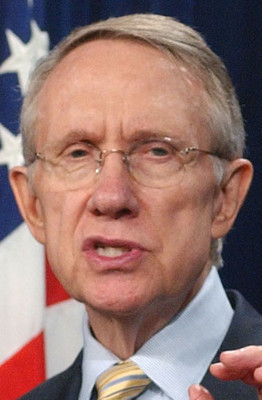


WASHINGTON -- When Sen. Harry Reid declared in July he would do "everything I can" to stop construction of coal-fired power plants in Nevada, friends and adversaries on the energy issue began watching for when he would make a big move.
Finally, Reid's strategy was revealed this week. Game on.
Reid has proposed an amendment that would effectively block coal energy plants planned in Eastern Nevada by toughening clean air standards at Great Basin National Park.
It is the Senate majority leader's most direct action against three plants on the drawing boards since he began campaigning against coal as a pollutant this summer and elevating his advocacy of renewable energy as Nevada's energy path to the future.
If enacted, the air quality law would terminate the $3.8 billion Ely Energy Center proposed to generate 1,500 megawatts using coal, said Roberto Denis, vice president for energy generation at Sierra Pacific Resources.
"It is very far-reaching," Denis said. For the national park, it calls for a Class One level of air quality equivalent to "preserving it in its natural state," he said.
As far as meeting the tougher standard, "Technically it could not be done," Denis said, adding it could also restrict natural gas projects in Eastern Nevada.
LS Power remains committed to developing its 1,600 megawatt plant but will comply with present and future air quality rules, said Eric Crawford, director of project development. A third project is being planned by Sithe Global Power, of New York. It is a $1 billion, 750-megawatt plant near Mesquite.
The 750-megawatt Sithe Global plant is about 240 miles south of Ely and does not appear to be close enough to the Great Basin to be affected by the Reid amendment.
Sierra Pacific Resources wants to build the Ely Energy Center 20 miles north of Ely, and LS Power Group proposes to build its project 25 miles north of Ely. The Ely-area plants are about 70 miles from the Great Basin park, but Ely area leaders generally see the power projects as a long awaited anchor to their economy.
The bill amendment "is very frustrating," said White Pine County Commissioner RaLeene Makley, a Democrat. The Ely area depends on the cyclical mining industry and has been trying to promote economic development for more years than she could recall.
"We need something a little more stable," she said. Most residents in the area support the project, she said.
"It's disappointing," Mackley said. "I know a lot these companies have worked hard to go by the rules and get the permits. They have spent a lot of money to have this dropped on them like a bombshell."
While she fears the provision could delay he projects, "I imagine the companies wouldn't just give up on it right away."
The Reid measure would place Great Basin National Park in the same Class One as about 150 units in the national park system that were designated for the most protective levels of air quality by the Clean Air Act of 1977, according to Charles Benjamin, Nevada director of Western Resources Advocates.
The only national park in Nevada was created in 1986 with a Class Two designation, and there have been no efforts to redesignate it until now, said Benjamin, whose group opposes the coal plants.
"I think what Sen. Reid is trying to do is protect the integrity of the air quality at Great Basin Park and this is one way to do it, to get it reclassified," Benjamin said.
Benjamin noted the 1,580-megawatt coal-fired Mohave Generating Station near Laughlin was closed last year in part because it failed to meet Class One clean air standards for the Grand Canyon. In Class One areas, regulators look at haze, and the Mohave plant had been blamed for diminishing visibility in the Grand Canyon.
But as a sign of Reid's focus on the coal plants, his amendment is specific only to "any new or proposed electric generating unit" in the state that would be issued or that would request air quality permits in the next five years.
Sierra Pacific Resources and LS Power have obtained draft air permits from the Nevada Division of Environmental Quality. LS Power hopes to obtain a final air permit by year end.
Calls to the division were referred to Michael Elges, chief of Air Pollution Control, who didn't return a call for comment.
"If the Great Basin Park was truly generated a Class One area you would impact more than the power plants," said Denis. "It would impact mining and any other kind of development, even farther than our proximity."
While applauding Reid's actions, Launce Rake, a spokesman for the Progressive Leadership Alliance of Nevada, also noted the amendment was targeted.
"If we are going to make it a Class One area, let's just make it a Class One area," Rake said.
The legislation opened a fissure between Reid and Nevada's three Republicans in Congress who support the coal plants and who are blowing whistles of alert to prevent it from becoming law.
The GOP members say coal should remain a part of the state's energy portfolio as a reliable provider of electricity while development continues into solar, wind and geothermal sources.
Reid is attempting to add the amendment to a giant year-end measure that would combine 11 appropriations bills that Congress has been unable to pass individually.
Maneuvering for and against the amendment had taken place largely behind the scenes this week until it was reported Wednesday by Nevada political columnist Jon Ralston.
"I am doing everything I can to try to strip it out and to make sure that does not get in," Sen. John Ensign, R-Nev., said of Reid's amendment. "I have my colleagues trying to keep it out and he has his people trying to keep it in."
With Congress racing toward a Christmas adjournment within the next two weeks, lawmakers are frantically cutting deals to advance a number of bills.
Reid said in a brief comment Thursday that his measure only "would help" block the projects but not kill them outright. He said his bid to win passage was going "fine."
Another Democrat familiar with the year-end negotiations said "the situation is definitely very fluid" and that "early indications are not promising" for Reid.
Congressional leaders piecing a year-end spending bill "are not looking to add things that would precipitate a veto," this official said.
Reps. Jon Porter and Dean Heller, both R-Nev., sent a letter to House leaders this week arguing that Reid's language should be rejected on procedural grounds if not on merit.
"These plants are good for Nevada for a number of reasons," the House members said. The projects will replace "older, outdated plants that emit more emissions. Environmentally these plants will be cleaner than any in the West, perhaps the nation."
Reacting to the letter, Reid spokesman Jon Summers said: "If they want to champion the construction of dirty coal plants, that's their choice."
Heller said bills affecting Nevada energy should be fully debated, and not added late.
"I am concerned about this process," Heller said. "I think (the Reid measure) needs to be discussed in committee and on the House floor." Adding it at the end of the year "eliminates the ability to discuss this bill."
Rep. Shelley Berkley, D-Nev., has been largely silent to date. An aide said she was flying home and was not available for comment, and has not reviewed Reid's amendment.
Melissa Subbotin, spokeswoman for Gov. Jim Gibbons, said she could not comment on Reid's bill amendment because she has not seen it.
"We certainly will look at it and give it a thorough review," she said.
The governor supported the coal plants when environmentalists asked the state to suspend permits for the projects in September.


