UNLV places third in Solar Decathlon Build Challenge

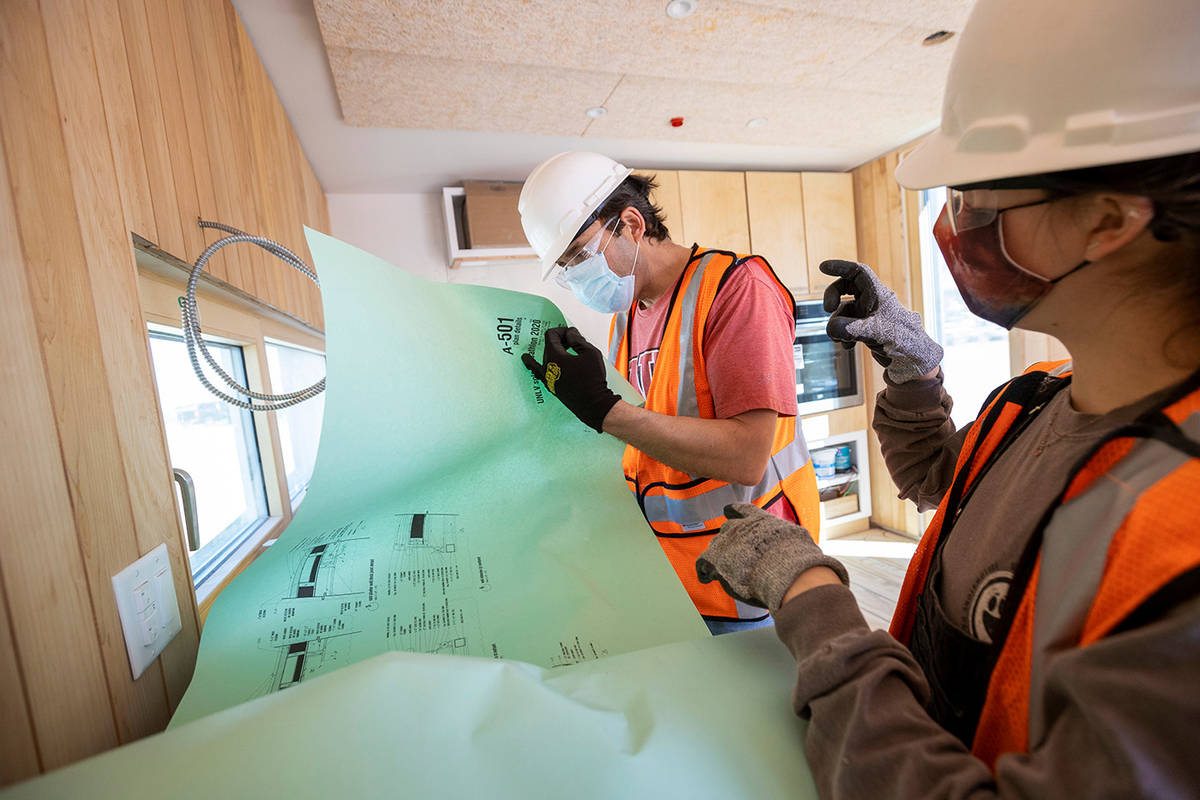
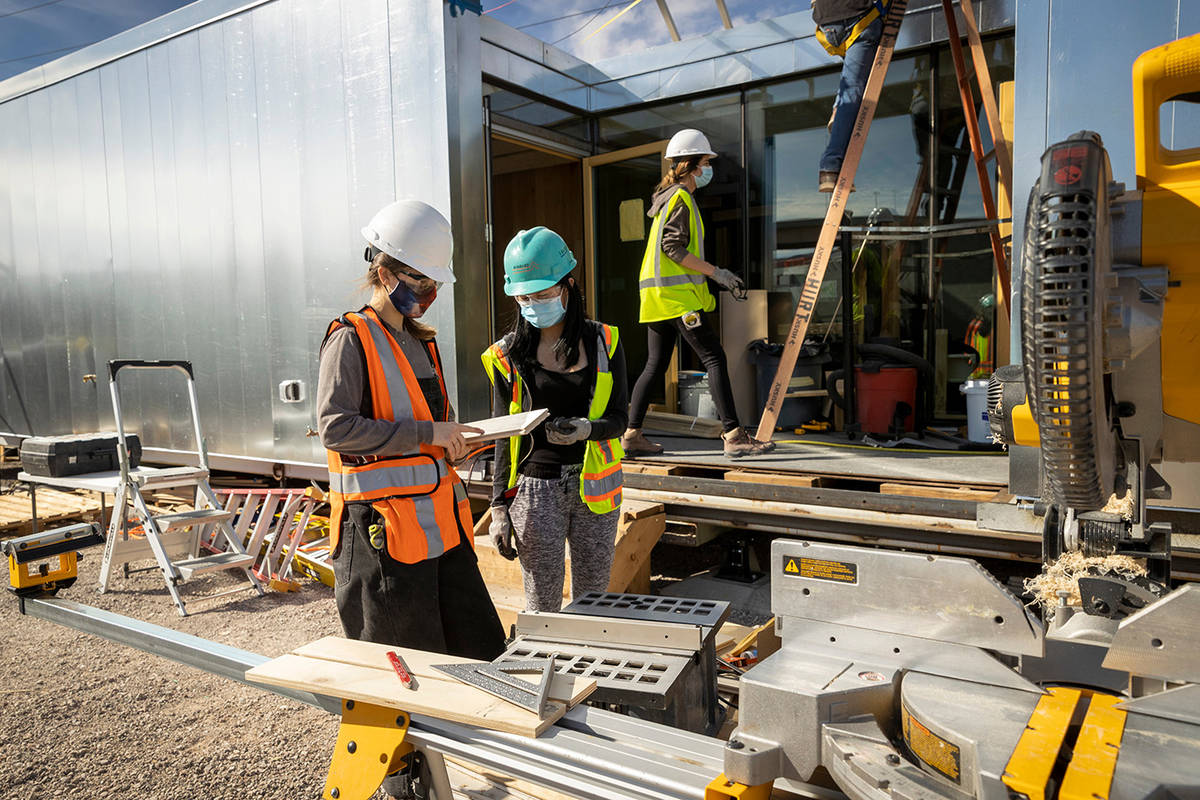


A team of students and faculty from the University of Nevada-Las Vegas competed against eight other international university teams during a Solar Decathlon Build Challenge from April 16-18.
The UNLV team placed third in the contest, that was sponsored by the U.S. Department of Energy.
“Our fight against the climate crisis is a lot like the decathlon,” said U.S. Secretary of Energy Jennifer Granholm during the awards ceremony. “We’ve got all these individual contests to get through like you did. There are new playbooks in this climate fight: on energy efficiency, on renewable energy, modernizing the grid, de-carbonizing the building sector, de-carbonizing the transportation sector, and de-carbonizing the industrial sector.”
During 2018, an interdisciplinary team of students at UNLV began the design and construction of Mojave Bloom, a high-performance home that could also serve as a nurturing shelter for returning military veterans who might be suffering from the effects of post-traumatic stress disorder and traumatic brain injuries.
UNLV Professor Eric Weber, the principal investigator from the UNLV School of Architecture, is a veteran of the Desert Storm conflict, where he served in the U.S. Marine Corps. Other members of the UNLV team were veterans of the U.S. Army and Air Force.
“The hardest part has been the effects of the pandemic on supply chains,” said Weber about the challenges to his student team. “Despite everything, they are still doing enormously important work. Their commitment and resilience have been really inspiring.”
The UNLV solar decathlon team reached out to local veteran communities in Southern Nevada for feedback. More than 10 percent of residents in this region had served in the U.S. military.
Building design guidelines provided through the Americans with Disabilities Act federal programs were an initial template to the architectural design team. ADA best practices for wheelchair access, service animal accommodations, bathroom and shower layout, lighting, kitchen appliances, cabinets, door handles, plumbing fixtures and other recommendations provided helpful considerations.
Further research turned up other design models, such as “prospect and refuge,” that attempted to minimize sudden triggers of emotional reactions during mental health states of hyper-awareness, depression, disconnection or isolation. These triggers could result from rapid environmental changes of sound, light, shadow, room temperature, air flow and color perception, as well as lack of sleep.
Mojave Bloom was designed around a central outdoor courtyard that divided the home into two partitions. An indoor, glass-enclosed walkway behind the courtyard connects the bedroom and bathroom to the kitchen and living room of the home. An abundance of glass in the windows and doors allows natural light to flow throughout all of the rooms while low-emission characteristics of the glass material help block the accompanying heat from the sun. The courtyard extends the indoor living space to the outdoor patio to create an open, “alfresco” lifestyle during comfortable weather conditions.
Indoor LED lighting is energy-efficient but also complements the natural light within rooms to allow for predictable circadian rhythms that can help residents sleep more comfortably and deeply during each night. To reduce glare from the LEDs, a translucent panel overlay diffuses the light to create a soft glow throughout the home, which is complemented by white ash wood paneling around the inside walls.
The natural wood wall coverings inside the home provide strong cues for horizontal and vertical orientation that reinforce a sense of balance.
The living space was designed so that it can be easily reconfigured by the resident when undergoing PTSD or traumatic brain injury events. The indoor-outdoor expansiveness of the dwelling place can be closed off with an external courtyard gate, to provide a solitary refuge for recuperation and relaxation when needed.
Internal acoustic paneling isolated noise from outside the home. Integrated plant-based landscaping along internal walls of the corridor provided a pleasing aroma throughout the rooms, accompanied by flowing water sounds from a drip-irrigation system.
During the last three years of the development of Mojave Bloom, the UNLV Solar Decathlon team has numbered more than 50 students from the schools of architecture, engineering, computer science, business, communications, landscaping, building construction, fine arts and other areas of study on campus.
They competed against eight other universities during the U.S. DOE Solar Decathlon Build Challenge.
Each team’s design and construction goal was to achieve a top score of 100 points in 10 different events, for a maximum total score of 1,000 points. The 10 categories of competition included energy performance, engineering, financial feasibility and affordability, resilience, architecture, operations, market potential, comfort and environmental quality, innovation and presentation.
Other universities in the design/build decathlon included Hogeschool Utrecht University of Applied Sciences, Netherlands; Universidad Tecnica Frederico Santa Maria, Valparaiso, Chile; University of Waterloo, Ontario, Canada; Kansas State University; University of Colorado-Boulder; University of Colorado-Denver; University of Illinois Urbana-Champaign; and Weber State University, Ogden, Utah.
The UNLV Mojave Bloom residential home was awarded a cumulative total of 760 points after the 10 judging sessions, placing third behind the University of Colorado-Boulder with 891 points and the University of Waterloo with 809 points.
Mojave Bloom excelled in the categories of energy performance, engineering, operations, architecture, presentation and innovation within the decathlon competitions.
“We are just really excited to share the message about what architecture and engineering can do for individuals,” said UNLV Project Leader Ryan Manthei, as he accepted the award from Secretary Granholm.
The Solar Decathlon Build Challenge contest rules constrained the project design to just 600 square feet of indoor and outdoor living space. The initial competition guidelines also required the home to be built into a footprint that could be mobile and transportable.
Ahern Co.’s Xtreme Manufacturing facility provided modeling tools and construction assistance for the UNLV team. The Mojave Bloom project used the company’s Xtreme Cube construction technologies to join together five steel-framed cubes. The resulting rectangular structure included four rooms with an interconnecting middle corridor, that also opened to an outside courtyard area.
The metal frame construction also allowed for advanced design features that included an internal wooden frame structure. The UNLV team installed internal 5.5-inch rigid foam panels and a second layer of 2-inch outer foam, along with closed-cell spray foam to create an insulated cocoon that surrounded the living space. The quality of the insulation within the structure was calculated at R71 for the roof and walls, while the floor was rated at R56.
The Mojave Bloom steel-framed structure also included external connectors for crane lifts and fork lifts, so that the home could be more easily loaded onto a transport truck or towed.
The architectural design team, led by UNLV architectural students Ryan Manthei and Jorge Medina, worked with a team of UNLV student landscape architects to incorporate plants into the desert home. The goal of the design team was to use plant life to create a comfortable, aesthetic environment that could add oxygen, humidity and soothing aromas to the inside air, while also absorbing CO2.
The bedroom and bathroom in the west wing provided comfort to people with disabilities by including assistive handle grips for the toilet, a transfer bench and easy shower access that could accommodate the use of a wheelchair. The laundry area and wardrobe area were integrated closely together, to provide minimal mobility requirements for residents while washing and sorting clothes.
The kitchen and living space in the east wing of the home included accessible appliances such as refrigerator, cooking range, dishwasher and other amenities.
The home’s power usage was designed efficiently by the engineering school to be able to function independently from the electric utility grid. Daily operation of appliances consumed just 4,445 kilowatt-hours of electricity per year, while embedded photo-voltaic solar panels could generate about 11,740 kilowatt-hours of electricity per year.
Mojave Bloom harnessed the sun through an array of photo-voltaic solar panels mounted on top of the roof structure. The bi-facial solar panels, manufactured by Sunpreme and donated by local distributor Sol-Up, can generate 6 kilowatts of electricity when the sun is shining.
Solar cells were fabricated on both sides of each solar panel. The roof of the home is painted white to reflect secondary light back toward the bottom layer of cells.
During the night, two Tesla Powerwall 2 energy storage systems can provide 26 kilowatt-hours of stored electricity from lithium-ion battery packs. These energy storage devices work in conjunction with the photo-voltaic solar panels to keep electrical appliances operating off-grid for up to three days.
To heat the home and to pump running hot water to home faucets, an efficient solar-thermal heating system was designed to capture the sun’s rays through evacuated tube collectors, that are rack-mounted outside the home’s mechanical room on the west wing. The rack of thermal solar collectors can be manually adjusted to the position of the sun for an optimum heating angle.
The solar collector tubes heat the water running through pipes, that are routed throughout the floor of the home to provide radiant heating. Hot water is also collected, mixed and pumped through pipes that are plumbed to the shower, sinks and appliances in the home.
Two Mitsubishi mini split heat pumps are positioned on each internal wall of the two indoor partitions. The connecting walkway between the two partitions allows each heat pump to be able to heat the entire home if required. Mini-split heat pumps and radiant floor heating are more efficient and quieter than traditional HVAC systems, that usually require larger ducting channels for air flow, as well as higher electric power consumption.
The mini split heat pumps have a seasonal energy-efficiency rating of SEER 33, that indicates high-efficiency cooling and heating compared to the electric power consumed to run the system.
Each heat pump unit requires two pipes with refrigerant to run between each indoor module and the outdoor processing module, as well as an exhaust pipe for condensation. The collected condensation moisture is routed to the outdoor landscaping to help with irrigation.
Both outdoor heat pump modules for the home are enclosed within the external mechanical room that efficiently integrates all the water heating systems together. Large louvers built into the walls of the mechanical room channel air flow to each system. The mechanical room also houses a gray water recovery system that also can be used to irrigate the outdoor landscaping.
The UNLV School of Engineering also partnered with Neal Phase Change Technologies in Boulder City to develop an innovative heat-exchange module to assist the two mini split heat pumps, in order to provide more efficient cooling inside the home during the hot desert summers of Las Vegas that can reach 110 degrees Farenheit.
The final design and construction of Mojave Bloom received an overall Home Energy Rating System index of 44 without the use of its photo-voltaic solar panels. This index number is more than twice as efficient as a standard home, constructed to existing building codes at a reference index of 100.
After adding 6 kilowatts of solar panels onto its rooftop and coupling the additional generation of electricity with the Tesla Powerwall 2 energy storage system, the home received an adjusted HERS rating of -58. This new index number indicates that the house can generate a lot more energy than its residents will consume during daily operations.
Mojave Bloom has been permanently relocated to the Las Vegas Community Healing Garden at 1015 S. Casino Center Blvd., where the building structure will serve as an educational exhibit and a relaxing break area for the garden staff.
More information about the Mojave Bloom project and the UNLV Solar Decathlon Team can be found at solardecathlon.gov/2020/build/competition-team-las-vegas.html