Anything for a Laugh


EDITOR'S NOTE: This is the third in an occasional series of stories highlighting performers who played an interesting role in the history of entertainment in Las Vegas.
When I interviewed Phyllis Diller this summer at her home in Brentwood, Calif., I prefaced my first question with, "You were already an established star before you played Las Vegas ..."
"Well, you have to be or you just can't get there!" she quickly responded. She then added: "In Las Vegas you name it, I played it -- the Riviera, the Tropicana, the Hilton International ... over and over again. They just never learned!"
The raucous and delightful Diller is the woman who opened the door for all stand-up comediennes that followed, from Totie Fields and Joan Rivers to Rita Rudner and Kathy Griffin.
There were female stand-up comics before Diller, such as Rusty Warren and Belle Barth, in nightclubs and burlesque. Basically, these women told dirty jokes and off-color stories.
"I never knowingly did 'blue' material," Diller said. "Some of the jokes I did might have been interpreted as naughty, but I was rather naive when I started out, and I really didn't have a clue."
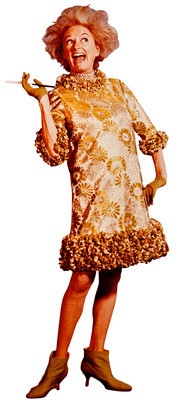
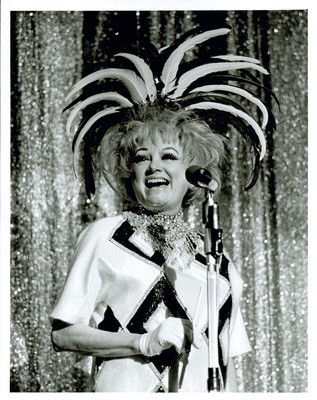
Writing most of her self-deprecating material, dressing wildly in costumes with go-go boots she designed in the 1960s with Keith Rockwell, wearing crazy wigs and handling that inevitable cigarette holder -- although she never smoked -- Diller has etched an indelible image upon our collective comedic memory.
In fact, Diller's last comedy stage performance, with her longtime friend, magician Mercer Helms, was at Las Vegas' Suncoast in May 2002 (recorded on the DVD "Goodnight -- We Love You," voted best documentary at the 2004 San Diego Film Festival). She still delivered as many as 12 laughs a minute.
"It was always like walking a tightrope without a net," she told me about her act, adamantly adding: "I never performed 'by rote.' The audience would know in a second. Each audience had its own IQ. I listened!"
I asked her the trick to her amazing timing. "Honey, you've got to listen. You've got to make sure they (the audience) are getting it."
She explained to me the difference between "high comedy," where the audience takes time to absorb the humor, and "low comedy," where the audience gets the joke quicker.
"Towards the end of my career doing stand-up, I did a lot of 'low comedy,' " she said. "That way I didn't have to wait so long for them to get it, and I could enjoy their laughs."
It wasn't clear from the beginning, though, that Diller's life would lead to such fame.
Born Phyllis Ada Driver in Lima, Ohio, on July 17, 1917, she was an only child. She studied piano for three years at Sherwood Conservatory of Music in Chicago, later transferring to Bluffton College, in Ohio.
Eloping with Sherwood Diller on Nov. 9, 1939, she soon after gave birth to her first child, Peter. (He was followed by Sally, Suzanne, Stephanie and Perry. She now is the grandmother of four, the great-grandmother of one.)
Settling down as a housewife, Diller soon realized that her husband could not, or would not, hold a job.
After the family moved to Alameda, Calif., in 1950, Diller found work as a copywriter for San Leandro's News-Leader. Several other jobs followed, including stints at KROW radio in Oakland, KSFO radio in San Francisco and the San Francisco Chronicle, where she worked as a columnist.
During her early days in California, she discovered a book that changed her life, "The Magic of Believing," by Claude M. Bristol. It was about self-realization and belief in miracles.
"These were the kinds of words that transported me out of the fire into which I'd thrown my scrapbook of dreams and aspirations," she wrote in her 2005 autobiography "Like a Lampshade in a Whorehouse" (Penguin). "From here on it was straight up, all the way."
While working in San Francisco, she discovered a small, intimate comedy club called the Purple Onion.
She auditioned and was accepted to perform for two weeks, making her professional debut on March 7, 1955. Diller's act consisted of her singing "Indian Love Call" (classically) and "I'd Rather Cha-Cha than Eat" (humorously). She also imitated Peruvian singer Yma Sumac and beat out rhythm on an oatmeal box. She was an immediate success, and her stay at the club was extended for 89 weeks.
Afterward, she toured the country developing and honing her act, which she dubbed "tragedy revisited." In 1958, she opened at New York's Blue Angel, and made her national television debut on "The Jack Paar Show."
She was a sensation "doing my way-out material while stripping from my dress to my black leotard so that I could perform 'Ridiculous,' " she wrote. "In the middle of my strip, I pulled a chunk of short green hair ... and said, 'This isn't my hair, these are nerve ends,' and that was the line that got Paar." It became the first of her numerous appearances on his show.
A major turning point for Diller occurred in late 1958 at "an awful little hole in Washington, D.C., called the Lotus Club," Diller continued. "I was on the bill with the Irish Senorita, who sang and wore white duck pants, as well as an opening act consisting of six girls who were expected to mingle. ... I was supposed to entertain ... salesmen and hookers."
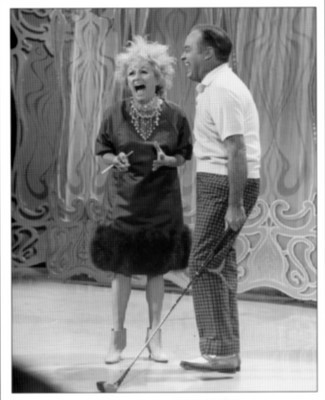
Bob Hope came into the club one night and although Diller feared she had bombed, he encouraged her. The two comics developed a deep, abiding friendship that would last until Hope's death in 2003.
In September 1960, Diller opened at the New York nightspot Bon Soir with a young Barbra Streisand, and was featured in the film, "Splendor in the Grass" (1961), directed by Elia Kazan. Various television, club and theatrical appearances rapidly followed, including a comedy performance at New York's Carnegie Hall.
In 1963, she starred in her own television special, and made her Las Vegas debut at the Flamingo in November 1964, with Enzo Stuarti.
While her career zoomed ahead, her marriage disintegrated. By 1965, she filed for divorce from Sherwood Diller, whom most people believed was the model for the character of "Fang," the shiftless husband in her act.
Diller starred with Hope in the movie "Boy, Did I Get a Wrong Number" in 1966, and they would do two other comedies together, "Eight on the Lam" in 1967 and "The Private Navy of Sgt. O'Farrell" in 1968. (She also appeared on 22 Bob Hope specials, and did a USO tour of Vietnam with him.)
Diller stunned film critics in 1969 by giving a tour de force dramatic performance in the British-lensed "The Adding Machine," a film version of Edgar Rice's expressionistic play.
And in 1970, she achieved what she considered her greatest professional dream: Broadway. Replacing Pearl Bailey, Diller starred as the last Dolly Levi -- after Carol Channing, Ginger Rogers, Martha Raye and Betty Grable -- in "Hello Dolly."
On television, ABC in 1966 gave Diller her own sitcom, "The Pruitts of Southampton," later retitled "The Phyllis Diller Show," for which she was nominated for a best actress Emmy. Then in 1968, NBC gave her a variety show, "The Beautiful Phyllis Diller Show," but it did not last long.
She continued in television with guest appearances on numerous variety, comedy and dramatic shows including "Blossom," "The Drew Carey Show," "The Family Guy," "7th Heaven" and "Boston Legal" in 2007.
Diller is the recipient of numerous awards, including a Lifetime Achievement Award at the American Comedy Awards (1992) and an award from the American Academy of Cosmetic Surgery for "(having) the courage to proclaim her surgery and show her results publicly."
An exhaustively creative woman, Diller has penned four best-selling books: "Phyllis Diller's Housekeeping Hints," "Phyllis Diller's Marriage Manual," "The Complete Mother" and "The Joys of Aging and How to Avoid Them" (all by Doubleday).
She is an accomplished solo pianist, performing Bach and Beethoven from 1971 to 1982 with more than 100 symphony orchestras across the United States. She has even written music, "The Phyllis Fugue" in 1937, and more recently, "My Prayer," set to music by Alvin Mills.
Diller also has evolved into an accomplished artist. Her paintings and abstract portraits are bold and expressionistic, fetching fees in the thousands.
She keeps her mind constantly active, though she has slowed down a bit. Today, Diller is content with her lot in life, she said. She lives in comfort and style. "It takes a lot to buy quiet," she confided to me.
She reflected on her years performing onstage. "I loved performing in Las Vegas. And you want to know why? Because the audiences are always on vacation!" And then she laughed that remarkable laugh, a true, honest "aaaagh," a laugh fans know and love.
As if telling a secret, she wrote about that laugh in her memoirs, "Like a yawn or a mood, it's infectious, and that's a plus for a comic."