Everyman as Funnyman


EDITOR'S NOTE: This is the final installment of an occasional series of stories that highlighted performers who played an interesting role in the history of entertainment in Las Vegas.
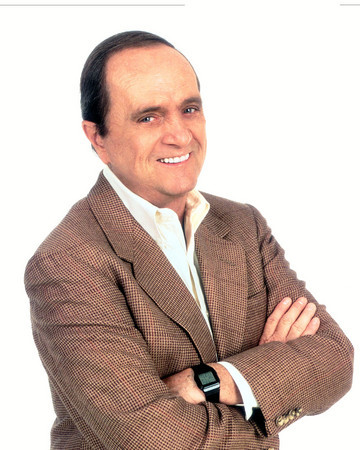
Although Bob Newhart will always be remembered for his two award-winning television series -- "The Bob Newhart Show" and "Newhart" -- his career as a Las Vegas headliner was equally prolific and rewarding.
"Las Vegas was just what everybody aspired to," the legendary funnyman told me earlier this year. "To have a deal in Vegas, you were set for the year. You know, you'd play -- usually contracts were six to eight weeks -- and you'd play a month, two shows a night, seven days a week."
But before he performed in Las Vegas, Newhart made his Nevada debut at Harrah's Lake Tahoe in May 1960.
"I remember when I played Freddie's in Minneapolis, which is now gone, and I was getting $600 a week when this offer came in for Harrah's Club to be the opening act for Peggy Lee. And it was for $2,000 a week, over three times what I was making. And I turned to my manager at the time and I said: 'Do they beat you up between shows? Why would anybody pay somebody $2,000 a week?' "
Newhart continued: "I arrived there and went up to Holmes Hendrickson, who was the entertainment director, and I said to him, 'Am I supposed to lose some of this back?' And he said: 'Oh, God no! No, that's the last thing we want is a performer who's lost all his money at the tables and he's still got two more weeks left on his contract, 'cause he's not a happy performer!' "
Newhart's career received a big boost in the early '60s from his Grammy-winning album "The Button Down Mind of Bob Newhart." He recalled a time in 1963 when he was performing in Austin, Texas, while the album was riding the charts.
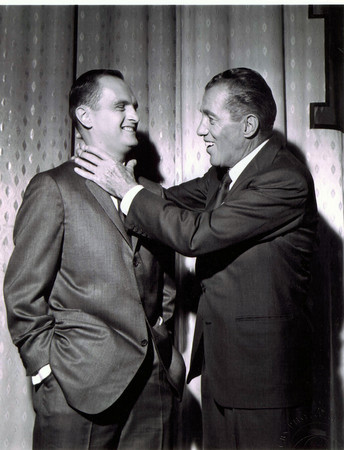
"It went crazy!" Newhart said, chuckling. "Oh my God, and then I was doing a lot of the (Ed) Sullivan shows ... and I remember my wife was pregnant with our son Rob, who was born in November 1963. At the time, Stan Irwin, who was the entertainment director at the Sahara, came to see the show. And he bought me for the Sahara. And after I did the show that night, he and I met afterwards, and I said, 'What should I do in Vegas?' And he said: 'What you just did! That's what they want to see.' "
Newhart made his Las Vegas debut in the Congo Room at the Sahara in early October 1963. His opening act was singer Sergio Franchi. He remembers the time fondly.
"Sergio sent us a baby outfit. And Vegas is supposed to be a town without a heart, you know. I just didn't find that to be true."
There's a likability factor with Newhart. His calm demeanor, his stuttering delivery, his pleasing everyman looks and voice, all contribute to his popularity. And possibly his Midwestern roots created his persona. George Robert Newhart was born in Oak Park, Ill., on Sept. 5, 1929. He went to a Catholic high school and received bachelor's degrees in business management and commerce from Loyola University in Chicago in 1952.
After serving stateside in the Army during the Korean War, Newhart became an accountant for United States Gypsum, then a copywriter for Fred A. Niles, a film producer in Chicago. The employees there would entertain each other by recording their telephone conversations and sending them to a local radio station as audition pieces. Dan Sorkin, one of the local DJs, introduced Newhart to the head of talent at Warner Bros. Records, and they signed him to an exclusive contract. Expanding his one-way telephone calls into comedy routines, Newhart developed his stand-up comedy act and soon became the world's first solo straight man.
In addition to recording, he hosted his own NBC variety show, "The Bob Newhart Show" (1961), which won an Emmy Award, a Peabody Award and a pink slip all in the same year, and guest-hosted "The Tonight Show Starring Johnny Carson" (his first of 87 times) in 1962.
Combining many TV variety show appearances throughout the 1960s with an occasional dramatic turn -- such as the role of Pvt. Driscoll in the 1962 film "Hell is for Heroes" -- Newhart was a familiar face to audiences by the time he appeared in Las Vegas.
"What was wonderful was you'd do a midnight show and get through about 1:30, 'cause they liked it to run an hour and a half," Newhart said about appearing in Las Vegas. "They didn't want it to run an hour and 35 minutes, they wanted an hour and a half exact so that they got a shot at the gamblers, you know. And then you'd go into the lounge at 2 in the morning, because you'd still have the adrenaline rush, and you'd go see Shecky Greene in the lounge at the Riviera, or you'd go see Rowan & Martin in the lounge at the Riviera, or Vic Damone, or (Don) Rickles, and you'd get to bed about 5 or 6 in the morning."
In 1962, comedian Buddy Hackett introduced the 33-year-old Newhart to Virginia "Ginny" Quinn, and the couple wed in January 1963. They have four children: Robert, Timothy, Jennifer and Courtney.
"I watched my family grow up in Vegas," Newhart told me. "We would intentionally take summer shows so that when the kids were out of school, and try and live a normal kind of life."
Throughout the 1960s and 1970s, Newhart played the Strip regularly, including the Sahara, the Desert Inn (from 1967 to 1973, co-billed with Rosemary Clooney, Teresa Brewer and Abbe Lane, among others), the Sands, the Frontier, Caesars Palace and the Riviera. He also played the Golden Nugget downtown.
By 1972, Newhart was starring in the first of his two sitcoms, "The Bob Newhart Show," and his career was consumed with months of shooting in Los Angeles. But he did not give up Las Vegas.
"We'd have two weeks off, I'd run up to Vegas and do two weeks, and then come and do three more weeks of shows. And then in the summer a month (in Las Vegas)."
"And about that time, Vegas was changing, you know," Newhart added, laughing. "I was in both Vegases -- I mean, I played it when 'the boys' owned it, and the one thing I learned was that you never asked the owner what he did before this -- what work he was in!"
Becoming more introspective, Newhart continued: "And then (Howard) Hughes came in, and I was there at that time. I played the Desert Inn. .... And then everything had to pay for itself -- the showroom had to pay for itself. ... It was pretty much a bottom line."
I asked Newhart about his craft, such as the challenges of doing two shows a night. "You would vary it for your own sake," he replied. "I mean, you know, it was truly a different audience, so you could do the same show. Singers have a set act because the musicians have the music, and they can't suddenly say, 'I think I'll do 'Birth of the Blues,' because the musicians would be scrambling for the charts! But as a comedian you could say, you know, 'I don't think I'll do 'The Driving Instructor.' I think I'll do the 'The Cruise Ship.' There is a freedom."
But with freedom comes the potential for chaos, especially if a comedian doesn't keep track of the things he's saying and repeats a joke.
"It isn't so much the performance, it's the concentration that eventually wears you out ... to be on top of it night after night after night. ... Singers can hide behind arrangements -- 'I like this arrangement' or 'I hate this song.' But a comedian -- you're kind of out there, you know. They're not responding to you, you can't hide behind anything," he said.
And not everyone in his audience intended to be there.
"The front row (of the theater) was always the casino's," Newhart recalled. "The casino controlled the front table. And, you know, a guy would drop $100,000 or something, and they'd say, 'How would you like to see Bob Newhart tonight?' you know. And the guy would be there and he wouldn't even look up during the show. He'd be going: 'OK. I got $2,500 equity in the car ... OK, now what do I have -- $11,500 in the house ...' The last thing he wanted was for me to make him laugh."
Newhart would continue to make club appearances across the country for many more years, and after his two TV series ended, he would guest star on television shows (recurring roles on "ER" and "Desperate Housewives"). He also appeared in movies, including a standout performance in 1970 as Maj. Major Major Major in Mike Nichols' "Catch-22."
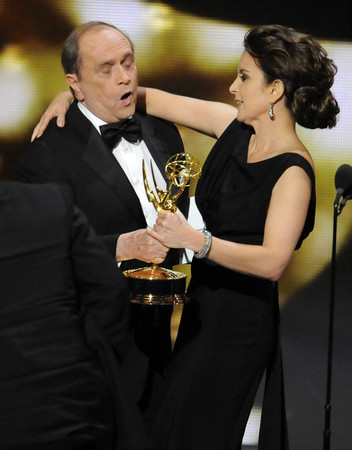
Newhart is the recipient of numerous industry awards such as the Kennedy Center Mark Twain Prize for American Humor. He also has won six Emmy Awards and a Golden Globe. He has a star on the Hollywood Walk of Fame, and in 1993, he was inducted into the Academy of Television Arts & Sciences Hall of Fame.
As we wrapped up our interview, Newhart gave me his thoughts about comedy and comics in general, and why these gifted people do what they do. When I asked him if he felt that comedy was a balm for tragedy, he said: "It kind of helps you get past a terrible moment and get on with life. And I think that's what we comedians do -- we help people get past things."
READ MORE
Longer versions of stories in Stephen Michael Shearer's Legendary Las Vegas Headliners series can be found online at www.reviewjournal.com/ legends/