Serious Business
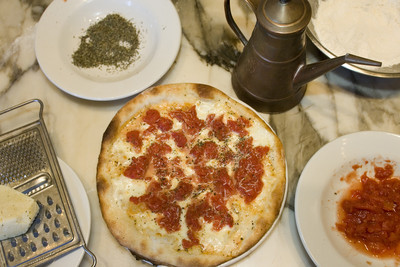
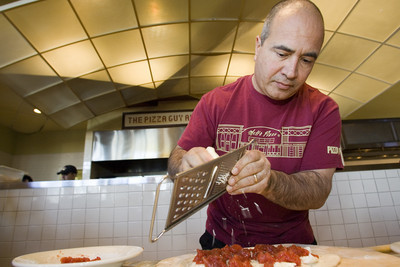
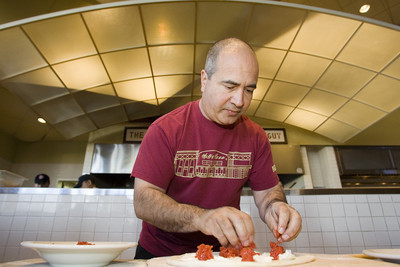


A course on pizza-making will be taught at the University of Nevada, Las Vegas, next semester.
It's not, as you might expect, a recreational class of the continuing-education type. This is an accredited course, among the offerings of the food and beverage management department in the College of Hotel Administration. Which puts it right up there with courses such as food service sanitation and hospitality purchasing.
And it was, as of last week, at full capacity.
The course will be taught by John Arena, co-owner of Metro Pizza. Arena "is passionate about what he does" -- which, as you'll discover, is a gross understatement -- said department chairman Pat Moreo. He also is well-educated, Moreo said. And the course will further the school's mission of combining management principles with hands-on experience.
Arena said the course, which will include "a little anthropology, a little sociology," came about partly through discussions with UNLV administrators who frequent the Metro Pizza restaurant near campus at 1395 E. Tropicana Ave., which, like the company's Henderson outlet, does offer recreational pizza-making classes to the public. Arena said their conversations centered on the evolution of the pizza industry and the quality of pizza education in most culinary schools.
He knows whereof he speaks. Arena has taken continuing-education classes at culinary schools, and "even when the subject was Italian cooking, they didn't have a thorough understanding of our craft, and they didn't respect it," he said. There was, for example, the class at the storied Culinary Institute of America that spent eight hours on the preparation of rabbit and 45 minutes on the preparation of pizza.
"And there's a lot more people in this country eating pizza than there are rabbit," Arena said. "Why wouldn't you give it the same kind of attention? There's no solid foundation of education for pizza-makers beyond apprenticeship, and even that's getting lost."
He has seen the results of what he calls a "French-centric" emphasis in most of the nation's culinary schools. Even though in the past decade more and more non-Italian restaurants -- some of them upscale -- have been putting in wood-fired ovens and adding pizza to their menus, "they put the low man on the totem pole on the pizza station," Arena said. "Then they try to work their way out."
Which is an affront to the son and nephew of pizza-makers, since "in a pizzeria, that's a position of honor."
Arena's ancestors came to America from Naples and Calabria in Italy. The first family business was produce.
"Like a lot of families, that evolved into an espresso bar," he said. Those may seem a little commonplace now, but in 1961, they were rarely seen outside Italian neighborhoods. Before long, the espresso bar evolved into a pizzeria, in Garden City, on New York's Long Island.
It was there that Arena and his cousin and partner, Sam Facchini, first started making pizza in 1967. They were ages 13 and 12, respectively.
"Every day we'd walk to the pizzeria and talk about how we were never going into the pizza business," Arena said. But when he graduated from Adelphi University in 1980 with a degree in communications, jobs in his field were scarce. The day after graduation, he and Facchini moved to Las Vegas and opened a pizzeria, and it almost seemed like it was meant to be. By then, Arena said, "we'd fallen in love with what pizza meant to people, how it resonated with people."
Their first pizzeria was at Tropicana Avenue and Sandhill Road, and in 1980, kids rode there on their horses, moving the Brooklyn-born cousins to wonder what in the world they'd done.
But Las Vegas' population -- which did and continues to resemble nothing so much as a big international buffet -- had something to teach them.
"Although we were very New York-centric, there were people from all over the country who had similar feelings about their (hometown) pizzeria," Arena said. "We needed to understand and appreciate all of that. You can't argue with people's associations about what is authentic. We became less New York-centric."
Travels across the country helped expand that. They examined other regions' pizzerias, "what they did and how it was special."
So did trips to Italy.
"The pizza of Rome is not like the pizza of Naples," he said, "because the people of Rome are nothing like the people of Naples."
Along the way, Arena made a lot of observations about the evolution of pizza -- which is where the anthropology and sociology comes in. Pizza-making tradition in the United States developed not from all Italians, but from Italians who came from the part of Italy where pizza was made. He pointed out that while New Orleans had a wave of Italian immigrants in the 1890s, it's not known for its pizza because the majority of them were Sicilian and pizza wasn't made in Sicily in the 1890s. San Francisco became known for its Italian seafood and salami because most if its immigrants came from Liguria and Genoa.
When a customer asks if Metro serves pepperoni rolls, Arena likes to ask, "What part of West Virginia are you from?" because they were baked there by immigrants from Calabria who had been recruited to work in the mines and needed a snack that was easy to pop into a pocket or lunchbox.
And coal-fired ovens are popular in New York pizzerias because that was the fuel that was readily available and affordable to immigrants.
Which brings us to another of Arena's favorite subjects: dispelling pizza myths. Those New York pizzas were baked on stone, which, he said, is more important than the source of heat, because it sears the crust and pulls moisture out of it (although coal-fired ovens are known for making crisper pizzas that are more charred).
And as for stories about people importing water to ensure a perfect crust, he scoffed. "Pizza-makers in Brooklyn say you can't make a good pizza in Manhattan because the water's no good. The key ingredient isn't the magic water. If you got a great artisan baker in New York and plopped him down in Denver, he's going to make great bread."
While Arena said he respects people who are trying to strictly honor age-old Italian tradition, he noted that pizza has had a 100-year history in this country and that even in Italy it continues to evolve. When he was in Rome a few months ago, he said, the most popular pizza was artichoke with fresh mayonnaise, and pizzarias were posting signs that bragged of the long fermentation times of their dough, which deepens the flavor and tenderizes the crust.
Then there's what Arena calls the "mock rivalry" between New Yorkers and Chicagoans, who both insist their pizza is the "right" one.
"People should come in with an open mind," he said. "We think our touchstones define the real thing. It's about loving what you do and treating it with respect."
If the development of a college class on the subject seems to reflect that we're taking pizza more seriously, it may actually be a smaller part of the whole.
"It seems to be kind of a trend in all of food these days," said Brad Otten, owner of Settebello, a Henderson pizzeria that's one of a handful in the country to receive the Vera Pizza Napoletana designation from the Italian government for its strict adherence to Neapolitan tradition.
"There's a big group of people who are into not just authenticity but people who make things in general with great ingredients and that take their time and do things right," Otten said. "I definitely think pizza's a big segment of that."
So does Arena, who's clearly a man on a mission.
"If we can create another generation of pizza-makers who take the craft seriously," he said, "maybe people will understand that pizza isn't supposed to come out of the trunk of a car."
Contact reporter Heidi Knapp Rinella at hrinella@reviewjournal.com or (702) 383-0474.