Shining light on Hanukkah


When Kristen Silberman converted to Judaism five years ago, the first Jewish holiday she celebrated was Hanukkah.
Because Silberman was raised in the Episcopal Church, she was accustomed to the commercial hubbub -- the trees and lights and other secularized seasonal trappings -- surrounding Christmas. But, she says, "I went out to see what decorations you do for Hanukkah, and there was nothing."
Not anymore. These days, it's hard not to find reminders of Hanukkah, the Jewish festival of lights, in the American marketplace. Department stores from Target to Neiman Marcus offer "some nice, expensive menorahs," Silberman says, as well as decorations -- place mats and the like -- with blue-and-white motifs, representing the colors of the Israeli flag.
"If you go looking around neighborhoods, you see many houses that are (decorated in) blue and white lights," Silberman adds.
Signs of creeping commercialism? Or just a sign that, like that other holiday that rolls around this time of year, Hanukkah has found a place in America's public consciousness.
Both, maybe, and neither, depending on whether you think Hanukkah, like Christmas, may be becoming a tad too commercialized for its own good.
Hanukkah -- which this year begins at sundown Tuesday -- traces its roots to about 165 B.C., when the Jewish people rededicated the temple in Jerusalem after a period of many years during which they were prohibited from practicing their religion. And, when they could find enough oil to light the menorah for only one day, the oil miraculously lasted for eight days.
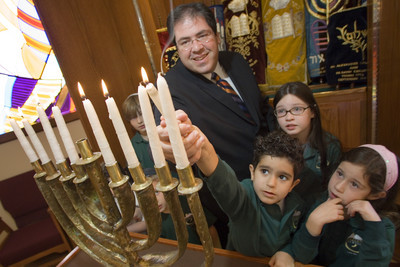
It's that miracle and a celebration of Jewish identity, standing up for what one believes in and religious freedom that Jewish people remember when they light the menorah during Hanukkah's eight nights.
Yet, Hanukkah is "a very minor holiday," notes Rabbi Sanford Akselrad of Congregation Ner Tamid. "It was never on a par with any major holidays such as Rosh Hashana or Yom Kippur."
Rabbi Shea Harlig of Chabad of Southern Nevada notes, too, that Hanukkah -- unlike such holidays as Passover -- doesn't appear in the Hebrew Bible.
But none of this has stopped Hanukkah from becoming the most recognizable holiday on the Jewish calendar, certainly among people who aren't Jewish and maybe even some who are. According to Harlig, some studies indicate that more Jews participate in Hanukkah celebrations than in services for such biblically based holidays as Sukkot.
Hanukkah's high public profile is owed, first, to the evolution of the Jewish people. Historically, Akselrad says, "Jews lived in concentrated areas, not by choice but because of persecution. So there were Jews in ghettos, there were Jews in shetls, there were Jews in villages."
When that began to change during the late 1700s and early 1800s, and when Jews began to live wherever they wanted, Akselrad says, more people became aware of Jewish holidays.
In the United States after World War II, when Jewish people became fully integrated into American society, Akselrad says, it was their desire to assimilate -- as well as, perhaps, "social pressure on the part of the Jews to compete with Christians" -- that put Hanukkah more fully into the general public consciousness.
Just as significant is the fact that, unlike Yom Kippur, Rosh Hashana or other major Jewish holidays, Hanukkah takes place around Christmastime. That, for good or bad -- most Jewish people certainly would side with "bad" -- has created the notion among non-Jews that Hanukkah is a sort of "Jewish Christmas."
Granted, it does share one similarity to Christmas: It is an occasion for giving gifts. However, traditionally, Hanukkah's gifts primarily involved the giving of gelt -- real or candy coins -- to children, in a tradition Harlig says dates back hundreds of years.
But, from that simple practice, Hanukkah gifting -- just like Christmas gifting -- eventually got bigger and more extravagant. Because of Hanukkah's proximity to Christmas, "Jewish kids felt left out," Akselrad says, "and Jewish parents felt a need to compensate, and there come the (Hanukkah) presents."
For those whose memories are of more low-key Hanukkahs, an extravagant, full-tilt Hanukkah can be confusing. Rabbi Felipe Goodman of Temple Beth Sholom admits to being "perplexed by the commercialization of Hanukkah."
When Goodman was growing up in Mexico, Hanukkah was "just another holiday," he explains. "I got a couple of checks from my family as gifts, but we didn't exchange gifts. There were no Hanukkah cards. This is all new, and this is all American."
In fact, he adds, "you go to other places in the Diaspora outside of the United States, and you find Hanukkah is a beautiful but low-key celebration."
Akselrad concedes that the fear of a too-commercial Hanukkah probably is "more of a clergy concern than a parent concern. The clergy has always tried to emphasize the religious message of the holiday."
Yet, Goodman says he does hear from parents who "are concerned it's getting out of hand" and seek ways to return Hanukkah more fully to its religious underpinnings.
Silberman knows of no family that completely eschews Hanukkah gift-giving. However, she does know parents who choose to give their kids smaller gifts during the festival's first nights and a more substantial present only on its last.
Leora Blau, who grew up in Queens, N.Y., remembers her parents giving her one gift for each night of Hanukkah. But, she adds, the gifts tended to be small -- leggings or a leotard for dance class, markers, coloring books and the like.
For many years, Blau gave her own kids "that one big gift" each year for Hanukkah. This year, she's returning to her parents' tradition: Giving each one a small gift -- a Starbucks gift card, a carwash, "little, tiny things" -- each night, with a more substantial gift reserved for Hanukkah's final night.
Blau has heard stories of parents who give kids incredibly expensive gifts -- iPhones, PlayStations and such -- for Hanukkah.
"Does it exist? I'm sure that it does," she says. "But I don't know anybody who does that."
Blau also makes it a point to incorporate into her own family's Hanukkah celebration the traditions of her youth -- lighting candles, saying blessings, eating traditional foods and offering tzedakah, or charitable contributions to others.
And that could be a fine start for parents who wish to scale back a Hanukkah that has gotten out of hand.
Akselrad suggests a family might start a tradition of taking the charitable offerings they've collected during the year and gifting it to a charity. Harlig suggests parents might incorporate in their Hanukkah celebration a retelling of Hanukkah's origin and its significance as a celebration of Jewish identity and freedom. And, in keeping with the festival's candlelighting theme, Akselrad says children might make candles for the family menorah, or even clay menorahs themselves.
This year, Goodman is starting a Hanukkah tradition of his own: He's writing a Haggada for Hanukkah to tell the story of the holiday and its meaning, much in the same way as the Haggada text that's recited during Passover.
In keeping with Hanukkah's theme of Jewish identify and freedom, he has included in it "profiles in Jewish courage."
"For each candle," he says, "I'll talk about a different Jew in a different era who stood up for the right to defend his or her identity, so people understand the value of Jewish identity."
Contact reporter John Przybys at jprzybys@ reviewjournal.com or (702) 383-0280.