Sites serve as a resource for aspiring green thumbs





Growing plants in the valley can seem daunting. But more than a century of practice has led to some tried and true techniques, and there are a few places to learn them for little or no money.
“We offer research-based programs,” said Marilyn Ming, marketing/public relations specialist for the University of Nevada Cooperative Extension. “There are some classes with some cost recovery, but most are free. We have children’s youth and family programs covering topics like health and nutrition, water use, horticulture, economics and environmental programs.”
Those classes are in addition to more nuts-and-bolts sessions teaching how, when and what to plant and how to nurture plants to full growth. The classes are taught primarily at the Cooperative Extension Research Center & Demonstration Orchard, 4600 Horse Drive, and the Lifelong Learning Center, 8050 Paradise Road. The Cooperative Extension is affiliated with the University of Nevada, Reno.
“Each state has a cooperative extension that is housed under the state’s land grant university,” Ming said. “In Nevada, that’s UNR. The program started out with mostly agricultural and economics studies. Over the years, it’s evolved to more of an urban gardening programming as the community has changed.”
Master Gardeners also teach many classes in the community at churches, community centers, after-school programs and other places.
The Cooperative Extension usually doesn’t announce these events, as they are often tailored for the particular community served. Groups interested in scheduling a class should contact Ming at lvmastergardeners@unce.unr.edu.or 702-257-5555.
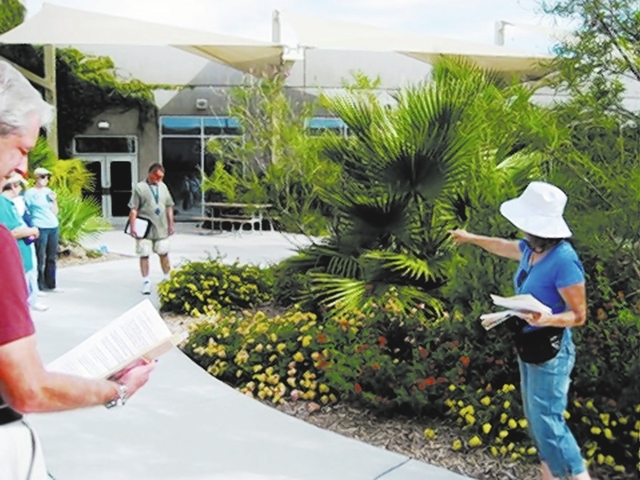
“I’ll find out what you’re looking for and see if we can connect you with an expert and work out a schedule that works for the group and the instructor,” Ming said. “We also have garden tours at the Lifelong Learning Center on Fridays at 10 a.m. and special monthly tours that focus on a specific subject.”
For more information about the Lifelong Learning Center, visit www.unce.unr.edu or contact Ming.
Ann Edmunds is the Master Gardener coordinator at the center. She explained that the Mojave desert offers some challenges that aren’t found in many other places, including the heat, soil and geological makeup of the valley.
“The main challenge is water,” Edmunds said. “Many people don’t understand how to water correctly. We get 4 inches of rain in a good year, and the amount of water we lose to the atmosphere is 81 to 82 inches. That means we have to irrigate everything, except the established native and desert-adaptive plants.”
For an example, she cited trees that may require 30 to 50 gallons of water two or three times a week. She has seen homeowners attempting to water trees with pop-up sprinklers when the appropriate equipment is a drip irrigation line with multiple drip heads encircling the tree.
“A sprinkler is good at irrigating the top 4 to 6 inches — maybe as deep as 8 inches,” Edmunds said. “Trees need to be watered long and deep, not short little pops. You need to wet the whole root ball.”
She said even when the hardware for irrigation for a tree is properly set up, she often sees trees under-watered because people are used to sprinklers, which run for a few minutes once or twice a day.
“If you have a 1-gallon drip emitter and run it 15 minutes, that’s a quarter-gallon of water,” Edmunds said. “That’s not nearly enough to get to the roots.”
Many of the valley’s gardens are in raised beds because there is a lot of caliche, a hard, cement-like compressed soil. The soil around homes can include building materials, such as concrete, lime, nails or other nonorganic material.
Raised beds also make it easier to reach the surface for hand gardening. They offer a place to add nonnative or amended soil. The valley’s soil is not conducive to growing anything but native or desert-adaptive plants.
“This used to be an ocean back in the day, and our soils here are very salty, which is hard for plants to deal with,” Edmunds said. “It’s also very alkaline, so at the very least, you’ve got to amend the soil with fertilizer. A lot of people just start with completely fresh soil from somewhere else.”
Rock mulch has replaced lawns in many places in the valley, and while it is a water saver, it also exacerbates the valley’s natural heat, cooking plants before they can grow.
“Wood mulch can keep things cooler and a little bit moister, but it does have to be refreshed every now and then with fresh mulch,” Edmunds said. “When you look at your yard, you can’t think of it as a single environment. You need to think about micro-climates, such as areas that get full sun, partial shade, areas that are more exposed to wind or receive water from runoff. There are a lot of variables.”
Edmunds asserted that if you choose the right plant for a compatible climate and provide the appropriate amount of water, you would be well on the way to a successful garden.
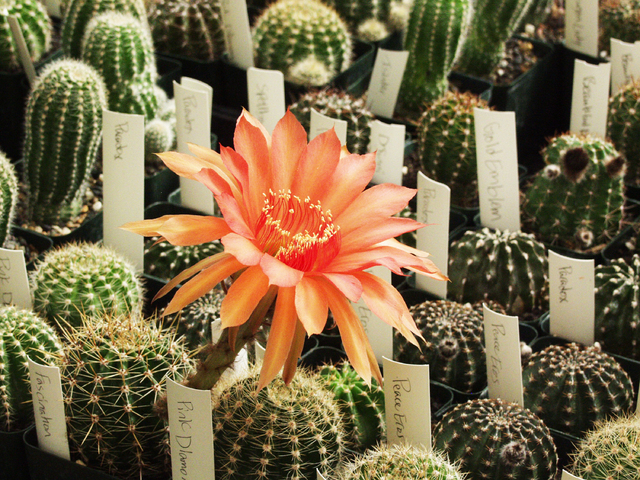
Most of the valley’s gardening clubs meet at Lorenzi Park, 3343 W. Washington Ave. This includes the Cactus & Succulent Society of Southern Nevada, but twice a year, the group gathers for the two-day show at Moon-Sun Cactus & Koi Gardens, 6430 McGill Ave., to show off its best and brightest.
Susan Kent is the president of the society and the manager of the commercial Moon-Sun Cactus & Koi Gardens. The group just had its spring event and is already gearing up for its fall event but has not scheduled the dates for it.
“We get together once a month, and we usually have a guest speaker and raffles,” Kent said. “Our numbers have been down, but we’re rebuilding them. Our last meeting had about 20 people, which is decent.”
Group members share growing tips and may bring their potted cactuses and succulents to the meetings, which speaks to the hardiness of the plants.
“Many of our members are older, so the society is less active than we should be,” Kent said. “We’re trying to recruit some younger members, but it’s not easy to find young people who are interested in gardening. Once they realize how rewarding and relaxing it is, I’m sure they’d take to it.”
Kent’s job allows her to think about her hobby more than many occupations do, and it also puts her in position to share her passion for plants with her customers.
For more information about the Cactus & Succulent Society of Southern Nevada, visit csssn.org. For more information about the Moon-Sun Cactus & Koi Gardens, visit tinyurl.com/moon-sun-cac or call 702-645-2032.
To reach East Valley View reporter F. Andrew Taylor, email ataylor@viewnews.com or call 702-380-4532.