UNLV’s first football coach dies
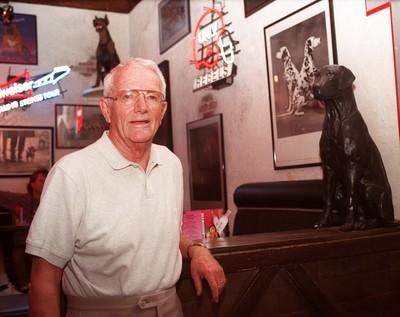



Bill Ireland, who had a profound impact on UNLV athletics as the Rebels' first football coach and later as the athletic director who hired Jerry Tarkanian, died Tuesday in Reno.
Ireland, 80, died at 4:10 p.m. at St. Mary's Regional Medical Center. The cause of death was not given, but he had suffered from poor health for a while.
"I'm kind of numb right now," said Bill Daniel, an assistant under Ireland from 1968 to 1971 and now the radio analyst for UNR football. "It's the blessing in disguise. He was having a hard time on this planet from the standpoint he was such a gregarious person and an outgoing person and he was a shell of who he was."
Ireland was a giant at UNLV, where he coached from 1968 to 1972 and was AD from 1973 to 1980.
He was part of the UNLV Hall of Fame's first class in 1987 and was named to the Southern Nevada Sports Hall of Fame in 1999.
"I doubt seriously they would've had football at that stage if Bill hadn't been there," said Brad Rothermel, UNLV's athletic director from 1981 to 1990 and now a special adviser to the AD.
Ireland coached UNLV's first football team, leading what was then Nevada Southern to an 8-1 record in 1968. It was the best showing ever for a four-year school playing its first season against other four-year institutions.
"He was the founding father of UNLV football," said Greg Brown, a wide receiver under Ireland.
Ireland's team was a success from the beginning, defeating St. Mary's College 27-20 on Sept. 14 before about 8,000 fans at the old Cashman Field.
"He was one of those guys that was a real father figure," said Bill Casey, the school's first quarterback. "He wasn't a yeller or a screamer. He was just a real solid coach with a very innovative mind."
Casey said Ireland relied heavily on the quarterback that first season, mostly because Casey, who began at California, had college football experience and was the team's only senior.
"Coach kind of turned over the reins to me, in a sense," Casey said. "Back in those days, the quarterback was still calling his own game. Then when Coach wanted to run something, he'd send in a play.
"We had a such a special relationship that really transcended football."
In 1969, the Rebels met UNR for the first time, losing 30-28. But Ireland, Daniel and assistant Doug Carder almost didn't make the trip up north.
They were the last ones to board the commercial flight and were told there were no more seats. Ireland began to argue, when someone from the front of the plane spoke up to ask what was wrong.
It was then-Gov. Paul Laxalt, who got off the plane and walked across the tarmac to a phone. About 15 minutes later, a larger plane arrived.
"Ireland was a very high-profile individual," Daniel said. "Everybody knew Bill."
UNLV won the rematch the following season 42-30 to claim the Fremont Cannon, the first time the trophy was awarded in the rivalry. The cannon was also Ireland's idea.
Over a five-year stint, he went 26-23-1 with the Rebels.
Brown said Ireland wasn't the stereotypical coach who believed all players should fit into the same mold.
"It was the '60s and I had hair down to my waist and wore an American flag as a head band and a had a huge mustache," Brown said. "He let us be individuals, but within the team concept."
Ireland was at UNR before taking over at UNLV. He considered his decision to leave the Northern Nevada school in 1967 for an upstart program to the south an easy choice.
"I'm a native Nevadan, and it was very obvious to me at the time the real future in my profession was in Las Vegas," Ireland, who was born on April 29, 1927, in McGill, once said. "It was that type of community where it could be done.
"It was everything I expected it to be. It had some ups and downs, but in the long haul, it was a great place to raise our family and a great place to work."
Ireland took over as athletic director in 1973. He left a lasting legacy by hiring Tarkanian -- who turned the Rebels into a national basketball power -- and in the construction of the Thomas & Mack Center.
Plus, Ireland was instrumental in leading UNLV football into Division I in 1978.
A memorial service is expected next week in Reno, where Ireland had lived the last four years.
He is survived by his wife, Jeanne; daughters, Christopher, Kerry, Kim Carano, and Kelly; sons, Michael, Patrick, and Terrence; daughter-in-law, Lucinda; sons-in-law, Joe Herold and Davis Masten; and 16 grandchildren.