Home Subscribe
Jobs Cars Homes Shopping Travel Weddings Golf Best of Las Vegas Photo
.
Member Center

Recent Editions
TWThFSSuM
>> Complete Archive
>> Search the site
.
.
.
.
OPINION
.
.
.
.
.
.
.


Sunday, February 15, 2004
Copyright © Las Vegas Review-Journal

VIN SUPRYNOWICZ: Dairy farmers ask, 'Got free speech?'


On Jan. 12 in Philadelphia, Institute for Justice attorney Steve Simpson argued the case of dairy farmers Joseph and Brenda Cochran of Westfield, Pa. -- about a mile from the New York state line -- before the 3rd U.S. Circuit Court of Appeals.

The Cochrans are suing the federal government for requiring them to participate in the dairy promotion program. You've seen those ubiquitous "Got milk?" ads on TV and billboards? Well, the Cochrans are asking, "Got free speech?"

The Cochrans say they're charged about $4,000 per year -- which they can ill afford because they're already losing money -- for generic advertisements that actually obscure the distinctions between their traditional farming methods and those of large-scale dairy producers.

The case could have major implications for the similar programs promoting a wide variety of agricultural products including the, "Ahh, the power of cheese," "Beef, it's what's for dinner," and "Pork, the other white meat" campaigns, IJ attorneys say.

(In fact, Congress has become so enamored of this form of central agricultural planning that in the past two decades Washington has created federally supervised "promotional programs" for products as wide-ranging as beef, pork, honey, potatoes, watermelons, mangos, kiwi fruit, limes, fresh cut flowers, peanuts, popcorn, pecans, soybeans, avocados and wool ... to name just a few.)

Dairy farming has been in Joe Cochran's family for three generations, and the couple has tried to move their operation back to the way it was done in the old days.

As "traditional" dairy farmers, the Cochrans allow their cows more room to graze and move around, and they don't use bovine growth hormone. They herd about 150 Holstein (and some Jersey and Normandie cross) cows on roughly 900 acres of land, 200 of which they own -- grazing the herd outdoors from spring through fall, feeding them corn silage in the winter.

In the Cochrans' view, these traditional methods result in healthier cows, easier calvings, lower veterinary bills (with less use of antibiotics), a cleaner environment and a superior product.

The Cochrans thus have every reason to want to distinguish their product from that of larger-scale producers. But the Dairy Act compels them to do just the opposite. It requires them to fund generic ads whose message is that all milk is the same, regardless of who produces it or how.

Under the Dairy Program, all dairy farmers are charged for the ads at a rate of 15 cents per "hundredweight" (100 lbs.) of milk they sell.

The Cochrans don't even have the option of not sending in a check, they explained when I called them a couple weeks ago. Rather, the payments they receive from their milk processor simply have their "Got Milk?" advertising contributions already deducted -- kind of like payroll withholdings.

The program was voluntary until the mid-1980s, when it suddenly became mandatory, Brenda Cochran explains.

"When we started milking our cows in 1975 we didn't know our First Amendment rights were going to be taken away. ... We're not allowed as producers to vote on this. The co-ops carry all the weight through their bloc votes -- we're perfectly willing to see this put to a vote of all individual farmers. ... It's wrong for the federal government to force this scheme on people who don't want to participate."

Institute attorney Simpson points out, "The U.S. Supreme Court long ago held that the First Amendment does not allow government to compel individuals to speak, just as it does not allow government to prevent them from speaking. Speech wouldn't be free if government could require people to convey officially sanctioned messages. The same principle applies to compelling people to pay for speech with which they disagree."

In fact, Thomas Jefferson once warned that, "To compel a man to furnish contributions of money for the propagation of opinions which he disbelieves and abhors, is sinful and tyrannical."

Weirdly enough, the Cochrans initially lost in a lower court based on legal logic that says the government can regulate their freedom of speech, since the government already regulates them so heavily in other areas. (In 1997, the U.S. Supreme Court upheld a federal law that required producers of California peaches and nectarines to subsidize a collective advertising program ... because they operate in a heavily regulated industry. But in 2001, the court struck down a program that required producers of mushrooms to do the same ... because they are not as heavily regulated.)

"Courts are telling agricultural producers that as long as the government controls their prices, production, terms of sale and so on, it may as well control their free speech, too," Simpson says. "But two wrongs don't make a right; restricting one kind of freedom -- economic liberty -- isn't license to destroy another -- free speech."

If the federal government is in trouble because its ill-advised, 55-year-old dairy price support program -- which stores tons of dried milk in caves in Kansas while American cheesemakers continue to import casseine and milk protein concentrate from Australia, New Zealand and Europe -- has become a hopeless snarl, the answer is not to require dairy farmers to subsidize a collective advertising program they don't want ... but to end the price support program entirely, and let competition and the free market determine how much milk we buy, and what price it sells for.

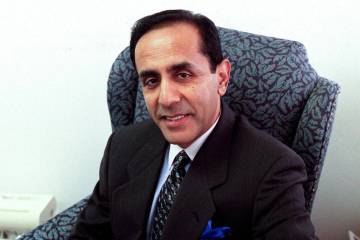
Vin Suprynowicz is assistant editorial page editor of the Review-Journal and author of the books "Send in the Waco Killers" and "The Ballad of Carl Drega." His Web site is www.privacyalert.us.


VIN SUPRYNOWICZ
MORE COLUMNS


Advertisement


Contact the R-J | Subscribe | Report a delivery problem | Put the paper on hold | Advertise with us
Report a news tip/press release | Send a letter to the editor | Print the announcement forms | Jobs at the R-J

Copyright © Las Vegas Review-Journal, 1997 -
Stephens Media   Privacy Statement