Saturday, August 06, 2005
Copyright © Las Vegas Review-Journal
HIROSHIMA: 60 YEARS LATER: WENDOVER'S SECRET
Remote base was perfect site
to maintain cloak over training
for Hiroshima, Nagasaki missions
By PAUL HARASIM
REVIEW-JOURNAL

A replica of the Enola Gay, the plane that flew the A-bomb mission over Hiroshima on Aug. 6, 1945, stands at the Wendover Airport. The 509th Composite Group trained in Wendover in the 1940s for the bombing of Hiroshima and Nagasaki. Photo by Jeff Scheid.

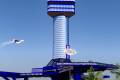
The flight operations and control tower still stands at Wendover Field. Photo by Jeff Scheid.

Concrete pits were designed to help load bombs onto planes at Wendover Army Air Base. Practice runs with bombs known as "pumpkins" were carried out at the base. Photo by Jeff Scheid.

The Enola Gay is located at the Steven F. Udvar-Hazy Center near Washington Dulles International Airport. Paul Tibbets, who led the Hiroshima bombing mission, named the plane after his mother. The plane was serviced at Wendover Army Air Base. *Credit*

The operations tower is seen from a window of the officer's service club at Wendover Field. The officer's club had a gym, bar and dining room. Photo by Jeff Scheid.

Click image for enlargement.

Retired Gen. Paul Tibbets recalls the days at Wendover Army Air Base from his home in Columbus, Ohio. Tibbets, 90, is one of only three surviving crew members of the Enola Gay, the plane that flew the mission over Hiroshima. Photo by Jeff Scheid.

The officers service club was built in 1943. The lights of West Wendover's casinos can be seen in the background. Photo by Jeff Scheid.

These were the airman barracks at the air base. Nearly 20,000 people lived on the base in 1944. Photo by Jeff Scheid.

The B-29 maintenance hangar at Wendover Field shows signs of disrepair in this photo from June 1. The steel-vaulted hangar was constructed in early 1945. Photo by Jeff Scheid.
|
WENDOVER, Utah
On the way into this small border town from the west, Interstate 80 curves downward out of Nevada and toward what has been called the most important airfield of World War II.
As far as the eye can see, the desert's bleached skin stretches tight, a flat, salt-covered lake bed formed thousands of years ago during the final evaporative stages of Lake Bonneville. Wendover sits where this white, crusty sea of alkali -- the Bonneville Salt Flats -- meets hills the color of strong bourbon.
Once, it boasted a single paved road and a gas station with a solitary light that beckoned to night travelers -- an unlikely place, it would seem, for history in the making.
But the seclusion was its draw.
"This was a far more remote area in the 1930s, with such a vast amount of open and flat territory that the Army Air Corps decided it would be a great place for a base and bombing range," said Jim Petersen, director of Wendover Airport and head of the Historic Wendover Airfield Foundation. "Later, during World War II, it afforded the kind of seclusion the government wanted for its secret project that has had a profound effect on the way people think about what can happen in a war."
No history of the dawn of a frightening new age -- the creation and subsequent first use of the atomic bomb on Hiroshima 60 years ago today -- can be told without focusing on Wendover.
Five years after physicist Albert Einstein, worried that Germany might be working on an atomic bomb, urged President Franklin Roosevelt in 1939 to build such a weapon, Wendover Army Air Base became the place where the assembly and delivery of the world's most violent engine of war was perfected.
The 1,800 fliers, scientists, welders, electricians and machinists sent here were part of a program given a deliberately nondescript name: the 509th Composite Group. The group was a direct descendant of the Manhattan Project, the name Roosevelt gave to the development of the atom bomb.
The 509th began operations in September 1944. For 10 months, working in concert with Manhattan Project scientists at Los Alamos, N.M., where the atomic weapons were created, it trained to deliver the "Little Boy" and "Fat Man" bombs that would shorten the war and take more than 250,000 lives in Hiroshima and Nagasaki, Japan.
But only one man stationed at Wendover actually knew the 509th was training to drop nuclear weapons: Col. Paul Tibbets, the unit's commander. Tibbets piloted the Enola Gay, the B-29 bomber he named after his mother that dropped the "Little Boy" A-bomb on Hiroshima.
"For success, for surprise, secrecy was necessary for this mission," the 90-year-old Tibbets said in a recent interview at his Columbus, Ohio, home. "I knew I was to wage atomic warfare to quickly end the war, but it wasn't necessary for anybody else at Wendover to know."
To help ensure that what happened in Wendover stayed in Wendover, 400 undercover federal agents, at the direction of Manhattan Project officials, descended on the area. Mail was monitored. So were phone calls.
"Even though the members of the 509th had only a vague idea of what the mission was, there was always the chance that they could give away information that could be valuable to an espionage agent," Tibbets said.
Tibbets tires easily these days and has refused to do interviews in recent months. The 30-year military man, who retired as a general, agreed to talk with the Review-Journal because he thinks it's important to acknowledge Wendover's role in the war.
Eighty-two-year-old Las Vegan Morris Jeppson, a weapons officer aboard the Enola Gay, knows it must seem inconceivable that the 509th's mission could be kept secret.
"In today's media-saturated world, where secrets leak as easily as water through a paper bag, I suppose it is hard to believe," Jeppson said as he sat with his wife, Molly, at their kitchen table. "But the words 'atomic' or 'nuclear' were never even heard at Wendover. As incredible as it may seem, the actual mission of the 509th was a secret that held until we were in the air and on the way to Hiroshima. We knew we had a special mission but never knew it involved atomic weapons. The country never even knew of the 509th's existence until after the war."
Jeppson, Tibbets and Ted "Dutch" Van Kirk, the navigator on the Hiroshima mission, are the only men still alive from the 12-man Enola Gay crew.
"Wendover has been largely overlooked by people," the 82-year-old Van Kirk said in a telephone interview from his home in Stone Mountain, Ga. "It's a place that should be remembered for having helped save many lives. Thousands more people would have been killed, both Japanese and American, if we had not dropped those bombs. And we learned to do it right at Wendover."
-- -- --
It was Tibbets who made the decision to use the airfield at Wendover as a training base.
When Gen. Uzal G. Ent, the commander of the Second Air Force, named him in the fall of 1944 to lead the nuclear strike force, Tibbets was only a 29-year-old lieutenant colonel.
Up until then, he had been more a man of action than a military planner.
He led the first American daylight raid on Hitler's occupied Europe, as well as numerous bombing strikes in North Africa. Perhaps just as important was this fact: He had led the testing of the B-29 bomber, the plane that military planners designated to drop nuclear payloads.
Tibbets was told by Ent that he could choose between one of three sites for training: Wendover; Great Bend, Kan.; and Mountain Home near Boise, Idaho.
"As I flew down to Utah from Colorado, I was at 5,000 feet, smoking my pipe, and then I saw Wendover," Tibbets said.
"I knew I didn't have to visit the other two bases," he said. "It was desolate, so I figured we'd have few security problems. I knew the men wouldn't like it, but we needed as few distractions as possible. We had a lot of work to do in very little time. When I got on the ground, I saw the runways could handle B-29s and the maintenance facilities were in good shape. As far as I was concerned, there could be no place better."
The air base itself had been built four years earlier. The townspeople, about 100 at the time, were largely rail workers. They had no facilities or commercial skills to support the installation, and they could do little but watch the base grow.
It would cover more than 3.5 million acres, the largest military reserve in the world, and become a self-supporting community. Hundreds of buildings hurriedly were constructed, including hangars, barracks, theaters, schools, a gymnasium and chapel, and a 300-bed hospital.
Bomber groups of B-17 and B-24 aircraft trained here. So did fighter plane crews. These crews participated in the strategic bombing of Germany, flew in support of D-Day and conducted combat operations from the Mediterranean to China.
By the time Germany surrendered in May 1945, nearly 20,000 Army Air Corps personnel had trained at Wendover.
Whatever Tibbets wanted in terms of personnel and equipment, he got. Major Gen. Leslie R. Groves, in command of the Manhattan Project, saw to that.
If anybody had qualms about any of his requests, Groves told Tibbets to utter the word "Silverplate," the code name for the nation's most secret mission.
Though only a select few U.S. leaders knew that "Silverplate" referred to a nuclear mission, all military commanders knew that any debate must stop when the word was used.
Tibbets called on old friends, including Van Kirk, his navigator in the European theater, to join him at Wendover.
"You couldn't say `no' to him," Van Kirk said. "You'd never want to. He was a great leader who really knew what he was doing. He made the Hiroshima mission simple."
Tibbets was right about how the 509th personnel would react to the place. They hated it. Comedian Bob Hope, when entertaining the troops during the winter, had called it "Leftover Field." Crooner Bing Crosby referred to it as "the end of Tobacco Road."
Primitive, ill-heated quarters dampened spirits. Soldiers who received passes did manage to drown some of their sorrows at the Stateline Hotel. The Utah-Nevada state line cut through the lobby. It wasn't unusual for airmen to eat burgers in Utah and gamble and booze it up in Nevada.
The late Jake Beser, a radar countermeasures officer who flew on both A-bomb missions to Japan, didn't mince words in a written evaluation of the base: "If the North American Continent ever needed an enema, the tube would be inserted here at Wendover."
But not knowing why they were brought to Wendover is what bothered the troops most. Many simply had looked forward to going overseas immediately to help end the war. But now they felt that they were miles from civilization with no clear purpose.
To make matters worse, security measures seemed to put a stranglehold on any semblance of normalcy. A wire fence was erected to keep in the personnel. Armed sentries seemed to be everywhere. Without several different passes, it was impossible for a soldier to make his way across the highly compartmentalized base.
Barbed wire barred the entrance to hangars and shops. Warning signs went up all along the perimeter. The largest one, near the exit, read: "WHAT YOU HEAR HERE, WHAT YOU SEE HERE, WHEN YOU LEAVE HERE, LET IT STAY HERE."
And Tibbets repeatedly told the men, both in meetings and printed material, not to say a word to anyone about what they were doing.
Today, Tibbets chuckles at the tactics imposed by the base's security chief, William "Bud" Uanna. He used measures that never could be used in peacetime. He brought in the small army of federal agents, whose job it was to infiltrate the operation and spy on people to make sure there were no leaks.
The agents might be dressed as clergy, janitors, bartenders, truck drivers or simply other military men.
Tibbets wanted personnel to know they were under surveillance.
If a wife phoned her husband to say she was pregnant, Tibbets would have an officer go over to congratulate the airman. The soldier, at first astonished, got the message: Uncle Sam was listening and watching everything he did.
To test security, Tibbets also gave the troops Christmas leaves, or vacations. Soldiers who might be catching a bus often found themselves being questioned by personable strangers, really FBI operatives, about what they did in the military.
After reading the reports of agents, if Tibbets thought a soldier revealed too much, he sent off telegrams ordering the unsuspecting soldier back to Wendover.
When the airman got to the commander's office, Tibbets would read off contents of a conversation that the stunned airman thought he had with a priest in a bus station. Why, Tibbets would growl, would the airman tell a stranger he was on "some kind of special mission" when he was told not to say anything?
Most of the wayward soldiers simply received a chewing out and were confined to quarters for a couple days. Tibbets said, however, that he did send some airmen with "big mouths" to Alaska for the duration of the war where "they could talk with polar bears to their heart's content."
Tibbets found he often had to lie to his family about what was going on at the base, something he believes ruined his marriage to his first wife, Lucy. But one lie still makes him laugh today.
"These scientists were out here in white coats, and when Lucy asked me who they were, I told her they were sanitary engineers," he recalled. "So one day when she had a stopped-up sink, she called for one of them to come in and help her. Fortunately, the nuclear physicist knew how to do it."
Shortly after the 1944 Christmas leaves were up, Tibbets decided that the 509th needed a little information to boost morale. He gathered the entire unit together and told them they were part of a special mission that could be going overseas to end the war.
"Everyone was really serious then," Jeppson recalled. "We had great camaraderie."
Problems with lifting large bombs into an aircraft were overcome at Wendover. Pits were constructed with hydraulic lifts to move the huge bombs into the plane. Challenges with electrical fusing, ballistics and bomb assembly procedures were surmounted. It was painstaking work, done day after day by teams around the clock.
Practice bombs weighing 5 tons, which were called "pumpkins," were dropped daily by B-29 crews from six miles up. The bombs were the same size, shape and weight of the expected atom bombs under development.
Tibbets pushed the crews until they consistently could hit targets within 25 feet of the bull's-eye, an astonishing feat given the technology of the day.
Tibbets also made the B-29 pilots constantly practice 155-degree diving turns after dropping a bomb. He dared not tell the pilots why. During his first visit to Los Alamos, the director of the Manhattan Project lab there, J. Robert Oppenheimer, warned Tibbets that the bomb's shock wave might crush the plane, even when it was flying at 30,000 feet.
In "How to Drop an Atom Bomb," an article Tibbets wrote after the war, he revealed that he designed the steep turns to get out of the lethal zone ahead of the explosion, trying to outrun the supersonic shock wave before it ripped apart the bomber.
The B-29s flying over both Hiroshima and Nagasaki were battered, but not broken, by shock waves.
"To be honest, I didn't know whether the strategy would work or not," Tibbets said. "Neither did Oppenheimer."
By late spring of 1945, Tibbets was convinced the 509th was ready for its mission. When Germany surrendered in May, he knew Japan would be the target for the atomic bombs. In June the entire 509th was on the Pacific island of Tinian, training for the nuclear strikes.
When Tibbets and his crew took off at 2:45 a.m. on Aug. 6, 1945, from Tinian to drop the first nuclear bomb on Hiroshima 6 1/2 hours later, the B-29 bomber they were flying had been used on training missions at Wendover.
So precise was Van Kirk's navigation that the Enola Gay, after a 2,000-mile, 6 1/2-hour flight, arrived only 15 seconds late over its target.
"During the initial time of our 10 months of training at Wendover, I thought our first two targets would be Berlin and Tokyo," Tibbets said. "Even I didn't know where we would go. When I was first given command of the 509th, I had a mission where the targets had yet to be named and the bombs had yet to be built. There was even talk that we may need 50 atomic bombs to end the war. That's why we had so many crews training to drop the bombs."
A crew trained by Tibbets at Wendover bombed Nagasaki on Aug. 9 when Japan refused to surrender unconditionally after the Hiroshima bombing.
Even after Nagasaki, the Japanese didn't surrender immediately, so a third atomic bomb was sent for by Tibbets.
Surrender, however, came on Aug. 14, 1945.
It was only afterward that the full history of Wendover was revealed.
-- -- --
On a June day this year, sun streamed in the windows of the rusted Wendover hangar where the Enola Gay once was serviced. Jim Petersen, who wants to turn the air base "into the best military museum in the country," said he often stands right where mechanics worked on the huge B-29.
"I know it sounds strange," he said. "But this place talks to me. I can hear Tibbets talking to his men, getting them ready. I can see the looks on the faces of the men, wondering what they're going to do. It must have been something, preparing for a mission that you really didn't have a clue about."
As head of the Historical Wendover Airfield Foundation, Petersen finds it incredible that the buildings that were at the Wendover base when the 509th was there are being allowed to fall into further disrepair.
"This is such an important part of history," he said, showing a visitor around a small museum at the base. "I can't believe we're just going to let it all fall apart and forget what was done here. Surely there is some money to save an important part of history."
Petersen often attends reunions of the 509th. This weekend, one is being held in Washington, D.C., where the Enola Gay is permanently on exhibit at the National Air and Space Museum's Steven F. Udvar-Hazy Center near Washington Dulles International Airport.
At Wendover Airport, Petersen envisions a restoration that would allow people "to see what preparation for end of the war" was like. Vintage airplanes would be on site. Tourists could see how the primitive bomb pits were used to load dummy atom bombs onto planes. Tours would be conducted by individuals in World War II uniforms.
Used sparingly by the military after the war, the base officially was given up by the Air Force in the 1970s. Fewer than 10 of the original 668 buildings at the base remain. The stark scene appeals to some filmmakers. Portions of "Con Air," with Nicholas Cage, were filmed here.
Chartered jets now land daily at this airport, bringing people from throughout the United States for gambling at West Wendover's six casinos.
Though attempts to make Wendover and West Wendover one community in Nevada have failed, the area is flourishing. In 1991 West Wendover was incorporated; 18,000 gaming visitors arrive each weekend.
More than 6,000 people now live in the Wendover-West Wendover area. There are new schools, new neighborhoods, a golf course and a recreation center, a far cry from the grim Wendover of 60 years ago.
On the Nevada side, a rock pedestal topped with a small replica of the Enola Gay sits in front of the Wendover USA Visitors Center. It's one-10th of the size of a mechanical cowboy down the road that welcomes people to gamble.
"I'd have to say that the Wendover air base was a lot more important than people think, if they even know about it," Tibbets said. "It got us ready to go to the Pacific, to Tinian island in the summer of '45 so we could fly off to Japan and win the war. We shook the world. I think that defines important, don't you?"