Saturday, March 26, 2005
Copyright © Las Vegas Review-Journal
COMPROMISE PROPOSAL: Plan cuts tax rate increase
Lawmakers give homeowners break,
reduce revenue from property taxes
By SEAN WHALEY
REVIEW-JOURNAL CAPITAL BUREAU

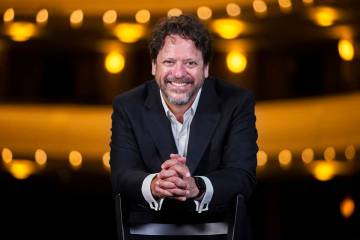
Assembly Minority Leader Lynn Hettrick, R-Gardnerville, acknowledged Friday that commercial property owners will pay more than most homeowners under a compromise property tax plan. But, using Clark County as an example, a 10 percent increase is preferable to a 28 percent increase, he said. Photo by CATHLEEN ALLISON/THE ASSOCIATED PRESS
|
CARSON CITY -- Most Nevada homeowners will see their property tax bills increase by no more than 3 percent on July 1 and every year thereafter under a plan expected to win approval in the Legislature next week.
Owners of other types of property will see sharper increases in their tax bills -- somewhere in the low double digits in Clark County -- under the compromise plan endorsed Friday by both parties and leaders in both houses.
"I think it is a fantastic solution and one of the best proposals I've heard so far," Clark County Assessor Mark Schofield said.
He was among the first public officials to warn of a looming spike in property tax bills.
The plan devised by lawmakers after seven weeks of debate will dramatically reduce what otherwise would be a huge property tax windfall in Clark County and Southern Nevada cities.
Instead of revenue from property taxes growing by 28.1 percent to $383.7 million next fiscal year for Clark County government operations, revenue will grow by 8.8 percent to $326 million under the plan, or $57.7 million less.
The plan might not appease homeowners who have threatened harsher Proposition 13-type property tax reform if the Legislature doesn't provide adequate relief.
Assemblywoman Sharron Angle plans an initiative petition on such a proposal in the fall.
The plan hardly satisfied Dan Roberts, publisher of a newspaper for senior citizens who recently submitted property tax appeals on behalf of 863 residents, primarily in Sun City, who felt their assessments were "too high, exorbitant and unfair."
Roberts said the plan is not a long-term solution to skyrocketing tax bills in Southern Nevada and that he intends to use his newspaper, The Vegas Voice, to back Angle's ballot initiative and rally residents.
"We might as well stop playing around and go with a Proposition 13," Roberts said. "This will be an honest-to-God grass-roots movement, no politicians, no political consultants, no lobbyists."
Local government officials were more receptive of lawmakers' compromise.
Clark County Manager Thom Reilly called the proposal "reasonable," saying it will offer relief to those who need it most without devastating county coffers.
"We knew all along that whether this (spike in property tax bills) was an anomaly or not, we would not realize that (windfall)," Reilly said.
Cities, including Las Vegas, Henderson and North Las Vegas, will also see reductions in their property tax revenue growth rates.
"From the municipal government perspective, this looks like a reasonable solution," said Mark Vincent, director of finance and business services for the city of Las Vegas.
"We never wanted, deserved or needed the windfall. All I'm looking for is sustainability of our growth in the services citizens demand."
The plan is expected to reduce the expected revenue increase to the state's school districts by $24 million over two years, with $20 million alone coming from Clark County schools.
But lawmakers vowed to make up for any loss using state revenue.
The Senate Taxation and Assembly Growth and Infrastructure committees will hear testimony on the plan, outlined in Bill Draft Request 32-1383, on Monday.
It was not known Friday if Southern Nevadans will be able to participate in the hearing via teleconference at the Sawyer Building in Las Vegas.
The two panels reviewed the draft Friday and voted unanimously to introduce the measure.
A bill could be passed and on Gov. Kenny Guinn's desk to be signed into law by Tuesday or Wednesday.
Under the plan, the smaller property tax increases will go to single-family, owner-occupied homes provided for under the state constitution allowing a break in property taxes for economic hardship.
The higher annual increases will go to commercial and other properties, which are not covered by the economic hardship provision approved by voters in 2002. The increase in Clark County will be based on a 10-year average growth rate in assessed valuation.
Schofield said the increase for that group of property owners will be in the "low double digits," but the precise increase has not been determined.
The plan also calls for an interim study of property taxes, and a constitutional amendment granting the Legislature more flexibility to provide property tax relief, lawmakers said. Also on the table is a fund to help any government unduly hurt by the plan, with the primary focus being rural governments.
Most lawmakers involved in the discussions agreed that the plan is the best possible compromise -- doing the least harm to rural governments while offering the most relief possible given the limitations of the state constitution.
The constitution requires property taxes be levied in a "uniform and equal" manner.
"This one will fly," Senate Majority Leader Bill Raggio, R-Reno, said of the compromise hammered out over the past week.
Assemblywoman Chris Giunchigliani, D-Las Vegas, said the plan gives the most relief where it is needed most: to homeowners.
Michael Hillerby, chief of staff to Gov. Kenny Guinn, said a few questions remain before the governor will declare his support for the plan.
"We still have some concern about what the impact is on business," he said. "We want to see how this plays out on Monday."
Assembly Minority Leader Lynn Hettrick, R-Gardnerville, acknowledged that commercial property owners will pay more under the plan than most homeowners. But, using Clark County as an example, a 10 percent increase is preferable to a 28 percent increase, he said.
"Is it a tax savings, however, to business? I believe it is," Hettrick said. "Are they equal? No, they are not."
Sen. Sandra Tiffany, R-Henderson, was the most vocal critic, calling it a split tax roll that forces businesses to pay more.
"It isn't fair," she said. "Everything is on the back of business again."
Christina Dugan, government affairs director for the Las Vegas Chamber of Commerce, expressed a similar concern. "We believe all property owners should be treated equally," she said.
But Assembly Majority Leader Barbara Buckley, D-Las Vegas, disagreed with the view that the plan creates a split tax roll.
"The voters allowed the Legislature to provide relief for owner-occupied residences," she said. "If this is not a time that owner-occupied residences need our assistance because of the severe economic hardship, I don't know what is."
Senate Minority Leader Dina Titus, D-Las Vegas, who has been pushing for a one-year freeze on assessed valuation increases for property owners, said she will seek to amend the bill. She wants to see no increase in the first year for the single-family, owner-occupied residences rather than a 3 percent cap.
"Houses that aren't going up in value, like the little guy, gets no break at all on this," she said. "There is not going to be that much difference in the money generated between the freeze and a 3 percent for one year."
Marvin Leavitt, a lobbyist representing the Urban Consortium, made up of the five largest Nevada cities, said local governments would have liked the cap to be higher than 3 percent.
"But at the same time, I think we recognize that for the voters to realize and vote against what eventually will become a Proposition 13, it has to be something fairly strict," Leavitt said.
Ron Queen, a retired disc jockey, fears the cap is too high for him to continue to afford his home near St. Rose Parkway and Las Vegas Boulevard.
If the latest proposal passes, Queen said he will support a Proposition 13-type ballot initiative.
"What they want to do is have huge windfall profits from what's happened the last three years," Queen said.
"I can't quite get my mind around this idea that the government always needs more and more money. This county has gotten more and more money over the last few years just by virtue of more people moving here."