The federal government relied on inaccurate data to help justify dropping Las Vegas from a list of cities eligible for special anti-terrorism funding, according to county officials who viewed the information last week.
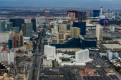
The officials said they identified at least 25 mistakes in classified U.S. Department of Homeland Security data, including information asserting that the Las Vegas area has no convention centers or military bases.
Advertisement
"We told them they were flat wrong on their numbers," said Clark County Sheriff Bill Young, one of 17 state, federal, and local representatives who met last week at the Grant Sawyer State Office Building to discuss the data. "It got a little murky on how they got those numbers."
Young and other Nevada officials at the meeting told five visiting Homeland Security officials about the Las Vegas Convention Center and other similarly large facilities in the area. They described Nellis Air Force Base as a prominent training location for fighter pilots.
Marc Short, a spokesman for the Homeland Security Department, said the convention centers might not have met the standards for what his agency considers "critical infrastructure."
"There needs to be a threshold of traffic or economic consequence or number of innocent victims that would be affected by an incident that would qualify it to be counted as infrastructure," Short said.
John Piet, senior research analyst for the Las Vegas Convention and Visitors Authority, said the city's convention centers are among the biggest, busiest, and most economically important in the nation.
Last year, 6.2 million people visited the convention halls, creating an overall economic impact of $7.6 billion, Piet said.
Short said he couldn't comment about the Air Force base not being listed.
Sharyn Stein, a spokeswoman for U.S. Senate Minority Leader Harry Reid, D-Nev., said a Reid staffer first noticed the data errors several weeks ago.
"We definitely found some information that needed to be corrected," Stein said. "That's why the meeting was held."
The approximately 40 pages of data shared at the meeting have other errors, according to Young and Clark County Emergency Management Director Jim O'Brien, who also attended the meeting.
They include:
Wynn Las Vegas, not the more than 1,100-foot tall Stratosphere Tower, was listed as the city's tallest building and the only building more than 600 feet high.
The Stratosphere, which is touted as the tallest structure west of the Mississippi River, was listed as an amusement park.
Las Vegas was listed as having only a limited number of shopping malls.
Interstate 215 was left off a list of highways
The Silver Bowl was listed as a stadium, but the Las Vegas Motor Speedway was not.
In January, Las Vegas and 10 other cities, including San Diego and Phoenix, were taken off a list of 35 areas that will receive special homeland security grants this year.
The grant program has brought $19 million in funding to Southern Nevada during the past two years. With that money, the Police Department has bought items including handheld computers, a bomb robot and a spectrometer to detect chemical agents.
Local infrastructure is one of several factors used to determine whether a city should receive the special funding, Short said. The other criteria include a city's population, vulnerability to an attack and potential consequences of an attack.
The data discussed at last week's meeting will not be adjusted for this year's grant cycle, Short said.
Nevada seeks $52 million in total homeland security funding this year and still is eligible to receive some special urban funding, though none is guaranteed as in past years.
Short said the Homeland Security Department asked state and local officials for help in compiling information about local infrastructure, but Young and O'Brien said their agencies were not contacted.
Giles Vanderhoof, administrator of the state Homeland Security agency, said his office supplied Homeland Security officials with a few pieces of information but wasn't asked about military bases or convention centers.
"We had all that data right at our fingertips," Vanderhoof said.
Vanderhoof, who was at the meeting, said he suspects the federal government only looked at infrastructure within Las Vegas city limits, not in the so-called "urban area" defined by the Homeland Security Department. That area includes Nellis Air Force Base and the biggest convention center.
Young said the federal officials at the meeting vowed to work more closely with local authorities to compile more accurate data next year.
"They were embarrassed," Young said. "I think next time around they'll be a little more careful."
Michael Greenberger, a University of Maryland law professor and director of the Center for Health and Homeland Security, said federal officials ultimately are to blame for any errors in the data.
"The failure to identify convention centers in Las Vegas is such a self-evident mistake that it goes beyond finger-pointing," Greenberger said. "It should have been caught by anybody going over the information."
Greenberger said the mistakes in the Las Vegas data should raise concerns about the accuracy of other Homeland Security Department information.
"The fact that this could happen suggests that other data is askew as well and can't be relied on," Greenberger said. "That's a very worrying situation."
O'Brien said last week's meeting was "very professional" though the Homeland Security officials became defensive at times.
"They said, 'We collaborated on putting this together. We can't be that far off,' " O'Brien said. "Our side of the table said, 'Yes, you are.' "
Vanderhoof said he and the other Nevada officials were not permitted to make copies of the data but added he was pleased that the federal officials openly discussed the matter with them.
The binder with the information was left in Las Vegas with Gonzalo Cordova, a protective security adviser for the Homeland Security Department who is responsible for identifying critical infrastructure in the area.
Cordova, who also attended last week's 90-minute meeting, did not return calls seeking comment.
For months, Las Vegas officials and the state's congressional delegation have sought an explanation for the city's omission from the list of at-risk cities.
Trips to Washington to meet with Homeland Security representatives, including department Secretary Michael Chertoff, yielded few answers and fueled speculation about whether the decision-making process was flawed.
Last week's meeting about the data helped clear up some of the questions about why Las Vegas was left off the list, Young said.
"That's probably the reason," Young said of the misinformation relied upon by Homeland Security. "There's no other reason for why Las Vegas would be omitted from that list."
Short criticized county officials for complaining to a newspaper reporter about the data instead of helping the Homeland Security department to correct any problems.
Short said it is unlikely that data errors led to Las Vegas' removal from the list.
"It's misleading to suggest that a piece of data will change the outcome of this analysis," said Short. "It's simply too complex an equation for an omission to affect it."
San Diego County Assistant Sheriff Bill Gore said a delegation from the Department of Homeland Security will visit his county on Friday.
Gore said he expects problems with data will emerge at the meeting.
"We've suspected from day one that it was a matter of certain facts not getting back to them somehow," Gore said.
Melissa Subbotin, a spokeswoman for Rep. Jim Gibbons, R-Nev., said Gibbons hopes the process will go more smoothly next time.
"The whole goal was to discover where these flaws were made, so we can take positive steps to have the most accurate data in the future," Subbotin said.
The deadline for submitting data for next year's grants is June 1.
SPONSORED LINKS
SOUTHERN NEVADA FAILS TO MEASURE UP
DROPPED: Las Vegas was among the cities taken off a list of areas that will receive special homeland security grants this year.
FAULTY DATA: The U.S. Homeland Security Department's data showed the Las Vegas area lacked convention centers or military bases and had a limited number of shopping malls.
QUOTE: "That's probably the reason," Clark County Sheriff Bill Young said of the misinformation relied upon by Homeland Security. "There's no other reason for why Las Vegas would be omitted from that list."