Bypassing its usual policy of disposing of federal land through public auctions, the Bureau of Land Management is preparing to sell a publicly owned parcel directly to a prominent Las Vegas developer at a price that critics say is far below market value.
BLM officials confirmed last week that the agency intends to sidestep its standard competitive bidding process next month and sell a three-quarter-acre vacant lot along Durango Drive to Randy Black Jr.
Advertisement
The $546,900 purchase price for the taxpayer-owned land was arrived at using a real estate appraisal performed 16 months ago, according to BLM records.
Experts say this is an inappropriate time lapse between valuation and sale, especially in a thriving market like Las Vegas, where land values briskly appreciate.
"In a changing market like this, six months can easily be too old. I've seen lots in only nine months go up 50 percent or higher in value," said professor Mike Clauretie of the Lied Institute for Real Estate Studies at the University of Nevada, Las Vegas. "That's just common sense. The more quickly the market is moving, the faster they become outdated, especially if you're talking about vacant land."
Typically, the BLM only allows land to be sold on the basis of an appraisal performed in the past 12 months. A six-month extension was granted in the case of the lot Black is seeking from the government, federal records show.
In interviews last week, BLM officials blamed the delay on a slow-moving government bureaucracy.
"It took a long time for this to get pushed through Washington," said Shawna Woods, the BLM realty specialist who oversaw the proposed deal with Black.
Federal law allows the BLM to sidestep the auction process in rare instances. The agency's top local officials maintained in interviews last week that the proposed sale to Black was such an appropriate case.
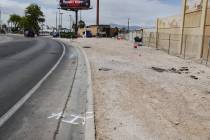
They also said the odd, triangular shape and size of the lot makes it useless to anyone else besides Black, who, according to planning documents filed with the city of Las Vegas, intends to assemble it with adjacent lots he owns and develop a 23-acre medical office and retail complex on the site.
"This property wouldn't benefit anyone other than Mr. Black and his proposed use of the property," said BLM Assistant Field Manager Sharon DiPinto, who oversees the Las Vegas office's lands division.
Veteran real estate brokers who have examined the property disagree.
They say the vacant lot's 465 feet of frontage along a major arterial, commercial zoning, proximity to the Las Vegas Beltway and location in a northwest neighborhood booming with development guarantees that it would easily fetch $1 million to $1.5 million in open bidding.
"A fast-food restaurant (chain) would pay $30 a square-foot for this site. He's buying it for about half price," said a broker who has bought and sold commercial land in Las Vegas for 25 years. "Frontage along Durango is worth a lot of money. This is a sweetheart deal."
"That's a great site," a second broker said. "If I got this from the BLM at this price, I could have a contract to sell it for twice that in a heartbeat, and I'd love to. It could bring a lot more than that. They're throwing money away."
The brokers spoke only on condition of anonymity because they intend to conduct future land transactions with the BLM and fear being frozen out for criticizing the agency.
Recent land sales in the immediate area appear to back the brokers' assertion of the parcel's value. The $546,900 price Black is slated to pay for the 0.77-acre to BLM is based on a February 2005 appraised value of $768,000 an acre. Black paid $2.8 million, or $1.4 million per acre, in May 2005 for the 2-acre lot bordering the east side of the BLM lot, according to Clark County assessor records.
Federal regulations require that the BLM use auctions to sell publicly owned land to ensure that taxpayer benefit is maximized by getting the best price for the land except in rare cases in which a field office determines the public would best be served by a noncompetitive direct sale.
However, BLM policy instructs field offices to use these exceptions rarely and with great caution.
"Particular care must be taken to fully document the decision and rationale for the use of a direct sale approach," states a BLM memo circulated to field offices in 2002, shortly after the agency was criticized by federal auditors for not maximizing value to taxpayers by selling land without auctions.
The memo advises BLM officials that even when federal regulations appear to allow use of a direct sale, "it may be preferable" to use competitive bidding instead.
One of the exceptions where the BLM may sell land without an auction is when a parcel "is an integral part of a project and speculative bidding would jeopardize" its development.
Local BLM officials say Black's proposed office complex meets this condition.
Black, the son of Mesquite casino operator Randy Black Sr., owns the adjoining property on two of the lot's three sides, and a Department of the Interior appraiser concluded that the "best use of the site would be for assemblage with the adjacent property controlled by Mr. Black."
The top BLM official in Southern Nevada said last week that the agency is proposing what makes the most sense for land use, not showing favoritism to one of the valley's most successful developers.
"We have requests all the time for direct sale, but they don't fit the criteria," said Juan Palma, field manager for the BLM in Southern Nevada. "Our staff believes a direct sale is appropriate in this case."
However, Palma acknowledged that it is a subjective judgment when deciding if a parcel should qualify for a noncompetitive sale.
"Some folks may disagree with us on this," he said.
DiPinto, the BLM assistant field manager, said Black's purchase proposal meets the "integral part of a project" exception in BLM land sale policy because the parcel he is seeking is the only area where he could build entrance and exit drives to access the retail portion of his development.
Also, the proposed sale meets another of the conditions that allow direct sale, DiPinto said. The notice published in the federal register about the proposed Black sale states that transferring the land to "any other entity would not protect existing equities of the surrounding private land owned by Mr. Black."
The intention to preserve existing equity in nearby land is another condition under which the BLM may circumvent the public auction process.
DiPinto disagreed with the brokers' assertion that the site was large enough to be marketed to a restaurant chain.
"You're going to have setbacks, where you'll have a little less than a half-acre to construct on," she said. "After you put your setbacks and access in, to me, I think it would be cumbersome to try to use that."
Later, DiPinto acknowledged that she was uncertain whether a commercial business independent of Black's development would fit on the site.
"It would be debatable what you could put there," she said. "I'm not an architect. I couldn't tell you what you could put."
Multiple attempts to reach Black, both through his locally based Land Baron Investments and the Black family-operated casinos in Mesquite, were unsuccessful.
According to Land Baron's Web site, Black is a native Las Vegan and third-generation real estate professional.
He and his two partners manage an $80 million real estate fund that they started with only $100,000 in 1993, the Web site says.