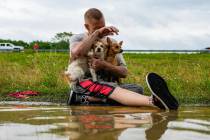
Melvin Dummar lies in the desert Thursday in the position and location he claims he found Howard Hughes when he stumbled across the billionaire in 1967. Dummar returned to the area with a documentary film crew. Photo by John Locher.
Melvin Dummar
Howard Hughes
Click image for enlargement.
NEAR LIDA JUNCTION -- At the edge of a lonesome valley studded with Joshua trees, Melvin Dummar flopped facedown in the dirt with his head pointed west and his legs splayed out behind him.
Advertisement
This, Dummar said, was what Howard Hughes looked like when Dummar stumbled across the bruised and bloodied billionaire on a frigid night in December 1967.
Dummar returned on Thursday to the site along U.S. Highway 95, 160 miles northwest of Las Vegas, to retell his tale for a half-hour documentary series called "True Vegas."
With a camera crew in tow, he walked to the spot where he claims to have found Hughes sprawled on a two-track dirt road that parallels the highway for a few hundred yards, then hooks west toward the mountains.
Dummar said he was driving a 1966 Chevrolet Caprice, not the truck depicted in the Academy Award-winning 1980 movie "Melvin and Howard."
He was on his way to Los Angeles from his home in the Nye County town of Gabbs, when he pulled off the highway at around midnight to empty his bladder.
"I thought I'd found a body," he said, with dust still on his blue jeans from when he lay down on the road. "I thought, 'Should I go get the sheriff?'"
The temperature dipped below freezing in the high desert that night, but the man lying in the road did not have on a coat.
He continued to shiver violently after Dummar helped him into the passenger seat.
Dummar said Hughes was tall and thin, with a scruffy white beard and hair down to his shoulders. He wore a beige long-sleeved shirt, tennis shoes and dark, pleated slacks that looked several sizes too big.
When Dummar asked him whether he needed a doctor or sheriff's deputy, the man grunted no.
Hughes said almost nothing else during the next hour of the drive, so Dummar said he sang songs and talked about himself.
The man perked up after Dummar mentioned his time in the Air Force and how he tried to get a job at Hughes Aircraft in Fullerton, Calif., after he got out of the service.
"He said, 'Well I'm familiar with that because I own it. I'm Howard Hughes,' " Dummar said. "I thought, 'Get a hold of your nuts, the squirrels are out tonight.'"
Before long, Dummar said the man told him he wanted to go to the Sands hotel in Las Vegas, and that's where he took him.
"I didn't ask him for anything. I didn't expect anything. I didn't even believe it was Hughes," he said. "I thought he was a bum."
Dummar's return last week to that patch of desert came days after he filed a lawsuit in U.S. District Court in Salt Lake City, renewing his claim to $156 million he insists Hughes left to him in a will that mysteriously appeared after Hughes' death in 1976.
The "Mormon Will," so named because it included the Church of Jesus Christ of Latter-day Saints as a beneficiary, was dismissed as a fake in 1978, and the Hughes estate was divided among several relatives.
Dummar's lawsuit is based on new details gathered by former Las Vegas FBI Special Agent Gary Magnesen, who met Dummar in 2003 and has uncovered information that he thinks places Hughes in remote Central Nevada on the night in question.
The most surprising revelation comes from Robert Deiro, a pilot who worked for Hughes Tool Co. Deiro has said he once flew the reclusive billionaire to the Cottontail Ranch at Lida Junction, in Esmeralda County, about six miles north of where Dummar claims to have picked up Hughes.
An airstrip leads right to the brothel's back door, and Magnesen said Deiro described how he parked and left the single-engine Cessna's landing lights on, so Hughes could find his way inside the building.
"That's why he (Hughes) didn't have a coat or jacket on," Magnesen said.
According to records at the Esmeralda County courthouse in Goldfield, Hughes had 30-day options on 36 Central Nevada mines in December 1967. Magnesen said the road where Dummar found Hughes leads to several of those mines.
The former organized crime investigator chronicled his work last year in a book, "The Investigation: A Former FBI Agent Uncovers the Truth Behind the Most Contested Will in American History."
The book and the lawsuit have drawn new attention to a story that turned Dummar into a national punch line three decades ago.
He still gets emotional when he talks about the jokes Johnny Carson told about him on the "Tonight Show," and the way the media invaded every corner of his life.
"They'd go and question my family dentist about my kids," he said as tears ran down his face. "It almost killed me. It even drove me to the verge of suicide a couple of times."
The 61-year-old lives in northern Utah and sells frozen meat from a truck. He has been weakened by two bouts with cancer since 1999 and a blood clot in his shoulder that requires him to wear an orthopedic sleeve to control the circulation of his right arm.
He said he wants to see the record set straight while he is still alive. "I picked up Hughes. There's no doubt about it," he said.
To some, though, doubt and skepticism is all there will ever be when it comes to the desert encounter and the "Mormon Will."
James Whetton of Ogden worked for Hughes for more than 20 years starting in 1953, becoming his chief of staff. He said his experiences with Hughes led him to discount Dummar's claims, despite a powerful reason not to.
"I liked the Mormon Will," Whetton told the Standard-Examiner in Ogden. "I was in it for about $25 million."
As for the incident in 1967, Whetton and other former aides have said that between 1966 and 1970 Hughes never left his residence on the ninth floor of one of the Desert Inn buildings in Las Vegas.
Hughes had "physical problems at that time, which made it hard for him to leave," Whetton said.
Magnesen, who was interviewed for the documentary Thursday, said he did not believe Dummar at first. "I thought the guy was a nut because of what I'd read in the newspaper."
His opinion began to change as he interviewed Dummar and began to investigate.
"I don't think it was a bolt of lightning," Magnesen said as he stood in front of the now-shuttered Cottontail Ranch. "It's one brick on top of another brick, and pretty soon you've got a brick wall. This guy's got to be telling the truth."
The Dummar story is one of four episodes of "True Vegas" being produced by Las Vegas journalist George Knapp and author Jack Sheehan.
The other half-hour shows will profile major success stories and epic burnouts in Las Vegas, million-dollar golf bets played out on the local links, and the city's underbelly of strip clubs and prostitution.
Sheehan and Knapp hope to finish the episodes late this summer and shop them around.
Sheehan said Dummar's story might be the best of the bunch. He called it a strange and tragic piece of "American folklore," starring a man who "hasn't had a wonderful life."
"He's had this kind of bizarre celebrity connected to this one event. He's a trivia question," Sheehan said. "It kind of ruined his life."