Home Subscribe
Jobs Cars Homes Shopping Travel Weddings Golf Best of Las Vegas Photo
.
Member Center

Recent Editions
MTWThFSSu
>> Search the site
.
.
.
.
NEWS
.
.
.
.
.
.
.
Sep. 10, 2006
Copyright © Las Vegas Review-Journal


IN DEPTH: THE LONG SHADOW OF 9/11: Weighing the risks

Increased vigilance arises from knowing Las Vegas has inviting terrorism targets.

By Alan Maimon and Margaret Ann Mille
REVIEW-JOURNAL


Graphic by Mike Johnson.


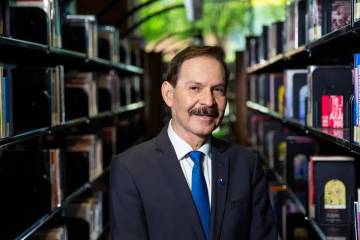
Clark County Sheriff Bill Young, shown at his weekly crime briefing meeting at the Investigative Services Division, says he worries about trying to stop a lone suicide bomber.
Photo by John Gurzinski.


Click image for enlargement.


Click image for enlargement.

In 1993, the federal government asked Marvin Cetron to lead an exercise to predict how and where terrorists might strike in this country. Cetron, a professional forecaster of global trends, nailed the assignment with a scenario about aerial attacks on the World Trade Center and government buildings in the nation's capital.

"Coming down the Potomac, you could make a left turn at the Washington Monument and take out the White House, or you could make a right turn and take out the Pentagon," the founder of Forecasting International told a Pentagon-commissioned working group.

Advertisement

Cetron also concluded that Las Vegas was a likely target of terrorism because of its crowded hotels and reputation for decadence.

The report, which was compiled using publicly available information, became classified out of concern it could give terrorists ideas. But Cetron said his opinion about Las Vegas hasn't changed.

"Las Vegas has some of the softest targets out there," he said in a recent telephone interview. "The hospitality industry is wide open."

Cetron's foreshadowing of the 9/11 attacks may have been an extraordinary fluke, but terrorism experts say it does not take much imagination to envision Sin City as a likely target of Islamic extremists.

"Las Vegas is a symbolic target that would speak to a cause," said FBI Assistant Director John Miller, who referred to Cetron's prediction in a book he wrote about the 9/11 attacks.

In the past five years, Las Vegas has been linked to terrorism through incidents including visits to the city by several of the 9/11 hijackers and the threat of an attack during New Year's Eve 2003. But law enforcement officials say Las Vegas faces no specific threat. Nor is there any hard evidence that any plot against Las Vegas has been disrupted in recent years.

But that has not kept the government and private companies from trying to gauge the likelihood of an attack, right down to the place and method.

By doing so, counterterrorism officials are trying to avoid being blindsided by a terrorist strike, or suffering from what the 9/11 Commission referred to as the "failures in imagination" that preceded the terrorist attacks five years ago.

But analyzing true risk is difficult because terrorist acts involve unexpected human behavior, said David Hassenzahl, assistant professor of environmental studies at the University of Nevada, Las Vegas.

"We know natural disasters will occur every couple of years, but you can't say the same about terrorism," he said. "The thing that really complicates it is intent. There is no intent in natural disasters."

The Department of Homeland Security has attempted to assess risks facing American cities through intelligence information, mathematical analysis and common sense, said George Foresman, the Department of Homeland Security's undersecretary for preparedness.

That evaluation resulted in Las Vegas being dropped earlier this year from a list of 35 cities perceived at highest risk of an attack.

But Dave Staretz, supervisory special agent with the FBI in Las Vegas, said the bureau operates on the assumption that some of the city's nearly 40 million annual visitors are here for purposes that could be related to terrorism.

"We know this is a meeting ground," Staretz said.

Taking his point a step further, Staretz said, "The pro-Western ideologies of leisure are something that would be of interest to radical Islamic fundamentalists."

Mike McClary, the Metropolitan Police Department's homeland security chief, said terrorism suspects have given authorities an earful about Las Vegas at various times over the past five years.

"We've been mentioned more times than we would have liked," McClary said. "There have been a number of times people have gotten on soapboxes and talked about Las Vegas."

Idle talk does not necessarily translate into credible threat, the FBI's Miller said. He described terrorist chatter about Las Vegas over the past five years as "blips on the radar screen."

MEASURING RISK

The government has a vested interest in preventing terrorism, and so do insurance companies that want the private sector to protect assets.

Companies that compile data about terrorism risk for insurance firms have taken notice of Las Vegas.

Las Vegas ranks among the top 10 U.S. cities at risk for an attack, according to a recent analysis by California-based Risk Management Solutions, a company that quantifies the risk and cost of natural and man-made disasters.

New York and Washington are considered at highest risk, according to the study. Then come Chicago, San Francisco and Los Angeles.

Las Vegas is among a group of cities considered to have the third-highest level of risk. That group includes Boston, Philadelphia, Houston and Miami.

Peter Ulrich, an executive at the company, said the analysis showed an attack in Southern Nevada most likely would involve a conventional bomb and take place at a casino or somewhere along Las Vegas Boulevard.

A report prepared for the Nevada Commission on Homeland Security earlier this year similarly concluded that a truck bomb on the Strip was one of the most likely terrorist scenarios.

Ulrich and other experts believe New York still is at greatest risk because of its status as financial capital of the world and the target of previous attacks.

In July, authorities said they broke up an overseas plot to bomb train tunnels between Manhattan and New Jersey.

Last year, security at New York subway stations was increased in response to a threat that terrorists planned to target the city's mass transit system.

New York officials have worked to deter terrorists by assigning about 1,000 police officers to counterterrorism duty, but aggressive efforts in Manhattan actually may increase risk to other cities where attacks could be more easily carried out, Ulrich said.

"Terrorism risk is kind of like a balloon," Ulrich said. "When you squeeze it in the middle, it pops up somewhere else."

SOFT TARGETS

Richard Clarke, the former White House head of counterterrorism, said the task of predicting potential terrorist targets is facilitated by looking at trends.

Since 9/11, terrorists around the world have targeted the transportation and hospitality sectors, Clarke said.

And no city is more identified with the latter than Las Vegas, home to 17 of the 20 largest resorts in the world.

"There's not some international terrorist targeting committee that meets and decides on things," Clarke said. "There's a lack of coordination, but they do learn from each other's experiences and go after the same kind of targets over and over again. Hotels are a recurring theme and have been for a long time."

Last October, the U.S. Department of Homeland Security mentioned Las Vegas in a national information bulletin that warned terrorists could attack tourist locations in this country.

Michelle Petrovich, an agency spokeswoman, said the warning was based on awareness of the "historical patterns" of al-Qaida and other terrorist groups.

In an age of new threats, McClary said, protection of the Strip is difficult.

"The resort corridor wasn't built with 9/11 in mind," McClary said.

For their part, Strip hotels have implemented dozens of new security measures, most of which are invisible to the public. After 9/11, MGM Mirage, Harrah's Entertainment and Wynn Resorts hired security executives who once held top positions at the FBI.

Some so-called neighborhood casinos, on the other hand, have not significantly altered their pre-9/11 security strategies.

Law enforcement officials in Southern Nevada say they are most worried about attacks that can be carried out without sophisticated planning: bombs carried into a hotel by a suicide bomber, truck bombs outside hotels, and gunmen opening fire inside casinos.

Sheriff Bill Young said he worries about the element of surprise.

"I'm most concerned about the lone suicide bomber scenario, the plot that doesn't have a lot of tentacles to Vegas," Young said. "How do you prevent the lone suicide bomber who did all the planning elsewhere?"

McClary said his job involves contemplating worst-case scenarios, including the possibility of "five al-Qaida guys with AK-47s shooting up casinos" and the use of private planes as weapons.

In a report on emerging terrorist trends, the Rand Corp., a nonprofit research organization, took note of the ambition of terrorist groups to launch chemical, biological, radiological or nuclear attacks.

But the study concluded that terrorist networks appear to lack the capability to execute large attacks using non-conventional weapons.

The researchers said the more likely unconventional scenarios are releases of radiological material through so-called "dirty bombs" and low-tech biological attacks, such as contamination of the food supply with bacteria or toxin.

Peter Chalk, a co-author of the report, said a strike in glitzy Las Vegas would be particularly effective as a recruiting tool for Islamic extremists.

BETTER DATA

Another post-9/11 endeavor has involved looking at the exact locations terrorists are most likely to strike.

In June 2004, the Department of Homeland Security included 14 sites in Southern Nevada in a list of about 600 potential targets nationwide. That list included six hotel-casinos, the Las Vegas Motor Speedway, the Las Vegas Convention Center, and the Mead Substation, an electric power facility near Hoover Dam.

A newer version of the list compiled this year has been classified.

Though Department of Homeland Security officials included the city's largest convention center on the 2004 list, the agency 18 months later said Las Vegas had no convention centers at all when calculating the city's risk level and eligibility for federal anti-terrorism funding.

To the consternation of Southern Nevada officials, the Homeland Security Department then dropped Las Vegas from the list of most at-risk cities.

It later was revealed that the omission of the convention center was among several inaccuracies in the data used by the federal government to calculate local risk. The Homeland Security Department also asserted that Southern Nevada had no military bases.

In addition, local officials suspect Las Vegas' tourist population and volume of threat information were not considered strongly enough in the formula.

The snub resonated with officials outside Las Vegas who believe an attack here would have major consequences.

"I'm absolutely amazed," Los Angeles police Chief William Bratton said last month. "I think (with) the symbolism of Las Vegas, with the millions of visitors, that the impact of a terrorist attack could be huge."

Bratton agrees with Nevada officials who contend that the state's security needs are intertwined with those of neighboring California.

In their application for federal homeland security funding this year, Nevada's emergency planners wrote that car bombs and suicide bombs are "a serious and probable threat in the region."

"With its massive international community, Los Angeles is a likely planning and staging ground for attacks throughout the Southwest and particularly Las Vegas," the application continued.

Foresman said criticisms of the government's formula for calculating risk will be taken into consideration for next year's funding cycle.

"Las Vegas is one of those jurisdictions we should be concerned about," Foresman said by telephone. "Some additional data has been presented to us, and we're going to factor that data."

Foresman said his department has been urged by local officials to consider facilities like Hoover Dam that are outside what the government defines as Las Vegas' "urban area" when determining anti-terrorism funding for the region.

Southern Nevada has "trophy targets," including Hoover Dam, that are potential targets based on their importance or international name recognition, said Jack Seaquist, a terrorism risk manager at Boston-based AIR Worldwide.

The good news, according to the FBI's Staretz, is that despite the catastrophic consequences of a breach at the dam, such an attack would be difficult.

"It would take a nuclear weapon to take it out," Staretz said.

Foresman said the federal government also was working to clean up the so-called National Asset Database, a digital collection of sites in every state with perceived vulnerability to an attack.

In July, a Homeland Security inspector general's report concluded the database was tainted by the puzzling inclusion of businesses such as an ice cream parlor and a petting zoo.

The Nevada list included several bars with slot machines that defined themselves as casinos.

ARE WE SAFER?

Senate Minority Leader Harry Reid, D-Nev., said the funding issue was one of many that caused him to lose faith in the Bush administration's ability to protect the nation.

"I am disappointed that five years after 9/11, we are not nearly as safe as we should be," Reid said. "America needs a new direction when it comes to homeland security and our foreign policy."

Reid said a recent visit to hurricane-ravaged New Orleans reinforced his viewpoint.

Reid urged the Bush administration to support all of the recommendations of the 9/11 Commission, including those intended to improve security of the nation's ports and mass transit systems, and to ensure first responders have systems that allow for interagency communication during emergencies.

Reid renewed his call for the firing of Homeland Security Secretary Michael Chertoff.

Chertoff defended the government's performance in responding to terrorist threats and said his agency's ability to deal with natural disasters also has improved.

"Time and again plots and plans have been disrupted," Chertoff said in Los Angeles last month. "There has been a sea change in the last five years."

Local officials, meanwhile, believe terrorism prevention should remain a high priority.

To assist the FBI in its counterterrorism work, the Las Vegas police have created a homeland security division with 29 officers exclusively working to prevent terrorism.

The Las Vegas police department is one of only eight state and local police agencies in the country with an officer permanently stationed at the nation's center for information sharing, the National Operations Center in Washington, part of the Department of Homeland Security.

"If we fail just once to prevent a terrorist attack, the economic engine that drives our economy will seize up," said police Lt. Tom Monahan. "I'm confident we could recover from a natural disaster, but I'm not so sure you can say the same about a terrorist attack."

SPONSORED LINKS


Advertisement


Contact the R-J | Subscribe | Report a delivery problem | Put the paper on hold | Advertise with us
Report a news tip/press release | Send a letter to the editor | Print the announcement forms | Jobs at the R-J

Copyright © Las Vegas Review-Journal, 1997 -
Stephens Media   Privacy Statement