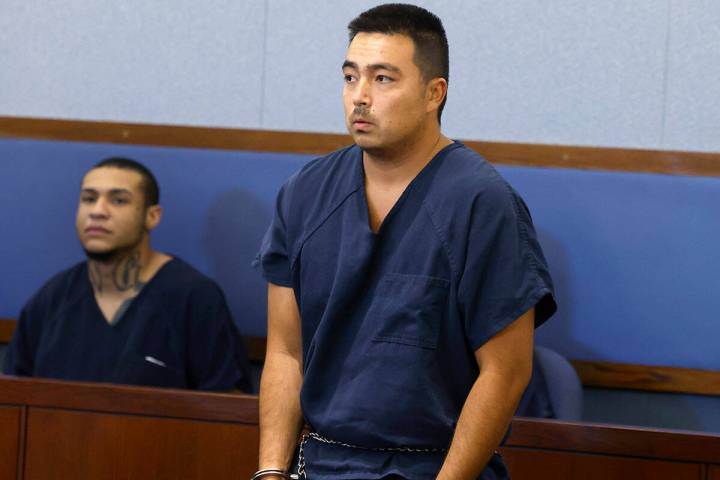
Attorney Paul Wommer meets at the bench with Justice of the Peace Nancy Oesterle, who appointed him as a contract defender more than a decade ago. Photos by Gary Thompson.
Electronic boards at the Regional Justice Center display the time and location of hearings. The Clark County court system is struggling to cope with heavy caseloads.
Click image for enlargement.
Darryl Cone had slipped far from his days as an all-state high school wrestling champion and recipient of a key to the city of North Las Vegas.
On a late summer evening in 2005, Cone was found several miles from home, sound asleep in the cab of a 1996 Dodge pickup that belonged to his employer.
Advertisement
A glass drug pipe lay on the seat next to him, alleged police, who arrested the 45-year-old Cone near the Las Vegas Country Club.
For the construction company that had reported the truck missing two days earlier, the matter was resolved.
"We just wanted our truck back," said Lisa Lattimore, safety director for Cedco Inc. "We didn't pursue it or press charges."
But the district attorney's office charged Cone with theft, possession of a stolen vehicle and possession of drug paraphernalia.
Cone could not afford an attorney, and the public defender's office had a conflict of interest, so part-time public defender Paul Wommer was assigned the case.
Wommer, a private attorney who was paid a flat monthly fee by the county to handle an unlimited number of indigent cases, urged Cone to plead guilty.
But Cone said he wanted to plead not guilty.
"I kept the truck over a three-day weekend. I didn't steal it," Cone said in a phone interview from the Southern Desert Correctional Center. "He (Wommer) didn't want to hear my side of the story."
When Cone resisted a plea deal, things got ugly between him and Wommer.
Cone complained in three separate court filings that his attorney threatened to work with prosecutors to get him the most severe punishment possible.
Cone said Wommer told him at a court hearing, "You want to have some fun, huh? We are going to trial on everything. ...You're going to get life in prison, and I'll make sure of that, my brother."
Two witnesses to the exchange signed court affidavits backing Cone's memory of the events.
In an interview, Wommer did not distance himself from Cone's allegations.
"I have no quarrel with someone saying I have a loud and intimidating manner," Wommer said. "Sometimes you have to threaten and chastise. ... I tend to get frustrated with people who don't use prudence and logic."
PROBLEMS PLAGUE CONTRACT SYSTEM
A lot of things in Clark County have changed substantially since the 1980s, but the county's alternate method for defending the poor is not one of them.
The county still relies on a contract system started two decades ago to help a handful of suspects the county public defender's office could not defend because of conflicts of interest. Such conflicts arise in cases with co-defendants who might implicate each other or cases with witnesses the office once defended.
The county-funded system that cost about $4 million in 2006 is budgeted for $5 million this year.
A six-month investigation by the Review-Journal found the conflict system is beset by a severe lack of oversight that hurts both defendants and taxpayers.
The attorneys, who are hired by judges in whose courtrooms they regularly appear, are paid a flat monthly fee of $3,000 by the county for an unlimited number of criminal cases. Though the monthly fee has increased over the years, it still amounts to only a token payment per case.
To balance the scales -- inappropriately, some say -- the defense lawyers are first in line to get cases carrying a possible life sentence that qualify them for an hourly fee of $100. The fee jumps to $125 per hour for capital cases.
Judges are not required to assign such cases to their contract defenders but routinely do so as a reward for what District Judge Sally Loehrer calls the "grind" of handling many other cases for little pay.
About one-third of the $3.2 million paid to all Clark County attorneys in hourly fees last year went to contract defenders, according to county records.
Much of the rest went to attorneys in Family Court or to non-contract attorneys assigned to some serious felony or death penalty cases, such as attorney Peter Christiansen whose firm billed the county for close to $300,000 last year.
The newspaper's findings, which stemmed from an examination of every case the 30 contract defenders took to District Court between July 1, 2005, and June 30, 2006, included the following:
Some contract defenders spent a vastly disproportionate amount of time on felony cases that pay hourly, leaving little time for the many other cases they have been assigned.
In the approximately 1,200 appointed cases that were not paid hourly during the one-year period the newspaper examined, contract defenders in District Court had a trial rate of a little more than 1 percent. A 2000 U.S. Department of Justice report showed the average trial rate for criminal cases in the country's 75 largest counties in 1996 was 5.6 percent.
Defense attorneys with little trial experience frequently were assigned to defend people accused of serious felonies, including murder and sexual assault.
Some contract defenders had limited contact with defendants before trial or plea bargain.
The district attorney's office played a significant role in how the system functioned. Of 11 defendants in drug trafficking cases who faced possible life in prison, eight got no prison time at all, raising questions about whether the original charges were appropriate.
Huge payments were not limited to contract defenders. Christopher Tilman, another local lawyer, billed the county more than $450,000 last year for cases in Clark County Family Court. Tilman often billed the county for more than 24 hours in a single day.
Attorneys who hold contracts have been allowed to subcontract or turn over work to other lawyers without the knowledge of court administration.
The newspaper's case data did not include dozens of pending cases that entered District Court before July 1, 2005, cases that were dismissed or pleaded out as misdemeanors in Justice Court, or cases handled by contract attorneys in Family Court.
In response to the Review-Journal's investigation, judges and court officials have formed a committee to explore ways to improve the contract system.
"None of our operating procedures are written down," said Loehrer, a committee member. "We need to see if it should be set down into more formal procedure."
District Court Administrator Chuck Short went a step further, endorsing the idea of expanding the county special public defender's office, a small group of attorneys who since 1997 have handled murder cases and cases involving the termination of parental rights.
"I think the community is ready for a more structured process," Short said. "It's time."
The Clark County contract system violates most American Bar Association guidelines for indigent defense delivery, most notably by giving judges authority to hire and fire contract defenders.
Norman Lefstein, a professor at the Indiana University School of Law in Indianapolis, said Clark County's alternate system for defending the poor is deeply flawed.
"It's a terrible system," said Lefstein, who works with legal organizations on indigent defense issues. "It's one that invites abuse."
JUDGES FREE TO PICK DEFENDERS
The county has ceded nearly all power over the contract system to judges by not formally screening candidates or establishing a process to address complaints against attorneys.
Contract jobs are unadvertised, and many lawyers have been given contracts without even submitting applications and résumés to court administrators.
"That was supposed to be happening, but it wasn't," Short said. "There was negligence on our part."
Some contract defenders do a conscientious job, others do not even do the work themselves, but all are feeling the strain of serving a court system in which the number of cases filed increased from 7,909 in 2003 to 9,651 in 2005.
In a recent one-year period, contract defenders were involved in about one out of every seven indigent cases.
Some contract defenders grumble that defendants are inappropriately declared indigent and that the public defender's office removes itself from too many cases.
Among the current contract holders, or lawyers who appear on their behalf, are a state assemblyman, the youngest son of Mayor Oscar Goodman, the former law partner of a presiding judge, and two lawyers whose law licenses formerly had been suspended by the Nevada Supreme Court. Another attorney, who gave up her contract last year, had been suspended from working as a substitute judge for not meeting state education requirements.
Often considered a training ground for new lawyers, the contract positions have become increasingly popular among veteran attorneys. About half of the current contract defenders have had contracts for more than six years.
Since 2002, current contract attorneys have made political contributions totaling at least $12,000 to the judges who hired them.
Most notably, attorney Craig Mueller gave $2,500 last year to Justice of the Peace Natalie Tyrrell's re-election campaign, the single largest contribution she received.
Clark County judges not only control the hiring process. In many ways they control the purse strings.
Because Nevada has no attorney-eligibility standards other than for capital cases, judges are free to appoint defenders with little experience to cases they would not be qualified to try in other states.
The public defender's office has training and experience requirements. They were devised in response to scathing reports on its operations and a federal lawsuit by a former death row inmate who had been represented by an inexperienced attorney.
QUALITY OF WORK IN DOUBT
In interviews with more than a dozen current and former contract defenders, almost all said they would not want a contract if not for the perk of being assigned to cases they can bill hourly.
"You couldn't do the $3,000 all-you-can-eat contract absent the court-appointed hourly work," Robert Langford said.
Langford, whose firm also has a contract that pays $6,500 a month for misdemeanor cases in Las Vegas Municipal Court, said he is concerned about the substantial role judges play in the process.
"We have to change the way we award contracts," he said. "An independent committee that chooses attorneys who are eligible for contracts is where you have to start."
Bill Kephart, a veteran prosecutor in the district attorney's office, said it is an open secret that contract defenders seek ways to maximize the amount they bill on hourly cases to compensate for how little the contract pays.
"We might be ready to negotiate a case, and sometimes you'll hear, 'Come on, let me do some billing,'" Kephart said. "It's been going on for a long time."
Alzora Jackson, a former contract defender who works in the county special public defender's office, said she gave up her contract in part because of the payment system.
"I didn't like that I had to become a businesswoman to survive," said Jackson, who won the 2006 Defender of the Year Award from the Nevada Attorneys for Criminal Justice. "The hourly cases make the track quite profitable."
Several contract defenders proved that point last year.
On top of the $36,000 he earned from his contract, attorney Greg Denue billed the county for an additional $380,000, much of that for work done in 2006.
In the first six months of last year, Denue said he worked more than 950 hours on a small group of hourly fee cases, several of which the district attorney's office admitted it could not prove beyond a reasonable doubt.
In one case, a man found asleep next to a stash of drugs in another person's apartment was charged with high-level drug trafficking.
The newspaper's analysis showed that contract defenders went to trial on 10 percent of hourly cases in a recent one-year period, compared with 1 percent on cases that were not paid hourly.
In most of the cases examined by the newspaper, defendants waived their right to probable cause hearings in Justice Court in preparation for guilty pleas in District Court.
A review of 71 cases in which defendants got at least three years in prison showed that 16 received no jail visits from their attorneys. Of those, 13 had cases that did not qualify attorneys for hourly payment.
Unlike full-time public defenders, contract lawyers cannot easily phone into the jail, do not have access to criminal background checks on potential witnesses, and have to get permission from judges to hire investigators.
Another obstacle for defense attorneys has been the district attorney's increasing attempts to achieve longer sentences under Nevada's habitual offender status.
Contract defender Wommer said Cone's criminal history, which included several low-level felony convictions, could have allowed prosecutors to label him a habitual criminal. Cone would have faced a long prison sentence if convicted.
Court and jail records show Wommer paid scant attention to Cone's case after Cone rejected plea negotiations.
Wommer did not go to see him in the Clark County Detention Center for two months and did not file any motions with the court leading up to trial.
On the day of his April trial, Cone agreed to plead guilty. As part of the plea deal, the district attorney's office said it would not oppose probation.
But instead of probation, Cone got 10 years in prison, with possibility of parole after three years. He is serving his time at the Southern Desert Correctional Center.
He tried to withdraw his guilty plea, but it was too late.
Short said the newspaper's examination raises questions about how contract defenders are spending their time.
"The less time you spend per transaction, the less quality you have," Short said.
Clark County Special Public Defender David Schieck said he is worried that prosecutors take advantage of the contract system to offer less lenient plea bargains.
"Prosecutors know track attorneys can't afford a weeklong trial with no compensation," Schieck said. "That would be financial suicide."
Chip Siegel, a contract defender and the former president of the Nevada Attorneys for Criminal Justice, is candid about what he thinks are the priorities of many contract lawyers.
"As much as you do the best that you can and try your hardest on every case, there are practical realities of running an office that come into play," Siegel said. "If I have an appointment at 2 p.m. with a track client, and a paying client calls and wants to meet with me, guess who's going to get bumped?
"That's just the reality. Any track attorney who tells you it isn't is lying."
CLARK COUNTY LAGS BEHIND
Clark County could look in a lot of directions for a more structured approach to indigent defense: Phoenix, San Diego, Seattle, even Reno.
Washoe County, although it contains the city of Reno, has about 25 percent the caseload of Clark County. Nevertheless, it plans to replace its contract system with a secondary public defender's office in July.
"At some point, if you look at defense delivery systems in the U.S., the best and most economical use of resources is to have an official public defender's office," said Washoe County Public Defender Jeremy Bosler, who helped the county launch the new office.
Maricopa County, which contains the city of Phoenix, ensures that lawyers who contract with the county are independent and closely supervised.
Mark Kennedy, the director of Maricopa County's Office of Contract Counsel, said judges stopped picking the attorneys that appear before them in 1990.
Kennedy said he was surprised at how little the Clark County system has evolved in the 17 years since Maricopa County made its changes.
"You have a very broken system," Kennedy said. "That model is just the wrong one given the volume of cases."
A YEAR IN REVIEW
Below is a breakdown of cases filed in Clark County District Court between Juen 30, 2005, and July 1, 2006, in which 30 contract attorneys were appointed or privately retained.
Total cases:
1518
Contract cases:
1236
Guilty pleas:
1136
(92%)
Jury trials:
13
(1%)
Dismissed:
36
(3%)
Pending:
41
(3%)
Other:
10
(1%)
Hourly-fee cases:
109
Guilty pleas:
65
(60%)
Jury trials:
11
(10%)
Pending:
27
(25%)
Dismissed:
4
(4%)
Other:
2
(2%)
Privately retained:
166
Guilty pleas:
145
(87%)
Jury trials:
2
(1%)
Pending:
12
(7%)
Dismissed
6
(4%)
Other:
1
(1%)
Could not be determined:
7
NOTE: Status as of 3/1/07. Totals do not all equal 100 percent due to rounding to the nearest percent. Does not include cases that were dismissed in Clark County Justice Court or resolved as misdemeanors.
The landmark 1963 U.S. Supreme Court decision Gideon v. Wainwright required state courts to provide free representation to defendants in criminal cases who could not afford an attorney.
In response to the ruling, Clark County opened a public defender's office in 1966.
About 20 years later, the system was expanded to account for the growing number of conflicts of interest within the county office, including cases with multiple defendants who might testify against each other.
The county created a "conflict system" in which judges hire private attorneys to contract with the county as part-time public defenders.
In 1997, the county opened a special public defender's office, which handles murder cases and cases involving the termination of parental rights.
More than 80 percent of defendants in state courts nationwide are declared indigent, the U.S. Justice Department reports.
REVIEW-JOURNAL
JUSTICE COSTS
Attorneys who billed the county for most money from November 2005 to December 2006:
1. Christopher Tilman - $458,298
2. Greg Denue - $417,354
3. Bret Whipple - $172,796
4. Peter Christiansen - $168,829
5. Christiansen Law Offices* - $159,470
6. Ross Goodman** - $159,077
7. Stanley Walton - $144,878
8. Paul Wommer - $143,168
9. Michael Villani - $118,701
10. David Amesbury - $107,464
* Law firm of Peter Christiansen and associates
** Billed as Goodman Law Firm
Bold denotes contract defenders whose bills included monthly fees of $3,000.
NOTE: Bills submitted by attorneys may reflect work done on cases that originated in earlier years.