



Sandoval silent on ACLU report calling for parole reforms
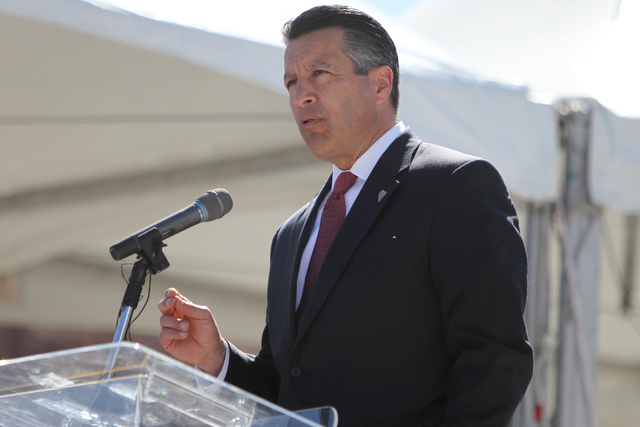


Gov. Brian Sandoval is remaining silent on an issue he tried to fix last legislative session and told the Las Vegas Review-Journal as recently as February he would look into: why Nevada is granting parole to inmates but not letting them out.
The American Civil Liberties Union of Nevada asked for an outside review of the state’s parole system Thursday and released the results of a survey of inmates who remained behind bars after the state determined they should be let out. The ACLU argued the parole process is in utter disrepair.
The call to action followed a Review-Journal investigation that showed inmates are often granted parole but not released, a problem that keeps poor prisoners behind bars at a cost to taxpayers of some $4 million a year.
Sandoval said in February he was unaware of the parole backlog until the newspaper brought it to his attention, and said he would look into the matter. Less than two weeks ago, the governor signed into law Senate Bill 449, which authorizes an interim legislative study of the parole system. It remains unclear if that will be his only action on the issue this legislative session.
The governor’s office did not return several calls and emails seeking comment Thursday. Sandoval spokeswoman Mari St. Martin initially deferred comment on the matter to Nevada Parole Board Chairwoman Connie Bisbee. She later indicated the governor would issue a statement on the ACLU report. The Review-Journal had not received that statement Friday afternoon.
“Many of the inmates who remain in the parole release process refuse to cooperate in the preparation of an acceptable supervision plan and, therefore, they are not eligible for immediate release,” St. Martin wrote late Friday night. “All of the Nevada agencies who have a role in the criminal justice system work diligently to comply with Nevada law, expeditiously review and release all inmates who are eligible for parole, and strive to ensure that the safety and well-being of our communities is always protected.”
Sandoval’s silence on the parole backlog seemed to grow deafening Friday, as one state legislator said he would like to see the governor do more to address the issue while another said it would be better to do away with Nevada’s parole system altogether.
Although Sandoval said in February he didn’t know about the backlog — which averaged 365 prisoners last year — he backed a proposal that brought the issue before the Legislature in 2013. Nevada Department of Corrections Director Greg Cox was then pushing to shift Parole and Probation to his control to fix the bottleneck. Cox pitched the change to lawmakers as a way to cut costs and prevent recidivism, and Sandoval included it in his budget request.
The governor said in February he pushed the 2013 proposal as far as it could go but moved on when it was voted down.
The agency responsible for dealing with the delays, Parole and Probation, has said some criminals just don’t want to leave prison. Bisbee, the parole board chairwoman, echoed that suggestion. But the state’s own statistics show such refusals accounted for only around 6 percent of parolees stuck in April’s backlog.
All of the prisoners who told the ACLU they refused parole — 20 percent of those surveyed — did so because of how challenging it was to create a plan to get out. The ACLU sent its survey to 75 inmates who had been granted parole but remained locked up. Forty-three responded.
Clark County Public Defender Phil Kohn, whose office regularly gets calls from inmates complaining about being paroled but not released, said he was glad the backlog issue is being raised. He added that Nevada needs more halfway houses, which are far cheaper than prisons.
As it stands, the state has only a small fund to assist inmates with housing. The Legislature appropriated $68,928 for fiscal year 2014-15. In 2014, 378 inmates applied for that money. Only 113 applications were approved.
The ACLU report showed securing and paying for housing was a problem for 80 percent of the inmates surveyed. The report said the state admitted its parole system was broken a decade ago after an internal review. And changes made by the state appear to be largely theoretical, with most inmates unaware of programs meant to help them, ACLU of Nevada Director Todd Story said.
State Sen. Tick Segerblom, D-Las Vegas, said Friday the state has been “penny-wise and pound foolish” in failing to address its parolee backlog.
Segerblom, a longtime appointee to the state’s 17-member Advisory Committee on the Administration of Justice, expects an upcoming justice committee study will take dead aim at each of the parole system shortcomings outlined in Thursday’s ACLU report, including allegations that inmates receive little assistance in crafting a release plan and almost no aid in finding and paying for a halfway house.
That study was passed into law early this month under SB449. Segerblom, who has called on the state to better fund its Parole and Probation division, expects committee members will seek help from at least one independent criminal justice foundation in conducting the inquiry, which is set to wrap up by Sept. 1, 2016.
Meanwhile, Segerblom wouldn’t mind seeing some action from the governor.
“(Reform) takes money, but you have to just step up to the plate,” he said. “We know what we need to do; we’ve just never had the money or the will to do it.
“I know the governor has made education his thing. I hope he makes prisons his next thing.”
Fellow committee member and state Sen. Greg Brower, R-Reno, proposed a more radical solution for tackling the backlog: dismantling the parole system.
Brower said he would prefer to see the state adopt the kind of “determinate sentencing” used in federal courts and in 16 states. That would either reduce or completely eliminate the Nevada parole board’s power to reduce a prison sentence, leaving it up to judges to issue non-negotiable criminal sentences.
He hopes committee lawmakers and judges will take a hard look at that solution, alongside gentler parole system reforms, before the start of the 2017 legislative session.
“(The ACLU report) certainly suggests we need to take a look at the parole system,” Brower said. “I’ve long believed we should go to a federal system where there is no parole. … That, in my view, is a much more efficient way to handle the issue.”
Parole and Probation Capt. Dwight Gover deferred comment on the ACLU’s report to Bisbee.
Gover, who was interviewed at length for the Review-Journal’s February investigation on the state’s parole system, said he was not in a position to comment on the survey but wouldn’t say why. He was forwarded a copy of the ACLU’s report Thursday morning.
Contact Bethany Barnes at bbarnes@reviewjournal.com or 702-477-3861. Find her on Twitter: @betsbarnes Contact James DeHaven at jdehaven@reviewjournal.com or 702-477-3839. Find him on Twitter: @JamesDeHave


