Special session: Film tax credit bill narrowly survives early challenge in Nevada Legislature
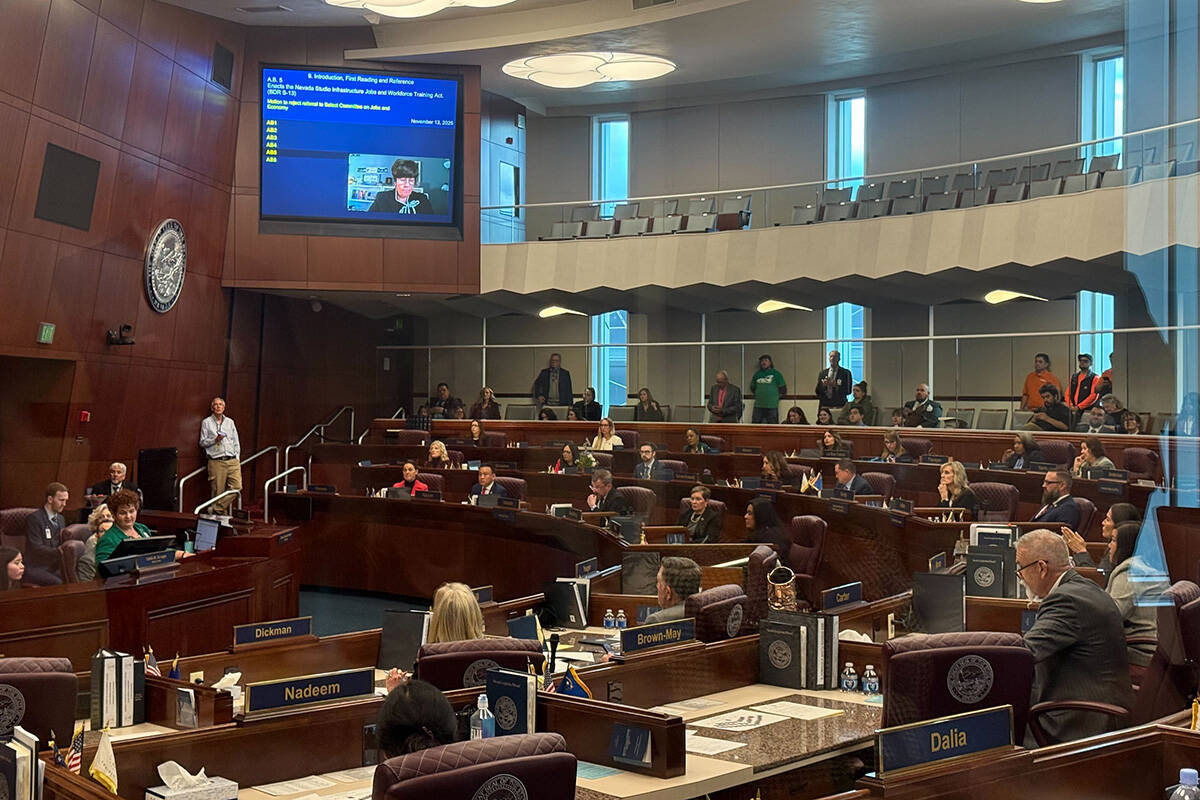




CARSON CITY — A special session of the Nevada Legislature started with dramatics Thursday that challenged a blockbuster bill to lure Hollywood studios to Southern Nevada and followed with hours of legislative hearings on more than a half dozen other proposals.
During the initial reading in the Assembly of a bill proposing increased tax breaks for the film industry, Assemblymember Selena La Rue Hatch, D-Reno, invoked a rule that can be used to force a vote on whether a bill should be rejected from further consideration. An absent lawmaker was teleconferenced in for the vote, and a 21-21 tie allowed the measure to move forward.
Republican Gov. Joe Lombardo called a special session of the Legislature on Wednesday, saying the state needed to address more than a dozen pieces of legislation. The agenda includes some high-profile bills that failed in the regular session about five months ago.
Telephone testimony limited
The Assembly did not allow call-in public comment. Regular legislative sessions include that option for remote testimony.
After the vote, La Rue Hatch questioned why call-in testimony from the public would not be allowed during Assembly meetings. Lawmakers also suspended requirements to post advance public notice for meetings.
“I feel like what we just saw was democracy at work, and I do have concerns that we are in an emergency special session considering bills that the public has not gotten to see,” she said on the floor. “And I’m especially concerned that we are allowing remote participation for our member, which I believe is right, while we are not allowing it for the public.”
The American Civil Liberties Union of Nevada condemned the testimony limitations in a joint statement with Battle Born Progress, highlighting what it said are “transparency and accountability issues” within the Legislature.
“This decision undermines the same principles of accessibility and participatory democracy that Assembly Democrats have purported to champion,” ACLU of Nevada Executive Director Athar Haseebullah said in a statement. “If this is truly the people’s house, we would encourage Assembly Democrats to reverse course and take the people’s phone calls.”
Assembly Speaker Steve Yeager, D-Las Vegas, did not respond to a request for comment. In-person testimony is available in legislative buildings in Carson City and Las Vegas, “time permitting,” according to a Wednesday evening press release from the Assembly Democratic Caucus. Written testimony will also be accepted. Caucus Executive Director Liz Luna said the policy was consistent with previous special sessions and that the Assembly is working with a limited staff.
Film tax credit program expansion considered
Perhaps most notable is the push to build the Summerlin Studios project. That bill would expand the state’s transferable film tax credit program to up to $120 million available annually, $95 million of which would be tied to the development of a film studio campus near Town Center Drive and Flamingo Road in the southwest Las Vegas Valley.
In an afternoon hearing on the film tax credit expansion, some lawmakers sought to understand the expanded program’s effect on future general fund balances. Legislative Counsel Bureau fiscal staff projected the fund could have an ending balance in 2030 below the minimum of 5 percent of proposed expenditures that is required to be reserved in general fund budgets.
“That said and in reality, the Legislature essentially would not allow the 5 percent minimum ending fund balance to be reduced, and as such, expenditures would either have to be cut by those dollar amounts or revenue enhancements would have to be approved in order to meet the ending fund balance,” Assembly Fiscal Analyst Sarah Coffman told the committee.
Testimony also explored a portion of the bill that would allow Clark County to create a special tax district encompassing the proposed studio. Those funds would support pre-kindergarten expansions in the Clark County School District.
Superintendent Jhone Ebert and John Vellardita, the head of Clark County’s teachers’ union, spoke in favor of the legislation. Ebert said the district has multiple early education programs with hundreds to thousands of students on their waitlists.
“The sheer volume of these wait lists, especially for our most vulnerable students, underscores the urgency of expansion, in addition to adding the seats for full-day pre-K classrooms, we must move from our half-day programs,” she said. “In Vegas terms, investing in pre-K is the bet. It’s not just a safe bet.”
Still, other educators are not in favor of the bill. Progressive groups, including the Nevada State Education Association, called out the proposed tax credits as a “Hollywood handout” during a press conference Thursday.
Lombardo’s revived crime bill heard
The Assembly Public Safety and Security Committee heard hours of testimony Thursday afternoon on the sweeping crime bill, but did not vote on the measure.
The crime bill is identical to legislation that failed in June due to time constraints, and is a priority for Lombardo, the former Clark County sheriff. It’s an attempt to alter nearly a dozen different areas of Nevada’s criminal justice laws.
Those changes include enhanced penalties for DUI offenses, assaults against hospitality employees and property damage offenses that occur during thefts; expanded definitions of domestic violence and stalking; and expanded requirements for court hearings to seize firearms from criminal defendants and requirements for mental health evaluations in juvenile court cases.
The bill also requires Clark County to establish a “resort corridor” in the Las Vegas Strip and report crime data from that area. Crimes committed in the corridor can result in court orders banning defendants from the area for up to a year.
The legislation stops short of requiring judges to bring back the controversial Resort Corridor Court program that opponents say targeted homeless people on the Strip. But it does specify that judges are allowed to create such a court.
“The Resort Corridor Court was meant to reduce crime on the Strip, but in reality it punished people for being poor and unhoused,” testified Taisacan Hall, representing the Nevada Homeless Alliance.
The Resort Corridor Court operated for nearly two years before Las Vegas Justice Court judges elected to end the program in late 2024. A Las Vegas Review-Journal analysis of Las Vegas Justice Court data showed that trespassing was the most common offense tied to orders banning people from the Strip, and that few cases associated with the program involved violent crimes.
Virginia Valentine, president of the Nevada Resort Association, said that available criminal justice data does not “tell the entire story” of the reality of the resort corridor.
“The number of cases seen by the court pales in comparison to what hotel security sees,” Valentine said.
Other proponents for the crime bill included several major gaming companies, the Nevada District Attorney’s Association, the Metropolitan Police Department and the SEIU Local 1107 union.
Opponents questioned the necessity of including the crime bill in the special session when officials have said crime rates are down across the state.
“This is not an emergency measure,” said John Piro, a lobbyist for the Clark County public defender’s office. “This is a resuscitation of a failed policy from last session, and this failed policy should not be revived.”
State version of SNAP moves forward
A bill to create a state-funded public assistance program called the Silver State General Assistance Program was considered and voted out of the Senate Select Committee on Health and Wellness.
That bill would have allocated funds to the program if there was another lapse in funding to the federal Supplemental Nutrition Assistance Program, or SNAP. But the committee removed the funding allocation because of the end of the federal government shutdown.
The Senate continued to hold floor session Thursday night after the Review-Journal’s print deadline. The session resumes Friday.
Contact McKenna Ross at mross@reviewjournal.com. Follow @mckenna_ross_ on X. Contact Katelyn Newberg at knewberg@reviewjournal.com or 702-383-0240.