



CCSD to add more tests for middle schoolers in 2026-2027 school year
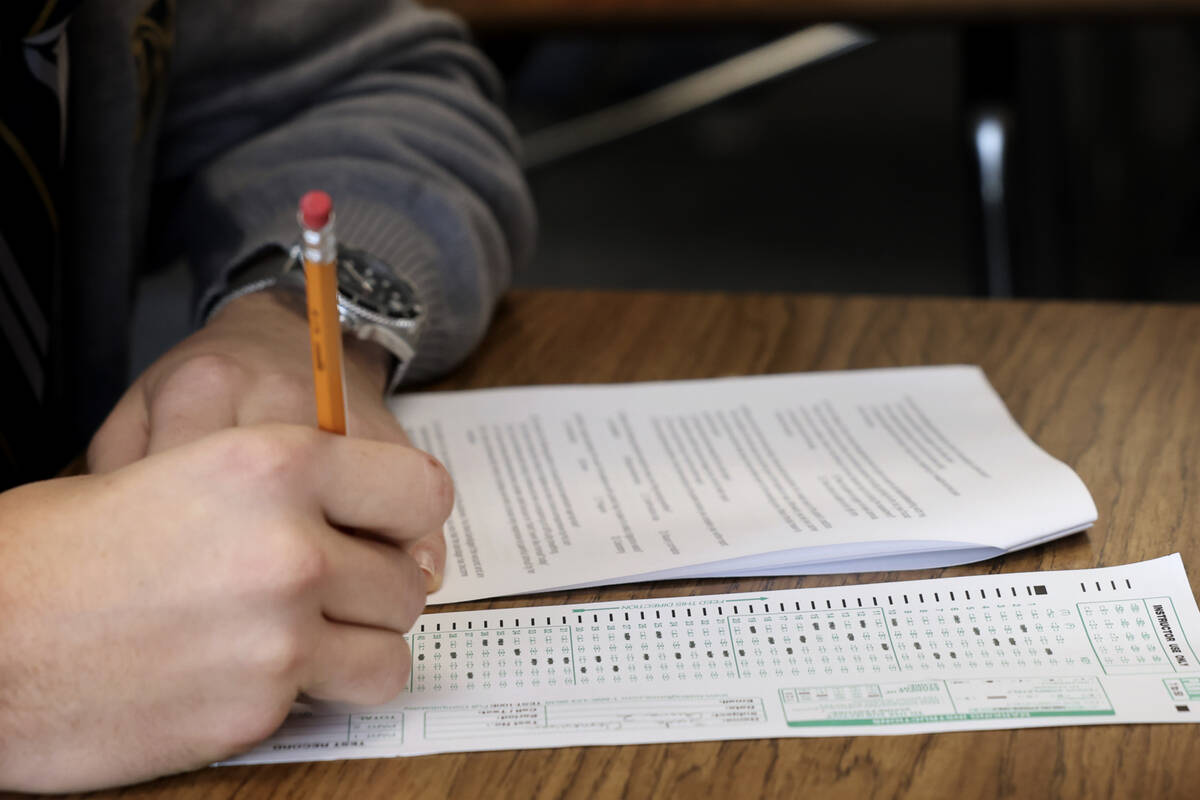




Middle school students can expect to take more exams starting next school year, according to a document sent to some Clark County School District principals earlier this month.
The CCSD document, titled “Middle School Common Semester Exams,” outlines a plan to establish semester exams to middle schools in the 2026-2027 school year.
The exams, scheduled to be administered in mid-December and mid-May, will test students’ knowledge in math, English language arts, science and social studies. The tests can be worth of up 20 percent of a student’s final semester grade in the subject being tested, the document states.
“Semester exams provide students with a meaningful opportunity to demonstrate their cumulative learning, reinforce key concepts, and develop consistent study habits that prepare them for the academic expectations of high school and beyond,” the school district document reads. “They also provide teachers and schools with valuable data to assess progress, identify strengths, and inform instruction.”
School days will be shortened to three hours and 40 minutes on exam days, with an hour and 45 minutes allotted for each period and 10 minutes scheduled for students to go from one classroom to another, the document states.
Semester exams will also be developed for high school math courses through Algebra II, a school district spokesperson said in an email.
The increased testing stems from a push by Superintendent Jhone Ebert, a former middle school math teacher, to improve math proficiency among middle schoolers across the valley.
Ebert previously floated the idea of regular middle school math testing in a September document outlining her first 100 days as superintendent. Last school year, the school district had just 27.4 percent of middle school students proficient in math and only 42.9 percent proficient in English language arts, state data showed.
Ebert’s September document, however, did not identify English language arts, science or social studies as areas of interest for increased testing. In an email, a school district spokesperson said the three subjects will be tested “to provide consistency among the core content areas in middle school.”
What will the tests look like?
The school district’s Curriculum and Instruction Division will develop the exams by the start of the 2026-2027 school year at no cost to the district, a spokesperson said in an email. Tests will be based on Tier I instructional materials, which are provided by the school district and are taught to all students.
Though exams are still in development, a school district spokesperson said in an email that all middle schools will be provided with the same exams for each course and the district anticipates tests will “consist of a variety of question styles to fully assess students’ mastery of the subject matter.”
The spokesperson did not say whether tests would be developed in multiple languages to accommodate English language learner students, but said the district “will take the appropriate steps to address the academic needs of students taking exams” in an email.
‘More tests are not always better’
Whether more testing actually translates to greater academic achievement isn’t clear, according to Megan Griffard, assistant professor of educational policy and leadership at UNLV.
Griffard identified two main areas where testing is useful: analyzing student growth over the school year and showing teachers what concepts their students aren’t understanding. But with students already taking many standardized tests throughout the year and past grading reforms de-emphasizing concept mastery through homework, Griffard said artificial grade inflation can occur.
“It’s not necessarily that I’ve learned and absorbed this information and I’ve really mastered it,” she said. “It could just mean that I’ve memorized and parroted back what I’m expected to do on these tests.”
Griffard said one change semester exams could usher in is ensuring all schools teach the same standard lessons. “Having a common assessment can make sure that there is consistency in the curriculum … but more tests are not always better,” she said.
More tests can also cause more stress for both students and teachers, Griffard added. Not all students thrive in a high-stakes test taking environment, she said, and teachers in low-performing schools with disadvantaged students can get burnt out from feeling extra pressure to teach to the test.
“There are lots of other ways that students can demonstrate mastery of their learning besides sitting and taking a test,” Griffard said.
Contact Spencer Levering at slevering@reviewjournal.com or 702-383-0253.


