After gulf oil spill, diners as ‘Is it fish or foul?’
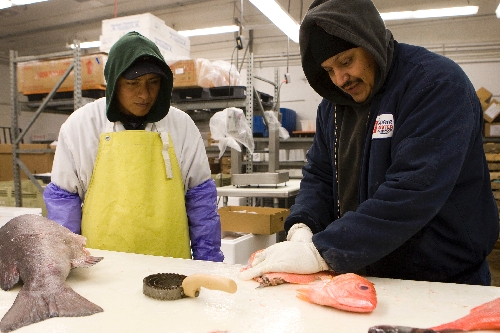
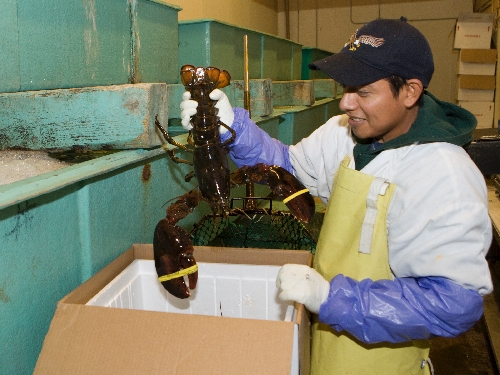


OAKLAND, Calif. -- Shawn Mattiuz, manager of the Hapuku Fish Shop in Market Hall, a collection of upscale food purveyors in Oakland's bustling Rockridge district, has been watching the Gulf seafood saga play out in the ice-cooled trays of his display cases.
For a few days after the oil spill turned into a crisis this spring, demand stalled as "everybody freaked out," he said. Since then, he says concern has died down and he's selling about the same amount of Gulf shrimp as he did pre-spill.
"I get a lot of questions about it, definitely. They want to know if it's regulated," Mattiuz says. "The truth of the matter is from everything that I've read, it's more highly regulated now than it ever has been."
More Gulf waters are reopening to fishermen, and government officials say seafood cleared for sale has been thoroughly vetted. Whether consumers are buying those assurances -- and the fish -- remains to be seen.
Nationally, an Associated Press-GfK poll that surveyed 1,007 adults nationwide between Aug. 11-16 found that 54 percent did not trust the seafood.
But Las Vegas wholesalers and restaurateurs have not seen a drop in their sales during recent weeks. Andrew Goodman, executive vice president of wholesaler Supreme Lobster and Seafood, said his customers among the Strip hotels have not cut their orders.
Likewise, said Greg Bonner, co-owner of wholesaler Oasis Seafood, said his business has not been affected by health concerns. Fish come from many parts of the world, he said, "and true seafood eaters know that."
The source of declining demand has been the slow economy, as more people at the retail level trade down from fish to much cheaper chicken, he said.
Lola Pokorny, the owner of Lola's - A Louisiana Kitchen, said the proportion of seafood she sells has remained steady in the wake of the oil spill.
"We make sure our customers know that we would not put anything on the table that we would not eat ourselves," she said.
But Jimmy Galle, founder of Sausalito-based Gulfish LP and supplier to Hapuku and a number of upscale restaurants in the San Francisco Bay area and elsewhere, says his business has begun to grow again after a few lean months.
"And the shrimp has been nothing less-than-spectacular lately," he said.
Ann Cashion, co-owner of Johnny's Halfshell in Washington, D.C., one of Galle's clients, sees concerns about Gulf seafood safety fading.
"I find that people aren't even asking right now. It was more on top of people's brains when the oil was still flowing," she said.
Cashion believes the testing is thorough, particularly because state officials are involved.
"The state of Louisiana and the Gulf Coast in general has so much to lose if there is any kind of problem with any seafood that gets through inspection, so I know the inspection is going to be thorough and is going to err on the side of 'Let's don't take any chances,' " she said.
Not everyone shares that confidence in Gulf seafood, which accounts for about 2 percent of overall U.S. seafood consumed.
"I would say that I always have a skeptical eye toward government regulation and government certification of things," said Genie Gratto, an Oakland food blogger. "It's been proven time and time again that, first of all government certification of food is such a massive job -- the USDA and the FDA tend to be pretty understaffed in those kind of inspection areas -- there's no way they can get everything."
However, she has confidence in buying from trusted suppliers, like the small meat and fish market she shops at. She also tries to buy local, which doesn't include Gulf seafood.
The Natural Resources Defense Council and other groups recently asked the Food and Drug Administration and the National Oceanic and Atmospheric Administration to strengthen procedures for determining whether seafood is safe and whether fishing areas should be reopened.
They also want sampling protocols and data published online.
"We're not saying that the seafood is not safe," said Gina Solomon, a senior scientist with the council. "We're basically raising questions about the government's procedures, their scientific procedures and their transparency."
One issue is whether government standards are strict enough to protect vulnerable populations, she said.
"We want to make sure that the government is setting up a robust seafood safety testing program that will be able to protect the public for years to come, because that's how long this problem is likely to last."
The main issue with oil contamination is potential cancer-causing substances called polycyclic aromatic hydrocarbons, or PAHs. These are pollutants that show up in other foods as well, such as grilled meat.
If there is contamination, fish metabolize it fastest, oysters and crabs slowest and shrimp are somewhere between.
Testing includes "sniffers," who check for traces of oil and lab tests on ground up seafood to check for signs of contaminants.
Because of strict adherence to procedures, the FDA "feels confident in the safety of seafood coming from these waters," Scott said in an e-mail. "We also understand that we must remain vigilant to ensure the safety of seafood coming from the Gulf. As such, FDA and NOAA will continue to monitor both water and seafood to ensure that tainted fish is not allowed into the marketplace."
Like Mattiuz, John Currence, chef/owner of the City Grocery Restaurant Group in Oxford, Miss., has been getting a lot of questions about Gulf seafood -- but not because customers are nervous.
"People have, through the entirety of this crisis, actually questioned us about our seafood because they wanted to support the Gulf fisheries and the Gulf fishermen, not because they were afraid of the quality of what was available out there," he said.
In Oakland, about half a dozen customers stopping by Hapuku Fish during a recent lunch-hour seemed unfazed at the idea of buying Gulf seafood. One exception was Louise Booth, a homemaker in the east San Francisco Bay. She wasn't ready to buy Gulf seafood "for a while."
"I know it's been authorized, but ... " she said, shrugging her shoulders.
But regular customer Sharon Francis of Oakland happily selected some fresh Gulf shrimp to go with a paella.
"I just trust my fishmonger," she said. "I know these guys carry the best."
Business Press writer Tim O'Reiley contributed to this report.