



Exec serves others by striving to be part of causes bigger than herself
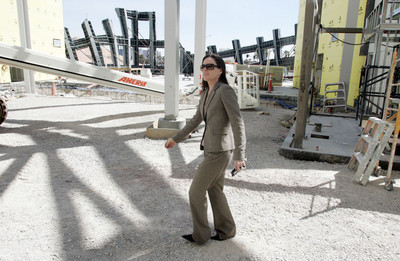


Seldom a day passes when Maureen Peckman doesn't meet someone whose close friend or family member is afflicted with some type of brain disorder.
She's had grown men break down in tears telling her stories about their mother in a memory-care facility.
Peckman lost both of her grandmothers to Alzheimer's disease.
"One passed away without ever having a formal diagnosis, which is very common," said Peckman, who accepted the position of chief operating officer for the under-construction Lou Ruvo Brain Institute in December.
The $74 million project, a centerpiece for the 61-acre Union Park development in downtown Las Vegas, is expected to be completed by early summer 2009. Whiting-Turner is the general contractor. The building was designed by Frank Gehry Architects.
The institute is named in honor of Lou Ruvo, whose son, Larry, owns Southern Wine and Spirits of Nevada and was a major donor to the facility.
Peckman said the brain institute will bring cutting-edge medical research to Las Vegas and become big business as roughly 10 million aging baby boomers enter some stage of dementia.
Before taking the job at the Lou Ruvo Brain Institute, Peckman was president of Peckman Outdoor Media. She served as senior political aide for state Sen. Jon Porter and worked on two U.S. House of Representatives campaigns in 2000 and 2002.
Question: Why did you want to become chief executive officer of the Lou Ruvo Brain Institute and how were you selected?
Answer: I like to be part of things that are bigger than I am and things that people say can't be done.
They looked at someone who had an administrative and business background and experience building an organization, and at the same time, someone pretty passionate about the community.
Question: What does the brain center do?
Answer: We treat people. We provide treatment for individuals who've been afflicted with neurological disorders -- Alzheimer's, Huntington's disease, amyotrophic lateral sclerosis, (also known as Lou Gehrig disease), Parkinson's -- and we also have extensive research initiatives that focus on detection of these diseases at earlier ages and ultimately prevention.
Question: Who would be considered your competition? Is there any in Las Vegas?
Answer: When you think of competition, you think in monetary terms and there's little if any reimbursement for this type of treatment. It's $45 for three hours of a doctor's time for initial diagnosis. Think how many patients that doctor could see in three hours if it was general maladies. He'd make $2,000 in that time. I don't know that there's other competition. There's competition, but our greatest challenge is breaking down the silos to share information among the doctors.
Question: How does the brain institute make money?
Answer: Off meager patient reimbursement. Neurology is not a high reimbursement field. When research initiatives begin to pour into the institute, research grants bring in a lot of money to absorb clinic expenses. We expect to garner a lot of public money from state and local sources and additional revenues from our life center, which has a 900-person capacity for meetings and conferences.
Question: What kind of an economic impact will the center have for Las Vegas?
Answer: I think we're going to fill an incredible void for the patient and caregiver services and that's just the local population impact. The institute, through its research, will bring economic development through the medical sector and notoriety on a national scale as Nevada being a premier institute in the world for treatment and research initiatives.
Question: What do you hope to accomplish there? Do you have a mission?
Answer: My personal goal is to see this organization open and begin to immediately serve the needs of the local population and spark a paradigm shift for how we better treat and prevent neurological diseases.
Question: Is Las Vegas on the map for medical research?
Answer: I think we're moving quickly toward it. The medical sector is beginning to ask what's happening in Las Vegas and the state itself is starting to grow. The federal government for years has tried to send multimillion-dollar grants our way, but they haven't found the proper community partners. They're able to do that now because we're here. A lot of people are starting to notice.
Question: What happened to your outdoor advertising company, Peckman Outdoor Media?
Answer: We've sold the inventory off in bits and pieces.
Question: For how much?
Answer: A lot.
Question: More than $1 million?
Answer: Yes. We've done pretty well.
Contact reporter Hubble Smith at hsmith@reviewjournal.com or 702-383-0491.
VITAL STATISTICS Name: Maureen Peckman Age: 39Position: Chief operating officer, Lou Ruvo Brain Institute Family: Husband, Phillip; daughter, Schafer Education: Penn High School (South Bend, Ind.), 1987; George Washington University, Bachelor of Science in sports medicine and exercise physiology, 1991 Work history: President of Peckman Outdoor Media; senior political aide for state Sen. Jon Porter; political director on two U.S. House of Representatives campaigns in 2000 and 2002; independent consultant in retail, commercial and entertainment; assistant director at Four Seasons hotel in Washington, D.C., 1990-1994 Hobbies: Running; reading international political policy journals and newspapers; watching European soccer; spending time with family Favorite book: "Good to Great," by Jim Collins Hometown: Naperville, Ill. In Las Vegas since: 1999 Quotable: "I like to be part of things that are bigger than I am and things that people say can't be done."Peckman's office is at 9510 W. Sahara Ave. and she can be reached at 233-1155.


