



Former Air Force captain now runs Tronox Henderson plan
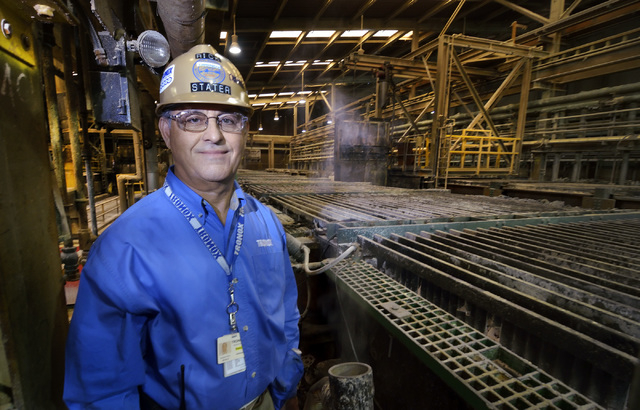
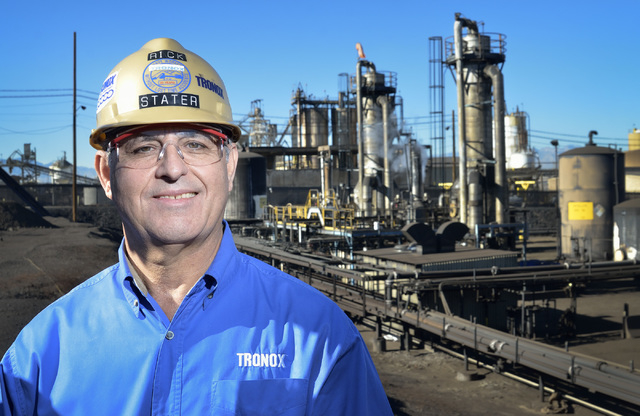


Many people drive by Tronox’s Henderson complex without knowing what goes on inside.
Its origins date to the early 1940s as a place the U.S. government set up shop to make magnesium for aircraft production and bombs for World War II.
The vacant land and access to power and water from Lake Mead made it an ideal location for Tronox’s Henderson plant, formerly known as Kerr-McGee. The plant’s chemicals are used to make batteries for children’s toys or household products. The plant could also help create the next generation of batteries for electric automobiles.
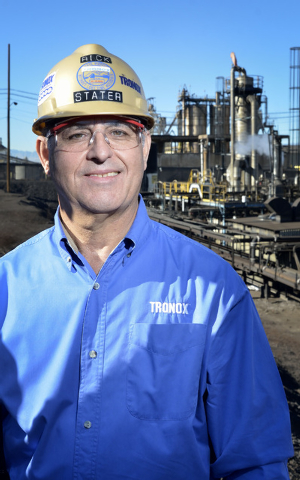
Rick Stater, 66, a former Air Force captain who once ran track at the University of Iowa, manages 100 people at the Tronox plant.
It’s been a long road to Tronox for the youngest of 10 children from Ottumwa, Iowa, who grew up working on farms and decided to pursue chemical engineering as a career.
Question: Why were you interested in pursuing a chemical engineering degree?
Answer: It’s a combination of true engineering like mechanical and all of those things that has chemistry involved with it. I like the chemistry as well. We have a standard debate that goes on between chemists and chemical engineers. They call us “superplumbers” because we deal with how to move fluids through processes and take into consideration all of the aspects of fluid flows and chemical reactions, kinetics and things like that.
Question: Why did you pursue that career out of college?
Answer: I got the degree during Vietnam era. I was on the military deferment program going through ROTC at the University of Iowa. I got the degree in 1971 when the Vietnam War was going on. Since I went through ROTC, I had to spend three to four years in the Air Force as part of the commitment to have deferment.
I went in as a second lieutenant in ordnance and munitions and spent a year in Thailand in 1973 and 1974. I decided I didn’t want to make that a long-term career and got out in 1977.
Question: Where did you go then?
Answer: I came to work for Titanium Metals Corp., which is Timet, right next door to this plant. I worked there for 5½ to six years.
I went through a large layoff they had in 1982 and came to work here within a couple of months. At the time this was Kerr-McGee Chemical. I came to work here and been here for almost 32 years.
Question: How did that come about?
Answer: I started here in March 1983. I came in through safety even though my degree background was engineering. They weren’t hiring engineers. They were in need of a safety person, and I had a military safety background in ordnance and it somewhat fit with the ammonium perchlorate and other things they made at the time here. I got my foot in the door that way.
I was safety engineer for a year and two months. I took over environmental for nine months and then did a project to design and build a new sodium perchlorate plant here for about a year.
Then I became a superintendent at one of the departments and had that job for a year and a half. I became operations manager in 1987. I’ve been (an) office manager or plant manager ever since.
Question: What did they do at the plant then, and how has that evolved?
Answer: In the 1985 time frame, we were trying to get rid of old technology that had environmental issues at the time and put in new technology. I and another engineer worked with an outside company to design and implement a new sodium chlorate plant that had none of the emissions the old plant had. That was built in 1988-89.
After getting that design going, I became superintendent of that department and then operations manager, which means manager of the all the production processes. Kerr-McGee at that time had eight different products here at the site. I had three superintendents working for me.
Question: What were you doing?
Answer: (The plant) made manganese dioxide — a black powder that’s in your Duracell and Energizer batteries. It’s the energy source in the alkaline batteries. It’s used in your airbag ignition system in your automobile and in ignition systems in military missiles. It’s part of the explosive system that separates the space shuttle from the general tank on that launch vehicle. It’s also a pyrotechnic compound that’s very expensive but reliable. We also made three different boron products.
Question: What are you main products today?
Answer: Manganese dioxide; it’s (manufacturing accounts for) probably 85 percent of this site in terms of staffing and people. We’re one of the largest facilities in the United States. We pride ourselves that our product is very high quality and in more demand than our competitors. That’s because we have been making it here since 1950.
We developed good technology and capabilities to develop a high-quality product. Duracell makes a battery called the Quantum, a new red battery that has 100 percent of this facility’s product in it. It’s not blended with any other manufacturer. It’s a unique formulation just for them.
Question: Are batteries a big part of your business?
Answer: The Duracell and Energizer batteries are alkaline batteries, a battery that’s been in existence for 60 to 70 years. The formulations have gotten better and you get a lot more power out of a AA or AAA battery than you would have years ago.
We’re also in the beginning phases of making another battery-grade material called lithium manganese oxide, and you may have heard of that in the recent Tesla (Motors) development here in Nevada. Tesla cars will use a product similar to that.
Lithium manganese oxide is made using manganese dioxide. You can do more chemical processing to ... allow it put out more voltage. Those batteries are used in automotive systems when you have the electric vehicles. Some have lithium manganese oxide as the battery source; others have lithium manganese cobalt. Lithium manganese oxide is the battery of the future for that.
Question: What will all these mean?
Answer: Eventually, that will become a battery of choice, I think, for the automotive industry. Its main use right now is in power storage. You can use lithium manganese oxide combined with a solar array in which the batteries are recharged. Batteries are used to drive in the nighttime when there’s no sun and the solar system drives the electrical grid in the daytime and charges the batteries.
VITAL STATISTICS
Name: Rick Stater
Occupation: Plant manager, Tronox Henderson
Family: Wife, Susan; daughter, Erin; son, John.
Work history: U.S. Air Force, six years (munitions officer-captain); Titanium Metals Corp. six years (process and project engineer); Kerr McGee/Tronox, 32 years (staff engineer-safety/environmental, two years; operations superintendent, one year; project engineer, one year, operations manager,12 years; plant manager, 16 years).
Education: Bachelor’s degree, chemical engineering, University of Iowa 1971; Master’s of business administration, marketing, UNLV, 1981
Hobbies: Gardening; woodworking; sports, volleyball and golf.
Favorite movie: "Gone With the Wind," "A Good Year," and sci-fi types.
Favorite book: "The Old Man and the Sea"
Favorite music download: Have none except 60s’ style rock and country
and western
Most admired: Locally Steve Wynn. Bill Gates for his philanthropic work around the world.
Favorite getaway: Mountains.


