



Las Vegas dealerships in doldrums
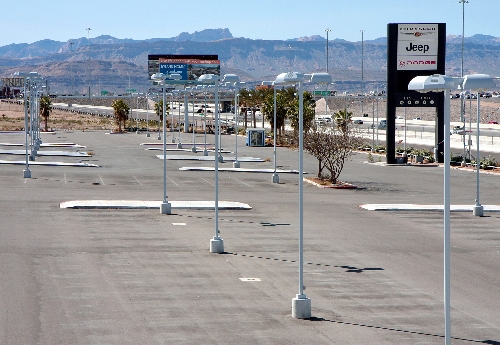


When Findlay Chevrolet opened in 2007, the barren stretch of desert there along the southern beltway between Jones and Rainbow boulevards looked poised to become another auto mall. General manager Justin Findlay envisioned it that way.
Tom Saitta had already opened Integrity Chrysler Jeep Dodge. Pat Clark was going to build a Pontiac GMC dealership. Gary Ackerman was bringing in Ford. Nissan and Toyota planned new stores, too.
Then the economy tanked, credit markets dried up and consumers hunkered down.
In a recession that has decimated Southern Nevada's work force -- 13.9 percent are jobless -- and sent one in 19 households spiraling toward foreclosure, buying a new car is as realistic for many local consumers as vacationing in Tahiti or getting a big-screen plasma television. It just isn't happening.
"It went the other way," Findlay said as he looked out over the empty desert from the top of his parking garage, juxtaposed near the now-vacant Integrity dealership.
New-vehicle sales in the United States hit a 30-year low of about 10 million units in 2009 and the outlook for this year isn't much better, local auto dealers said.
About 45,000 new cars and trucks were sold in Clark County in 2009, down from a high of 105,000 in 2006, according to the Nevada Franchised Auto Dealers Association.
Automobile dealerships are struggling in an economy that has curbed new-car sales and tightened credit for big-ticket items, leaving about a dozen empty lots dotting the valley and creating commercial blight along some of the city's major boulevards.
Several closed dealerships are scattered along Sahara Avenue, which was once a shining showcase for new cars in either direction. They include Pat Clark Pontiac, Las Vegas Cadillac, United Hyundai and United Chrysler Jeep Dodge. Bill Heard Chevrolet on Decatur Boulevard closed in late 2008.
Selling cars in Las Vegas used to be a low-risk business, Findlay said. Dealerships would change ownership or franchises, but very few would go out of business, he said.
"Things are getting better," the third-generation Las Vegas auto dealer said. "Obviously with fewer dealerships, there's less competition. It does feel a lot better. We feel sales coming back."
Spurred by government aid to auto financing companies, it should be easier for buyers to get approved for a deal this year. Banks and automobile finance companies are expected to quicken the pace on loans. Interest rates are still at record lows.
Chrysler Financial received a $1.5 billion, five-year loan as part of the $700 billion Troubled Assets Relief Program to loosen credit requirements for customers with a score in the 620 range.
"I think the credit market is easing up somewhat," said Jim Marsh, owner of Jeep, Kia, Mitsubishi and Suzuki dealerships in Las Vegas. "It has been a problem for sales. The biggest problem is lack of consumer confidence and getting people through the door."
The government's "Cash for Clunkers" incentive program spurred new-car sales for a couple of months in 2009, but that's over now.
"'Cash for Clunkers' boosted sales for a while, but at the end of the day, it depends on the financial health of consumers," Las Vegas economic consultant John Restrepo says. "Maybe one of the partners lost their job or they're loaded with debt. Buying another car may be viewed as discretionary spending if the car you have now is operating fine. It's one thing to buy because you need to and another to buy a new model every few years."
Bruton Smith, chairman of Charlotte, N.C.-based Sonic Automotive, said customers are slowly returning to showrooms. New-car sales have picked up 13 percent nationally from a year ago, he said.
February was one of Sonic's better months in some time with 8,000 used-car sales and March was on pace to top that number, Smith said.
The automotive executive faulted Wall Street investment firms and banks for subprime lending that created a problem for overleveraged home buyers. You can't loan to everybody, he said.
"Look at the housing market. What they did there was absolutely criminal," Smith said. "That put the economy in a tailspin. It's impossible for everybody to own a home. A lot of people can't buy a tent. We don't do that in the automobile industry because it does not work. If
25 percent to 30 percent of your sales are going to be repossessed, you're doing the finance company an injustice and you're hurting the buyer."
Sonic owns 145 dealerships nationwide, including two Cadillac of Las Vegas dealerships, Honda West and Volvo of Las Vegas.
The company posted a loss of nearly $686 million in 2008 and was considering bankruptcy last year before raising nearly $210 million in senior subordinated debt.
Tyler Corder, chief financial officer of Henderson-based Findlay Automotive Group, said core business was slow in 2009, but he saw sales start to bottom out late in the year and post small year-over-year increases. He was tracking 2,600 total new- and used-car sales in March, compared with about 1,400 in the same month a year ago.
"This is the first month we've seen a significant increase in a while," Corder said. "Credit has now started to loosen up. We're seeing a few lenders getting more competitive. When the credit crunch hit, quite a few automobile lenders pulled out or were more restrictive with higher rates. Now we're seeing additional lenders get back in the game. I've had three or four lenders call me in the last 45 days. I hadn't seen that for four years or so."
Depressed car sales forced Chrysler and General Motors to file for bankruptcy last year and close hundreds of underperforming dealerships.
The auto industry is expected to lose between 4,500 and 5,000 dealerships nationwide through forced closure by the manufacturer, dealers going out of business or not renewing their leases and franchise owners closing unprofitable stores, said Grant Traub, a broker at Colliers International in Las Vegas who specializes in disposition of auto dealerships.
The closings are punctuated by two trends in the credit markets, he said. One is the lack of dealer "flooring" credit lines, or lines of credit used to purchase vehicle stock and finance acquisitions of new stores. The other is lack of consumer financing for all but the very best borrowers.
"The president of one chain with several stores in Las Vegas told me he could easily triple his sales if there was a reasonable market for (lower-credit) loans," Traub said. "A buyer must have 720-plus credit score to achieve the best rates, but the gap between the best rates and rates for buyers with lower credit scores is so high that borrowers cannot qualify for the higher payments at double-digit interest rates."
Traub counted 11 closed dealerships in Las Vegas, most of them shutting down in the last 18 months. Some are new facilities in prime locations, such as the shuttered Integrity dealership. But more than half are older properties in poor locations with functionally obsolete buildings, the broker said.
One significant trend is the shrinking number of dealerships that manufacturers will approve in a given geographic territory, he said. Chrysler terminated three dealerships in Las Vegas and now has a strategy to have local Chrysler stores owned by two companies -- Towbin and Chapman.
Another trend is toward rebranding. Saturn of Henderson is being retooled to become Lincoln Mercury, one of three Saturn dealership changes for Findlay Automotive.
"I think there's going to be a lot of nameplate changes," auto dealer Marsh said. "Saturn is going away, Saab is going away, Volvo was sold. A lot of things we see today won't be here in five years or even three."
Dealers are also upgrading their facilities, often to meet the architectural and interior standards of the auto manufacturer, Traub said. Findlay Audi moved from a small dealership to a larger flagship facility that complies with Audi requirements.
Smith of Sonic Automotive said new-car production -- projected at 12.5 million units this year -- won't keep up with demand. About 11 million cars are scrapped each year and roughly 4.5 million Americans turn 21, a potential new-car-buyer age, he said. Combined, that's more than 15 million units.
"We're not producing at that rate," Smith said. "All of a sudden we're seeing pent-up demand. You and I will be talking in a year and a half and we'll be selling 15 million to 16 million and four years from now we'll be talking 18 million cars and trucks."
New-vehicle sales account for more than half of total sales revenue at franchised new-car and new-truck dealers, the National Automobile Dealers Association reports. Those sales generate additional revenue in other departments that are more profitable for dealers. By putting new vehicles on the road, dealers can count on new repair and service customers and future trade-ins of used vehicles.
Auto-shopping Web site Edmunds.com is projecting 1.1 million vehicle sales in March, a 31 percent increase from a year ago. They're driven by incentives from manufacturers such as Toyota Motor Corp., which is trying to make up lost ground from a recall of millions of vehicles and a temporary halt in production and sales.
Projected sales for March resulted in a seasonally adjusted annual sales rate of 12.4 million, the best performance in 18 months, excluding "Cash for Clunkers" sales. The association reported nearly
17 million sales of new cars and trucks in 2006.
Findlay said the 2010 Camaro is his hottest-selling car starting at about $28,000 for the V-6 version and going into the high $30,000s for the Super Sport model with a Corvette engine. He also expects the Volt, Chevrolet's electric car, to be a big seller when it comes out in 2011.
Contact reporter Hubble Smith at hsmith@reviewjournal.com or 702-383-0491.


