



Law firms invest effort in initiatives
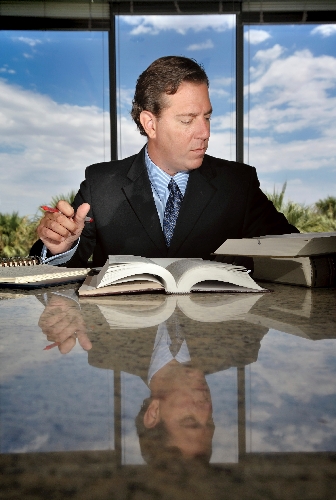


Social crusades such as immigration reform and pro- or anti-business causes like mining taxes usually grab headlines in the Silver State. Usually lurking on both sides of the ubiquitous election-year petition is a team of attorneys, unseen by voters, attracting little fame and racking up lots of billable hours.
As voters fight over verifying the citizenship of Nevada residents or increasing taxes on mining companies, law firms make money.
Jones Vargas, which has offices statewide, has handled some of the most prominent voter initiative fights. This year, the firm's attorneys successfully fought the Nevada Mining Tax Measure and the Nevada Immigration Reform Initiative.
Jones Vargas lawyers are opposing a federal lawsuit seeking to strike down Nevada's requirement to have a single subject on any one initiative petition. The requirement is known as the "single-subject" rule.
Joe Brown, the firm's president, said his attorneys benefit from "getting in on the ground floor of initiatives." The more petitions a law office handles, the greater its reputation as specialists in initiative issues.
Brown doesn't like the direction Nevada is heading with so many initiative petitions in recent years.
"I bet we (Jones Vargas) have done, honestly, a half-dozen (initiatives) in recent years, being so many interest groups want to circumvent the election process and go with initiative petitions," Brown said.
Back in the 1970s and 1980s, initiative work was rare for lawyers, the attorney recalled.
"Now that Nevada has been flooded with Californians, we all have signature drives, instead of going to the Legislature," he said.
Nevertheless, Brown can't deny that all the political issues have benefited his bottom line. Some initiative-related legal fights drag on for years.
Passage of the Nevada Clean Indoor Air Act followed legal challenges to its placement on the ballot. The end result of the 2006 vote was a ban on smoking in bars that serve food and most other public places. Passage meant three more years of work for Jones Vargas lawyers.
Bradley Schrager, who was a lead member of that legal team, said trying to overturn the Nevada Clean Indoor Air Act became his full-time job. His clients were operators of bars and slot routes.
"For months, that was pretty much all I did," Schrager said.
In the fall of 2009, the Nevada Supreme Court upheld the smoking ban.
Fighting a controversial ballot measure, and challenging it if approved, can cost litigants in the neighborhood of 400 hours of legal work, he said.
Taking the initiative
This election year provided plenty of toil for Nevada attorneys. More than a dozen initiative petitions were floated for the November ballot. Two of the most-publicized initiatives -- the Nevada Mining Tax Measure and the Nevada Immigration Reform Measure -- will not appear on the November ballot, partially because of legal challenges.
A petition called the Employee Paychecks Initiative, which would bar employers from deducting money for political causes from employee paychecks without employee consent, won't appear on the ballot, either.
Another petition, stipulating that workers cast secret ballots in union organizing elections, didn't qualify for the 2010 ballot. However, organizers of this secret ballot measure have their sights set on 2012.
Attorney Don Springmeyer said most work occurs during the petition battle, when signatures need to be collected. He said he worked pro bono for the Progressive Leadership Alliance of Nevada's Nevada Mining Tax Measure. The effort failed, and the measure won't be on the ballot this November.
Springmeyer and his law firm, Wolf, Rifkin, Shapiro, Schulman and Rabkin, donated about $120,000 in billable hours to the cause. Mostly, that was Springmeyer's own time. He believed the projections of nearly $200 million more in annual tax revenue would help the state immensely.
"We did it pro bono because it was the only way the proposal could get good, quality legal representation," Springmeyer said. "We tried to get other attorneys to work on a team, but we couldn't, because most attorneys had conflicts."
The mining tax proposal called for mining companies to pay not less than 5 percent tax on their gross proceeds, instead of the current law that allows a tax of not more than 5 percent of their net proceeds.
That drive ended in June, after the movement fell short of the required 97,002 signatures needed to qualify for the ballot.
Springmeyer guesses that opponents of the mining tax petition poured about $250,000 into defeating it. That included the costs of challenging the measure before the Nevada Supreme Court. Jones Vargas, the law firm representing the Nevada Mining Association, did not disclose its billable hours in that case.
A waiting game
Once an initiative makes it onto the ballot, lawyers typically get a time out while they await the vote. If a controversial measure passes, opponents often bring out their lawyers again, Springmeyer said.
Had the Nevada Mining Tax Measure qualified, that would have occurred, he said.
"They (opponents) would have attacked it again, and I would have defended it again," Springmeyer said.
Jones Vargas attorney and lobbyist James Wadhams represented the Nevada Mining Association. He suggested the mining tax initiative was a way to get publicity and make the mining industry look bad.
"I don't think it was (PLAN's) intent to get it on the ballot," he said. "I think it was designed to shut down mining."
Springmeyer said his sweat equity shows that backers of the mining tax proposal were serious.
"I wouldn't have invested so much of my time in it otherwise," he said. "It was frustrating when it didn't get on the ballot."
Wadhams was part of the legal team fighting the Nevada Clean Indoor Air Act. He also lobbied for insurance companies during the push for medical malpractice caps in the early 2000s.
This year, Wadhams again worked with Schrager in representing a group of Hispanic business owners opposing state Assemblyman Chad Christensen's immigration-reform measure.
That measure, which mostly mirrored Arizona's controversial immigration reform bill, was pronounced dead last month by the Christensen camp.
The Las Vegas Convention and Visitors Authority and the American Civil Liberties Union also sued to stop the immigration reform bill.
Wadhams was surprised that the initiative drive for immigration reform in Nevada went out with a whimper, and not a bang.
"I certainly thought it was political, because the idea of immigration weighs heavily on the minds of people," he said. "Yes, I thought the measure would go further."
the future of initiatives
Before Republican U.S. Senate candidate Sharron Angle rose to national prominence as the Tea Party's poster girl, one of her crusades was striking down Nevada's single-subject rule. She claimed the law was too restrictive in getting initiatives on the ballot.
Last October, Angle sued, and that case is now in the hands of the U.S. 9th Circuit Court of Appeals. Kermitt Waters, her attorney in the single-subject case, said the decision of the appellate court could have a profound impact on the future of Nevada initiatives.
"Hopefully, we will get a decision by the fall, before the general election; I would have wall-to-wall initiatives," Waters said. "I am not doing this for money. I will take it all the way to the U.S. Supreme Court."
The Las Vegas Chamber of Commerce is among the groups opposing the legal challenge to the single-subject rule. Schrager is the organization's attorney. He said when the political system lacks clarity, a bad business environment is created.
"I would see a (defeat of the single-subject rule) as opening the floodgates for initiatives in Nevada," he warned. "With the Legislature, you have a vetting process that you don't have with initiatives."
Schrager has a surprise ally in this view: Don Springmeyer. Although his mining tax initiative was challenged using the single-subject rule, the latter still says some version of the rule is necessary to avoid voter confusion.
"I think there are very good reasons for the single-subject rule," Springmeyer said. "If it wasn't there, sometimes you would get something that is very unpopular tacked on to something that is popular."
"This way," he added, "they can check 'yes,' or 'no.' "
Contact reporter Valerie Miller at vmiller@lvbusinesspress.com or 702-387-5286.


