



Unmanned vehicle tests create economic opportunities in Nevada
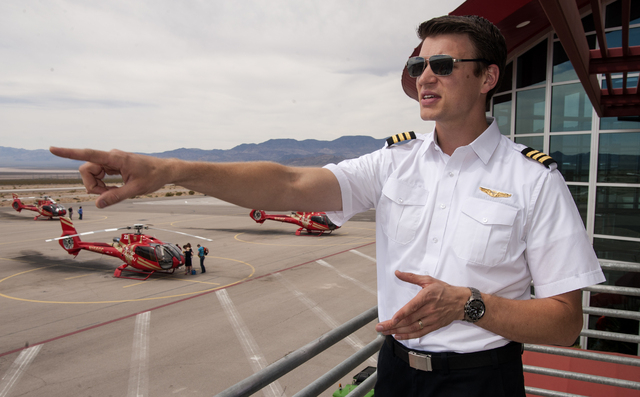
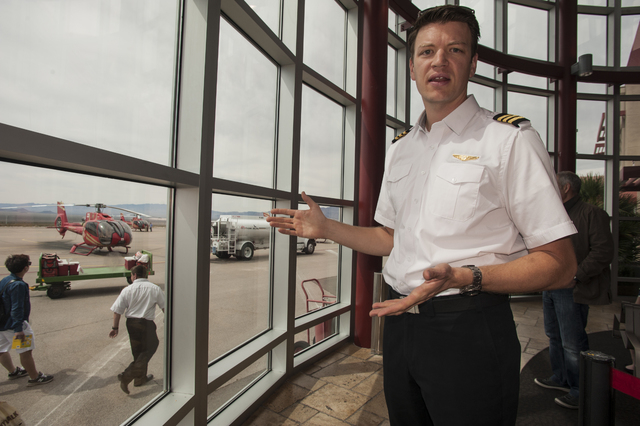
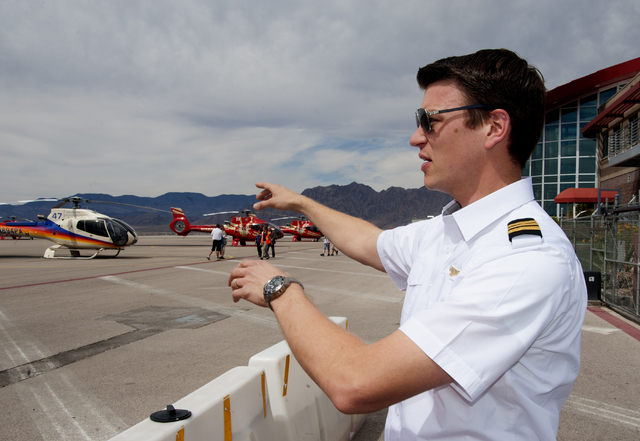


It won’t be long before pilots flying for the world’s busiest air tour operation may be seeing unmanned aircraft near where they fly hundreds of thousands of tourists each year.
Grand Canyon Airlines and its subsidiaries, Scenic Airlines and Papillon Grand Canyon Helicopters, based at Boulder City Municipal Airport, will be getting new neighbors next month. The Boulder City airport is one of four Nevada locations gearing up as test sites as part of the Federal Aviation Administration’s plan to integrate unmanned aerial vehicles into the national airspace.
The state was notified in late 2013 by the FAA that it was one of six states that would host test sites that would address aspects of drone integration.
Nevada was selected as a test site partly because it’s been home to military drone operations for two decades. Unmanned Predator aircraft operate from Creech Air Force Base north of Las Vegas, and pilots and systems operators — who were tapped for expertise when the state applied to the FAA — live in Southern Nevada.
If all goes according to the FAA’s plans, unmanned aerial vehicles, or “drones” as they are often referred, will be sharing airspace with commercial and general aviation by September 2015.
The state views this as a huge economic development opportunity. Nationwide, drones are expected to become an $11 billion-a-year industry with 70,000 jobs.
Within a decade, the state leaders expect 15,000 people in the state — about the size of the workforce of Nevada’s mining industry — to be involved in the drone industry. Unmanned aerial systems operators make an average of more than $80,000 a year and the average annual salary of a pilot is more than $110,000.
The University of Nevada, Las Vegas, and the University of Nevada, Reno, are each developing programs to produce skilled workers for the industry.
The state already had designated $1 million in the budget plus $4 million in contingency funds to establish the nonprofit Nevada Institute for Autonomous Systems Unmanned Aircraft Systems Program Management Office when it was preparing its application to become a test site.
What will this mean for a company that looks to fly more than a half-million tourists over the Grand Canyon this year?
“We’re actually looking forward to seeing them here,” said Jake Tomlin, general manager of Grand Canyon Airlines, whose company made Boulder City Municipal Airport the third-busiest in the state in 2007 when it relocated a large portion of its tour business there.
“I think our pilots are interested in seeing all this up close,” Tomlin said. “By nature, people in the aviation industry are interested in flight innovations and it’s pretty cool to see all the things drones are expected to be a part of in the years ahead.”
Unmanned aerial vehicles already are common in other countries, but have taken more time in the United States because of the size and sophistication of commercial airspace.
Many people are familiar with drones used on military missions — bombing runs and surveillance.
Generally, drones are used for missions that are too dangerous or too mundane for plane and helicopter pilots. Industry leaders expect drones to be used in assistance to first responders, survey resources for mining, power generation and electrical infrastructure, waterways, transportation infrastructure and mapping. They’d be used to monitor water use in agriculture and fighting forest fires.
Another application: freight and parcel delivery. State officials expect Nevada to have the first drone package deliveries in the country in rural parts of the state.
Most in the industry don’t see a day when commercial passenger flights are pilotless. But it’s possible that remotely piloted aircraft would use some of the same airports as those with manned flights.
“Nobody thought using helicopters was a good idea for this kind of work when that was first proposed, but now they do it all the time,” Tomlin said. “This is progress in the industry and if it’s something that’s going to be good for Boulder City, we’re all for it.”
Tom Wilczek, the industry specialist for aerospace and defense for the Governor’s Office of Economic Development, said about 15 companies already have lined up to be a part of unmanned aerial vehicle programs in the state.
Wilczek said state officials already have begun meeting with general aviation pilots and Grand Canyon Airlines to explain what’s planned when unmanned systems arrive. For most pilots that use Boulder City’s airport, it’s no different than being aware of where the tour planes and recreational skydiving vendors fly.
“So far, the response has been very favorable,” Wilczek said.
One reason why is that there’s a lot of open airspace surrounding Boulder City and drone tests will be confined to an area about 3 miles away from where the scenic tour planes fly.
Generally, the scenic tours fly to the east, taking passengers over Lake Mead and toward the Grand Canyon and Grand Canyon West. The state is designating the dry lake beds south and west of Boulder City around the Eldorado Valley for drone flight tests.
Test zones will be tucked into an area between Boulder City and McCarran International Airport’s established flight patterns.
Also, Wilczek noted that many people visualize large military aircraft — the Predator and Global Hawk planes — when they think about drone flights. What’s planned in commercial drone testing in Nevada are vehicles that will be considerably smaller.
“We’re looking at vehicles with payloads of 55 pounds or less,” Wilczek said.
Many of those types of drones don’t even need an airport runway to take off.
The early testing of drones will be limited to line-of-sight flights. That means an airborne vehicle must always be within view of the ground pilot. The combination of a small vehicle and line-of-sight rules results in test area of less than 4 square miles.
As testing progresses, the boundaries of flight will expand. So, too, will the sophistication of anti-collision measures and tests. But until the FAA signs off on integrating unmanned aerial vehicles into commercial airspace, there won’t be any test flights over populated areas or near routes used commercially.
Line-of-sight rules are similar to those used by radio-controlled aircraft hobbyists who generally fly their models in open areas away from buildings.
“We’re taking small baby steps on this,” Wilczek said. “But without them, there’d be no steps.”
Every company that plans test flights in Nevada will be required to receive its own certificate of authorization to fly from the FAA. Wilczek said companies looking to fly in Nevada generally fall into three categories: companies that just want to fly and need airspace for a finite time; companies that are a part of the drone manufacturing and supply chain; and companies with an interest in moving to Nevada because of its test facilities and are developing products that may have a drone component.
The state’s economic development leaders are confident the drone industry will be able to work side by side with existing commercial flight operations. Tomlin concurred and recalled how his company was embraced by Boulder City when it expanded there.
The Grand Canyon Airlines group still operates at McCarran, but it has moved all its air tour facilities that had been at North Las Vegas Airport to Boulder City.
Company officials are optimistic that 2014 will be strong for air tours.
Robert Graff, corporate vice president of marketing, said he’s cautiously optimistic that the peak season for 2014, which generally runs from March to October, will be better than last year’s.
Graff said international business is coming in stronger than expected, likely because the economies of other nations are improving. Also, the group has invested in developing contacts in the emerging markets of China, India and Brazil.
Graff said the company has added six helicopters and two planes to its fleet this year in hopes of eclipsing last year’s total of 500,000 passengers.
Domestic travel also appears to be picking up, he said, but international sales drive the business because those making the trip to Las Vegas like to combine their experience in the city with a flight over the Grand Canyon, one of America’s most visited national parks.
Airlines cater to foreign visitors with inflight audio tour programs in multiple languages.
The company also sells a variety of packages that include air and bus tours, backcountry horseback riding and raft trips on the Colorado River. Besides flying to the Grand Canyon’s airport at Tusayan, the company has trips to Grand Canyon West, operated by the Hualapai Indian Tribe; Page, Ariz., on the southern banks of Lake Powell; Monument Valley on the Arizona-Utah border; and other national parks in southern Utah.
Contact reporter Richard N. Velotta at rvelotta@reviewjournal.com or 702-477-3893. Follow him on Twitter @RickVelotta.


