



Wind power to bring rebates
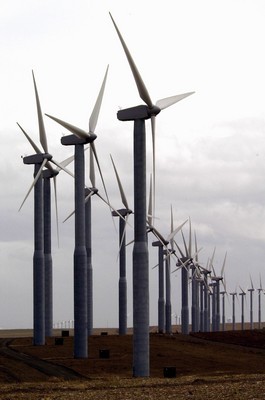


The electric company, which for several years has provided financial incentives to homeowners who install solar power systems, will start doing the same for home wind turbines in a few days.
Nevada Power Co. of Las Vegas and affiliate Sierra Pacific Power Co. of Reno are offering rebates of $2.50 per watt for wind turbines, based on the turbine's electricity production capacity. The maximum rebate for each customer would be $25,000.
Wind systems that generate more than 10,000 watts of power qualify for a $1.50 per watt rebate, but most home wind turbines will be smaller and will qualify for the $2.50 rebate.
Wind turbines can be used to generate electricity at homes, businesses, farms, schools and public buildings.
"I believe (wind turbines) will get pretty popular," said John Hargrove, RenewableGenerations program manager for the two electric companies. "People want choice. They want the opportunity to be as green as they can."
"I believe it will be a slow start and then (wind energy) will take off," said Jason Geddes, a Reno city official and member of the Nevada Renewable Energy Task Force.
The question is whether wind turbines will be permitted in many urban locations and whether they are economically viable in Southern Nevada. Experts are divided on those questions.
Clark County allows wind turbines in all zones, said Dan Kulin, a county spokesman.
The Las Vegas City Council in January 2007 approved small wind turbines in some residential zoning districts, but some homeowner associations may object, particularly if the wind turbine reaches high in the air or is noisy. Reno also has adopted a wind turbine ordinance, and Washoe County is reviewing a draft of a wind turbine ordinance.
"Wind turbines still don't make a whole lot of sense in an urban or suburban environment," said Chris Brooks, director of renewable energy at Bombard Electric.
The wind generally doesn't blow consistently enough in Southern Nevada to make wind power economically feasible, Brooks said.
Bombard typically wants a wind turbine to reach 30 feet high and to have no obstacles within a 300-foot radius, which eliminates many urban sites, Brooks said.
Mike Hess, chief executive officer of Mariah Power, a Reno-based wind turbine maker, disagreed with Brooks. A wind turbine fed by 12 mph average wind will pay back the initial cost in 10 years without a rebate, Hess said.
Hess said his company offers a 1,200-watt wind turbine that costs $5,000 and works well with winds averaging 12 mph.
Mariah Power also sells an $8,000 unit that works with average wind speeds of 8 mph, he added.
Customers can visit www.mariahpower.com for information about the company's wind turbines.
Before selling a wind turbine to a customer, Mariah Power looks at satellite pictures to determine whether the person's site is in a ZIP code with satisfactory wind power, Hess said.
The company also can install an anemometer to test a specific location for wind, Hess said.
Mariah Power has arrangements with companies that will install wind turbines for customers in Southern Nevada.
Hess ultimately hopes to get approval to put wind turbines on street lights.
Meanwhile, rural areas and public buildings, including schools, may make better sites for wind turbines than densely populated residential neighborhoods.
As required by new state law, Nevada Power and Sierra Pacific Power are continuing their solar power rebate programs. The utilities will start taking applications for wind and solar projects at 10 a.m. Sept. 4.
The companies also are accepting applications for rebates on hydroelectric power projects on farms and ranches. Few, if any, customers are expected to have opportunities for water power in Southern Nevada.
Hargrove recommends that interested customers apply as soon as possible for wind and solar rebates because the maximum amount of solar power rebates goes quickly, often in the first day.
The rebates alone will cost Nevada Power and Sierra Pacific Power up to $23.3 million, depending on the number of applicants.
Homeowners can apply for rebates at www.solargenerations.com, but Brooks recommends that they go through an electrical contracting firm like his, which is accustomed to answering technical questions.
Customers with solar panels and wind turbines qualify for net-metering provisions. That means they get credit for each kilowatt hour of excess electricity that they feed into the electrical grid.
Contact reporter John G. Edwards at jedwards@reviewjournal.com or 702-383-0420.


