



People who learn instruments late in life find it relaxing, fun


Since she started learning to play the piano a year ago, Earnestine Howell, 75, feels mentally sharper, less stressed and physically relaxed.
"It's been a pleasure and I think maybe it's been good for me," Howell says.
There's no maybe about it; an extensive body of research has found that music is good for your health and can even stave off dementia in the elderly. According to a Stanford University study, leisure activities, such as playing a musical instrument, are associated with a "reduced risk of dementia" in subjects older than 75.
There's a big connection between music and the brain, says Kathy Kavanaugh, a local musician and Howell's piano teacher.
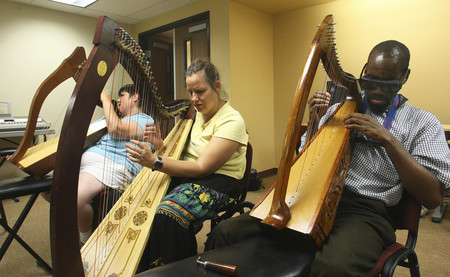
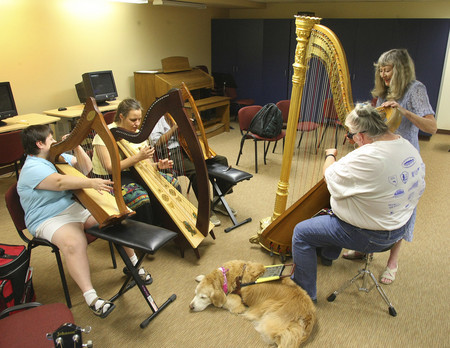
For several years, Kavanaugh, 62, worked as a harp therapist in California. She went to hospitals and care facilities, playing her harp for premature babies and senior citizens. In Las Vegas, she teaches piano and harp lessons at senior community centers and the Blind Center of Nevada. She also plays at local Alzheimer's facilities.
"They may not talk or remember what they ate for lunch, but they remember the music," Kavanaugh says.
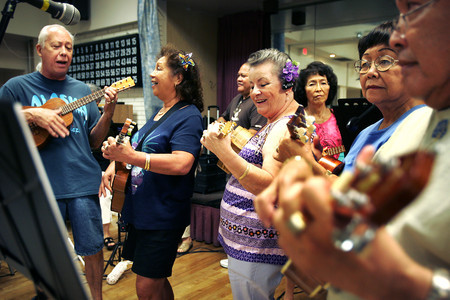
And, as Howell proves, it's never too late to learn to play an instrument. About 60 percent of Kavanaugh's students are seniors and many of them express the same thought: They've always wanted to learn how to play but thought they were too old.
"I started from scratch, I knew nothing," says Howell, adding that learning hasn't been easy, but it's worthwhile. "I could hear music but couldn't read it or play it. I've worked very hard."
Older adults learn differently than young people taking their first music lessons, Kavanaugh notes. They're not as coordinated, but they have more time to practice.
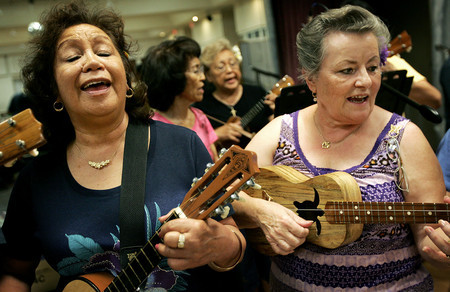
Rhythm is the hardest thing to teach older students, says William Brown, a musician who teaches guitar at Las Vegas senior centers.
"Rhythm is knowing when to start and when to stop," Brown says. Older adults may know how and when, but actually doing it is another matter. That just means they have to practice a little more and lower their expectations of becoming the next Eric Clapton, Brown says.
Playing an instrument also has emotional effects, an important benefit for older adults who may have reduced mobility or chronic illnesses, Kavanaugh says.
Moritz DeLauder, 62, says her father was ill and depressed when she introduced him to her easy-play organ recently. He was so intrigued, he wanted to learn to play it, says DeLauder, who helped him purchase his own for his assisted living facility. Since then, his attitude and health have improved.
"He's just so much better," DeLauder says. "I'm sure the music is a large part of it. When we left him yesterday, he said, 'I'm so happy.' "
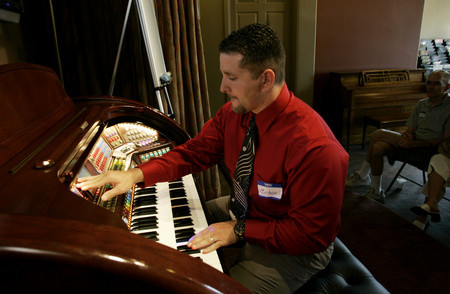
After her husband died two years ago, Nola Cox, 83, used her easy-play organ as a lifeline. She began taking lessons in 2005 and credits her daily habit of playing as integral to her recovery after brain surgery and knee replacement surgeries.
"I was in my walker, wasn't walking very good and I said to myself, 'I can do that,' " Cox says of her decision to learn the organ. "After I lost my husband, I had to have something in my life."
Cox says playing a musical instrument helps with stress and keeps her mind active. She also feels closer to her late husband when she's playing.
Cox started playing the Lowrey organ when she signed up for membership in a senior program operated by an organ dealer. For $49 a month, she gets weekly lessons and access to social events such as field trips and pancake breakfasts at the Memory Lane Music store, 10720 S. Eastern Ave.
"Our whole program is really customized to a 55 and older group," says Memory Lane Music owner Michael Cooney. "The emphasis is on personal enjoyment, it's a hobby. We're not teaching a bunch of theory. They're socially fun classes."
New students can get six weeks of lessons and a small loaner organ to take home for $20. After that, students must buy a Lowrey organ if they want to continue playing in their homes. Prices start at $1,000 and go as high as $85,000.
"We have a little instrument we put in their home during the six-week class. We don't try to sell it to them," Cooney says. "We do it because we know out of 15 people, 10 will continue."
But seniors who are interested in learning to play an instrument don't always have to purchase one. Most centers have instruments that can be used by students while they are in class. Rentals are available at local music stores, Kavanaugh notes.
Local senior centers also offer classes for a fraction of the going rate for music lessons, Brown says.
The average rate for private guitar lessons is about $50 an hour, he says. His hourlong Monday classes at Doolittle Senior Center, 1950 N. J Street, are free.
While senior center classes are taught in groups, some instructors offer private lessons and will negotiate the fee, Kavanaugh says.
Contact reporter Sonya Padgett at spadgett@reviewjournal.com or 702-380-4564.
Video


