Summerlin-area resident travels country as volunteer dentist for exotic animals
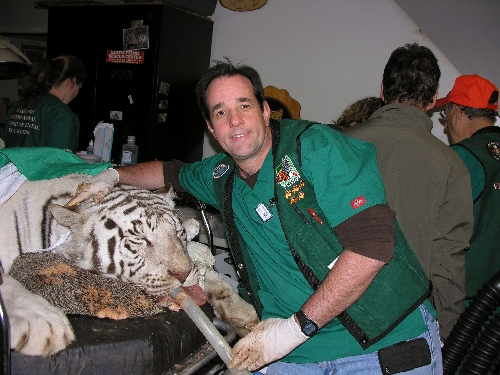
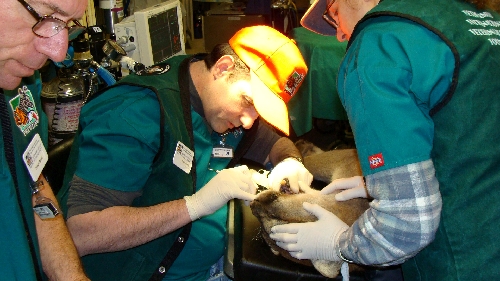
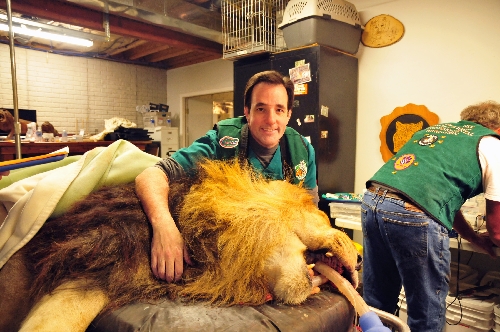


Lions and tigers and bears, oh my. Veterinarian Brian Hewitt has had his hands in the jaws of them all.
Hewitt, a Summerlin-area resident, volunteers his time to the Peter Emily International Veterinary Dentistry Foundation, which provides pro bono dental services for exotic animals at rescue facilities around the country. He opened his own practice, Cheyenne West Animal Hospital, now at 3650 N. Buffalo Drive, in January 2000.
Hewitt has been assisting the foundation since 2009. Many of the exotic animals, he said, were confiscated by the U.S. Department of Agriculture.
"They raid (places) like the drug dealer with the lion living in his basement," he said.
The foundation relies heavily on volunteers, so it often operates on animals over a weekend. Hewitt flies in on Friday nights, begins at 8 a.m. the next day, spends all day Saturday and Sunday on the free dental clinics and flies home Monday morning. He's been to California, Texas, Colorado and Indiana. Until certified, volunteers pay for airfare, hotel and meals. After several operations, Hewitt's status with the foundation was upgraded to a staff clinician, so he no longer pays the $1,500 volunteer fee, but he does cover his travel expenses. He travels to two to four weekend clinics a year.
His first experience with the foundation was in Sylmar, Calif., at the Wildlife Waystation. It has more than 900 animals used in shows. He worked on three chimpanzees, two wolves and a lion that weekend.
He assisted in tooth extraction with a chimp. It's a procedure he does often for cats and dogs, so he was able to step in and help. Being up close to a chimp is "really amazing, their human features, the fact that they have fingernails like we do but thicker and just to see the sheer muscle on these animals and realize how strong they are. It was an amazing experience," he said.
Holding the paw of a tiger showed him how large it was: twice the size of his hand.
A big concern is how well the animals tolerate anesthesia, as it can lead to other health concerns. In San Andreas, Calif., with one of the tigers, the veterinarian for the facility told them, "This animal has kidney disease. I'm comfortable having him out for one hour. Do what you can do in one hour."
It was a tall order, as a root canal can take an hour and a half to two hours.
Tigers are prone to anesthesia problems, getting abnormalities if under too long, which can be fatal. Still, working on animals is a waiting game.
"We're not even allowed in the room until the animal is anesthetized and down. Then they give us the 'all clear,' " Hewitt said.
In the wild, where only the strong survive, animals are great at hiding pain. With rescue animals, it's the same. So how does the facility know that animals need dentistry? Usually it's distant observation of broken teeth. In other cases, the animals were anesthetized for other reasons ---- injuries or tumor removal ---- when the vets realized the animal needed to go on the Peter Emily list.
"A lot of these animals have injured their teeth, and in some cases, it was intentional," Hewitt said. "You get these animals that come from overseas, and they'll cut the teeth off, to make it a little bit safer if they do attack somebody ... they probably, literally, took a hacksaw to them. There are a lot of questionable practices out there."
The worst case Hewitt has worked on was a grizzly bear, the 460-pound Miss Montana. She required one extraction and seven root canals. Hers was the longest surgery he worked on - four hours. It was also the largest exotic animal he's worked on to date.
The smallest was a ferret that needed a root canal.
Sometimes they work until 10 p.m., depending on the circumstances.
The volunteers get to tour the facilities in between patients. Hewitt said tigers are majestic and a little scary.
"Just to watch them ... their eyes are just piercing," he said. "Sometimes you can tell (they want you for lunch). You're walking through a facility, and you'll see the animals; you know it's stalking you. They can't get to you, but you can see they're thinking about it ... The noise tigers make at feeding time are some of the scariest noises ---- loud roars and growls. They're very vocal eaters (as if to say) this is their food ... If it's something you haven't heard before, it's a very interesting sound.
"Another thing about tigers is the sound that they make when they're happy. It's not really a purr, it's a chuff. I'll chuff back. It's a sound that has a calming influence on them, and you know they're happy. It's the tiger version of a purr."
Human dentists, such as Dr. Tina Brandon of Bassett Dental Care, 9530 S. Eastern Ave., Suite 160, also get involved. She's been volunteering alongside Hewitt for the past five years. She said she appreciates seeing the animals in their cages first and watching as they are darted and sedated. Not all the animals succumb to the anesthesia the same way.
"Once we were working on a chimp," Brandon said, "and it just jumped up, and we all stepped back so fast because the chimps are so strong. And their hands ---- you've heard the story of that woman whose face was demolished ---- but we're trained to get out of the way when we need to ... he was already intubated, and the anesthesiologist just (increased) the medicine (to sedate him), and at that point, they restrained his arms."
A red syringe is in the operating room, an emergency measure should an animal need immediate sedation.
Hewitt estimated he has operated on as many as 30 exotic animals. He plans to work with the foundation again in October.
Although he has been in the business for 22 years, veterinary dentistry is a field unto itself. He is on track to be board-certified in that specialty by 2014. It will be a 50th birthday present to himself, he said.
Contact Summerlin/Summerlin South View reporter Jan Hogan at jhogan@viewnews.com or 387-2949.